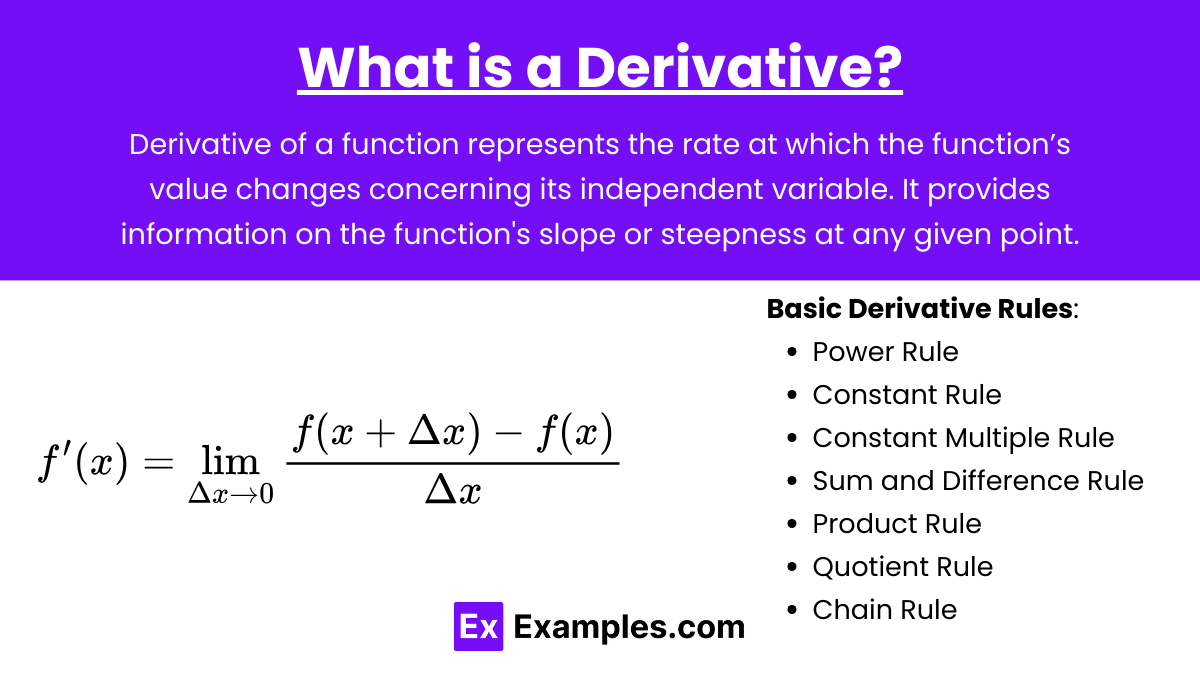
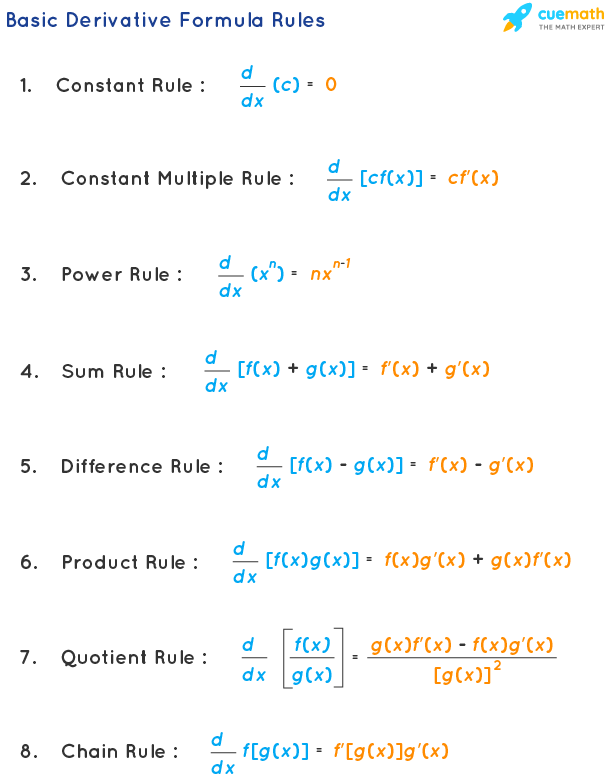
When you're first learning calculus, taking the derivative of a single polynomial term feels straightforward. You bring down the exponent and subtract one. But what happens when two distinct functions are multiplied together, like $f(x) = x^2 \sin(x)$? You can't just take the derivative of each piece separately and multiply them. Instead, you need the product rule for differentiation, the core algebraic mechanism that allows you to break apart interacting rates of change.
Understanding this technique unlocks advanced calculus concepts, ranging from higher-order derivatives to complex related rates and optimization problems in physics and economics. If you try to multiply out functions or avoid the rule, you'll quickly hit a wall where algebraic expansion fails or becomes impossible. This guide breaks down the underlying formula, walks through step-by-step examples, highlights frequent mistakes, and answers common follow-up questions so you can master the mechanic completely.
The Core Formula and Intuition
The product rule states that the derivative of a product of two differentiable functions is the first function times the derivative of the second, plus the second function times the derivative of the first.
Expressed in standard mathematical notation:
$$\frac{d}{dx} [u(x) \cdot v(x)] = u(x)v'(x) + v(x)u'(x)$$
Alternatively, using prime notation:
$$(u \cdot v)' = u'v + uv'$$
Why does this formula look the way it does? Think of a rectangle whose sides are changing in length over time, represented by functions $u(x)$ and $v(x)$. The total area of the rectangle is $A = u \cdot v$. As $x$ changes by a tiny amount $\Delta x$, the area changes because both sides change. The new area accounts for the expansion along the top edge ($u \cdot \Delta v$) and the side edge ($v \cdot \Delta u$), plus a tiny corner piece that approaches zero. The product rule captures these individual rates of change added together.
Step-by-Step Derivative Calculations
To see how this works in practice, let's walk through concrete examples ranging from basic algebraic products to combinations of trigonometric and exponential functions.
Example 1: Combining Polynomials and Trigonometry
Find the derivative of $f(x) = x^3 \cos(x)$.
- Identify the two parts: Let $u(x) = x^3$ and $v(x) = \cos(x)$.
- Find the individual derivatives:
- $u'(x) = 3x^2$
- $v'(x) = -\sin(x)$
- Apply the product rule formula:
- $(u \cdot v)' = u'v + uv'$
- $(3x^2)(\cos(x)) + (x^3)(-\sin(x))$
- Simplify the expression:
- $3x^2 \cos(x) - x^3 \sin(x)$
Example 2: Exponential and Algebraic Functions
Find the derivative of $g(x) = e^x \ln(x)$ for $x > 0$.
- Identify the parts: Let $u(x) = e^x$ and $v(x) = \ln(x)$.
- Find the individual derivatives:
- $u'(x) = e^x$
- $v'(x) = \frac{1}{x}$
- Apply the formula:
- $e^x \cdot \ln(x) + e^x \cdot \frac{1}{x}$
- Factor or leave clean:
- $e^x \left(\ln(x) + \frac{1}{x}\right)$
For official mathematical definitions and advanced properties of derivatives, you can review the LibreTexts Calculus Resource or explore the MIT OpenCourseWare Single Variable Calculus materials for deep-dive problem sets.
Common Mistakes to Avoid
Even experienced students stumble on specific traps when applying derivative rules under time pressure. Keep these pitfalls in mind during exams or homework:
- Taking component-wise derivatives: The most common error is assuming $(u \cdot v)' = u' \cdot v'$. Always remember that multiplication requires the full two-term sum structure of the product rule.
- Dropping negative signs: When differentiating trigonometric functions like $\cos(x)$ into $-\sin(x)$, missing a negative sign will completely invert your final answer.
- Forgetting to factor: While unsimplified answers are technically correct, leaving large expressions un-factored makes it nearly impossible to find critical points during optimization problems. Always look for common terms like $e^x$ or powers of $x$ to factor out.
- Confusing with the chain rule: If you have a composite function like $(3x + 2)^5$, you need the chain rule, not the product rule. The product rule is strictly for products of two separate functions of $x$.
Frequently Asked Questions
Can the product rule be used for three or more functions?
Yes. If you have a product of three functions, $f(x) = u \cdot v \cdot w$, the rule expands by taking the derivative of each component one at a time while leaving the others untouched: $(uvw)' = u'vw + uv'w + uvw'$.
Is the product rule required if I can expand the expression first?
Not always. If you have $f(x) = x(x^2 + 3)$, you can distribute the $x$ to get $x^3 + 3x$ and use the power rule directly. However, for functions like $x^2 e^x$ or $x \sin(x)$, algebraic expansion isn't possible, making the product rule mandatory.
How does the product rule relate to the quotient rule?
The quotient rule is essentially a specialized extension of the product rule combined with the chain rule. In fact, if you understand how to rewrite a fraction like $\frac{u}{v}$ as $u \cdot v^{-1}$, you can derive the entire quotient rule directly from the product rule.
When will I use this rule outside of pure math classes?
Engineering disciplines rely on product rules constantly when analyzing damped harmonic oscillators, alternating current circuits where voltage and current fluctuate together, and economic models where total revenue equals price multiplied by quantity.