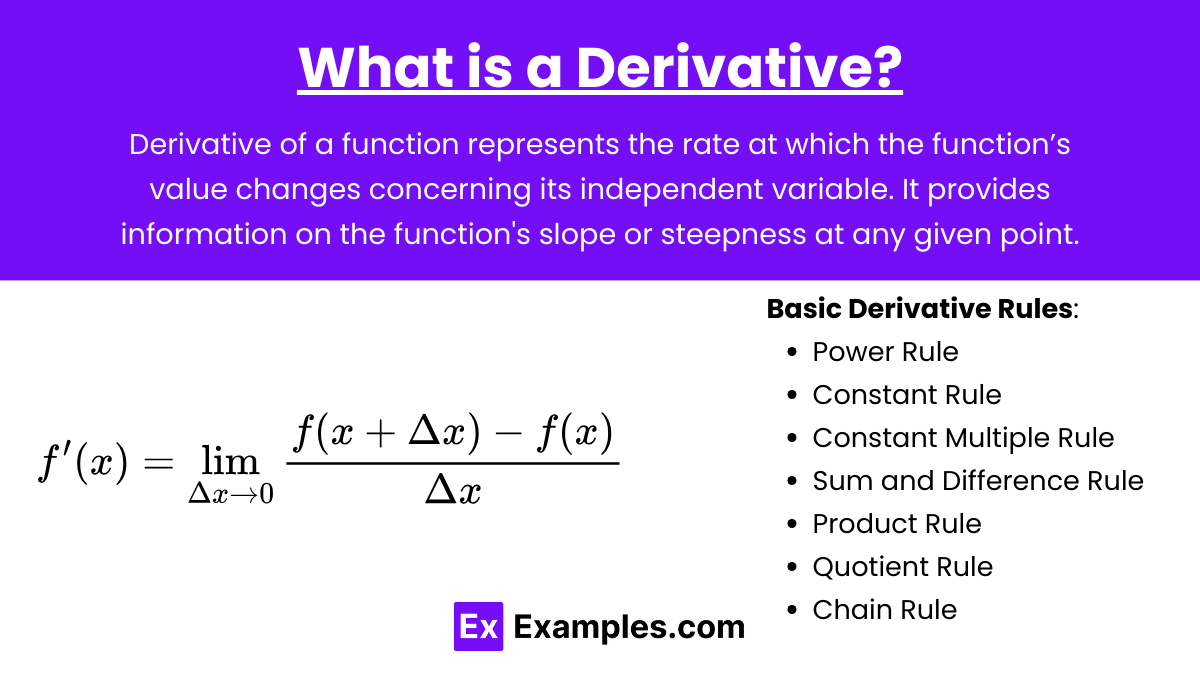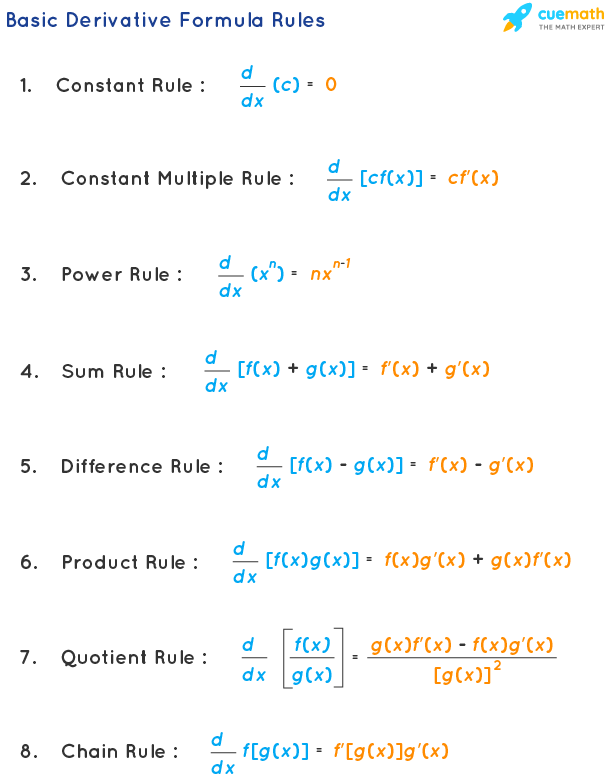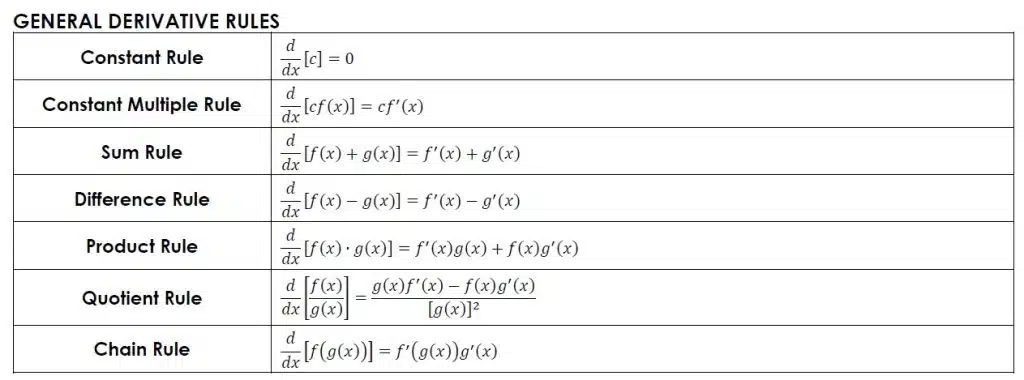
The derivative of the natural logarithm function, written as $\frac{d}{dx}(\ln x)$, is equal to $\frac{1}{x}$ for all $x > 0$. This core result connects transcendental functions with rational algebraic fractions, allowing you to solve complex optimization problems, evaluate tricky integrals, and differentiate functions with variables in their exponents through logarithmic differentiation.
Mastering this formula requires looking past memorization to understand how it is derived from first principles, how to apply it alongside the chain rule for composite functions, and how to avoid common domain pitfalls.
Core Formula and Search Intent
When you encounter a natural log in calculus, the fundamental rule is straightforward:
$$\frac{d}{dx}(\ln x) = \frac{1}{x}$$
For any positive real number $x$, the instantaneous rate of change of $\ln x$ is the reciprocal of $x$. As $x$ grows larger, the slope of the curve flattens out. When $x$ gets closer to zero from the right, the slope steepens negatively toward negative infinity.
You must remember that the domain of $\ln x$ is strictly $x > 0$. If you encounter absolute value wrappers, the generalized derivative rule states:
$$\frac{d}{dx}(\ln |x|) = \frac{1}{x} \quad \text{for } x \neq 0$$
This broader definition ensures your calculations remain valid when dealing with negative inputs inside a logarithm, provided those inputs are squared or otherwise forced positive by absolute value bars. For official reference materials on foundational calculus rules, you can check Calculus Resources at MIT OpenCourseWare.
Proof Using the Limit Definition
You can prove this derivative by returning to the definition of a derivative as a limit. Let $f(x) = \ln x$. By definition, the derivative is:
$$f'(x) = \lim_{h \to 0} \frac{\ln(x + h) - \ln x}{h}$$
To evaluate this limit, apply standard logarithm quotient rules to combine the numerator terms:
$$\ln(x + h) - \ln x = \ln\left(\frac{x + h}{x}\right) = \ln\left(1 + \frac{h}{x}\right)$$
Substitute this back into the limit expression and rewrite the division by $h$ as multiplication by $\frac{1}{h}$:
$$f'(x) = \lim_{h \to 0} \frac{1}{h} \ln\left(1 + \frac{h}{x}\right)$$
Use the logarithmic power rule ($a \ln b = \ln(b^a)$) to move the coefficient inside the logarithm:
$$f'(x) = \lim_{h \to 0} \ln\left[\left(1 + \frac{h}{x}\right)^{\frac{1}{h}}\right]$$
To match the standard limit definition of Euler's number $e$, let $t = \frac{h}{x}$. As $h \to 0$, $t \to 0$, and $\frac{1}{h} = \frac{1}{tx}$. The expression becomes:
$$f'(x) = \lim_{t \to 0} \ln\left[(1 + t)^{\frac{1}{tx}}\right] = \lim_{t \to 0} \frac{1}{x} \ln\left[(1 + t)^{\frac{1}{t}}\right]$$
Since $x$ doesn't depend on $t$, you can pull the constant factor $\frac{1}{x}$ outside the limit:
$$f'(x) = \frac{1}{x} \lim_{t \to 0} \ln\left[(1 + t)^{\frac{1}{t}}\right]$$
Because the natural logarithm is a continuous function, you can move the limit inside the logarithm:
$$f'(x) = \frac{1}{x} \ln\left[\lim_{t \to 0} (1 + t)^{\frac{1}{t}}\right]$$
The limit inside the brackets is the definition of $e$:
$$\lim_{t \to 0} (1 + t)^{\frac{1}{t}} = e$$
Substituting this in gives:
$$f'(x) = \frac{1}{x} \ln(e) = \frac{1}{x}(1) = \frac{1}{x}$$
This confirms the rule algebraically. For alternative proofs using exponential inverses and implicit differentiation, review the Calculus Tutorials at Paul's Online Math Notes.
Applying the Chain Rule
Real-world problems rarely feature a simple $\ln x$. When your argument is a function $u(x)$, you must use the chain rule:
$$\frac{d}{dx}(\ln u) = \frac{1}{u} \cdot \frac{du}{dx} = \frac{u'}{u}$$
Example 1: Polynomial Argument
Find the derivative of $f(x) = \ln(3x^2 + 5x - 2)$.
- Identify the inner function: $u = 3x^2 + 5x - 2$.
- Take the derivative of the inner function: $u' = 6x + 5$.
- Apply the formula $\frac{u'}{u}$:
$$f'(x) = \frac{6x + 5}{3x^2 + 5x - 2}$$
Example 2: Trigonometric Argument
Find the derivative of $g(x) = \ln(\sin x)$.
- Let $u = \sin x$, so $u' = \cos x$.
- Apply the chain rule structure:
$$g'(x) = \frac{\cos x}{\sin x} = \cot x$$
Logarithmic Differentiation
When you face functions with variables in both the base and the exponent, standard power rules and exponential rules fail. Logarithmic differentiation lets you simplify these expressions before taking derivatives.
Consider finding the derivative of $y = x^x$ for $x > 0$:
- Take the natural logarithm of both sides: $\ln y = \ln(x^x)$.
- Use log properties to pull the exponent down: $\ln y = x \ln x$.
- Differentiate both sides implicitly with respect to $x$. Remember that $\frac{d}{dx}(\ln y) = \frac{1}{y} \frac{dy}{dx}$, and use the product rule on the right side:
$$\frac{1}{y} \frac{dy}{dx} = (1)(\ln x) + (x)\left(\frac{1}{x}\right) = \ln x + 1$$
- Solve for $\frac{dy}{dx}$ by multiplying both sides by $y$:
$$\frac{dy}{dx} = y(\ln x + 1)$$
- Substitute the original expression for $y$ back into the result:
$$\frac{dy}{dx} = x^x(\ln x + 1)$$
Common Mistakes to Avoid
- Confusing base $e$ with base 10: Many students mistakenly treat $\log_{10}(x)$ the same as $\ln x$. Remember that $\frac{d}{dx}(\log_{10} x) = \frac{1}{x \ln 10}$. Always verify your base before differentiating.
- Ignoring the domain restriction: Trying to evaluate the derivative at $x = 0$ or for negative numbers without absolute value bars leads to undefined mathematical operations.
- Forgetting the chain rule: When differentiating $\ln(5x)$, students sometimes write $\frac{1}{5x}$ instead of multiplying by the derivative of the inner function, which yields $\frac{5}{5x} = \frac{1}{x}$.
Frequently Asked Questions
Why is the derivative of $\ln x$ not $\log x$?
In advanced mathematics, "log x" often implies base 10 or base $e$ depending on context, but "ln x" explicitly denotes the natural logarithm with base $e$. Because their growth rates differ by a constant scaling factor of $\ln(10)$, their derivatives differ by that same factor.
Can you take the derivative of $\ln(-x)$?
Yes, as long as the argument $-x$ remains positive. This requires $x < 0$. Applying the chain rule gives $\frac{1}{-x} \cdot (-1) = \frac{1}{x}$, which matches the absolute value derivative rule $\frac{d}{dx}(\ln |x|) = \frac{1}{x}$.
How do log properties simplify derivatives?
Before differentiating complex products, quotients, or powers inside a logarithm, use expansion rules like $\ln(ab) = \ln a + \ln b$ or $\ln(a^b) = b \ln a$. Breaking apart a massive fraction into simpler individual log terms saves you from messy quotient rule errors.