Mastering calculus means handling functions that undo each other. When you look at curves shaped by arcsine, arctan, or arcsec, standard differentiation rules stall out. You need the specific derivatives of inverse trigonometric functions to tackle rates of change on restricted domains.
These formulas pop up everywhere from differential equations to physics integrals. Instead of memorizing random algebraic fragments containing square roots and absolute values, you can derive every single rule using implicit differentiation and right triangles. Let's break down how these formulas work, why they look the way they do, and how to apply them without making common algebra errors.
The Core Formulas for Inverse Trig Derivatives
Before diving into proofs, you need the master table of derivatives. In these formulas, $x$ represents your variable, and the standard notation uses either $\sin^{-1}(x)$ or $\arcsin(x)$.
- Derivative of $\arcsin(x)$: $\frac{1}{\sqrt{1 - x^2}}$ for $-1 < x < 1$
- Derivative of $\arccos(x)$: $-\frac{1}{\sqrt{1 - x^2}}$ for $-1 < x < 1$
- Derivative of $\arctan(x)$: $\frac{1}{1 + x^2}$ for all real numbers $x$
- Derivative of $\text{arccot}(x)$: $-\frac{1}{1 + x^2}$ for all real numbers $x$
- Derivative of $\text{arcsec}(x)$: $\frac{1}{|x|\sqrt{x^2 - 1}}$ for $|x| > 1$
- Derivative of $\text{arccsc}(x)$: $-\frac{1}{|x|\sqrt{x^2 - 1}}$ for $|x| > 1$
Notice the clean symmetry. Co-functions always carry a negative sign. Functions with denominators featuring square roots of $1 - x^2$ correspond to sine and cosine inverses, while those with $1 + x^2$ correspond to tangent and cotangent inverses.
Proving the Rules Using Implicit Differentiation
You don't need to take these formulas on faith. Every single one stems from the Inverse Function Theorem or basic implicit differentiation combined with standard trigonometric identities.
Take the arcsine function as our primary model. Let's set up the equation:
$$y = \arcsin(x)$$
By definition, this means we can rewrite the statement as:
$$\sin(y) = x$$
We want to find the derivative with respect to $x$, which we write as $\frac{dy}{dx}$. Differentiating both sides implicitly gives:
$$\cos(y) \cdot \frac{dy}{dx} = 1$$
Now, solve for the derivative:
$$\frac{dy}{dx} = \frac{1}{\cos(y)}$$
We need this answer expressed in terms of $x$, not $y$. We turn to the foundational Pythagorean identity:
$$\sin^2(y) + \cos^2(y) = 1$$
Rearranging for $\cos(y)$, we get $\cos(y) = \sqrt{1 - \sin^2(y)}$. Since we defined $\sin(y) = x$, we substitute that value right back in:
$$\cos(y) = \sqrt{1 - x^2}$$
Plugging this back into our derivative expression yields the final formula:
$$\frac{d}{dx}[\arcsin(x)] = \frac{1}{\sqrt{1 - x^2}}$$
This exact strategy applies to all six functions. For tangent, you use $\sec^2(y) = 1 + \tan^2(y)$. For secant, absolute value bars appear to guarantee that the slope matches the graph's strictly positive behavior across negative domains. You can review detailed derivations on Math LibreTexts.
Applying the Chain Rule to Complex Arguments
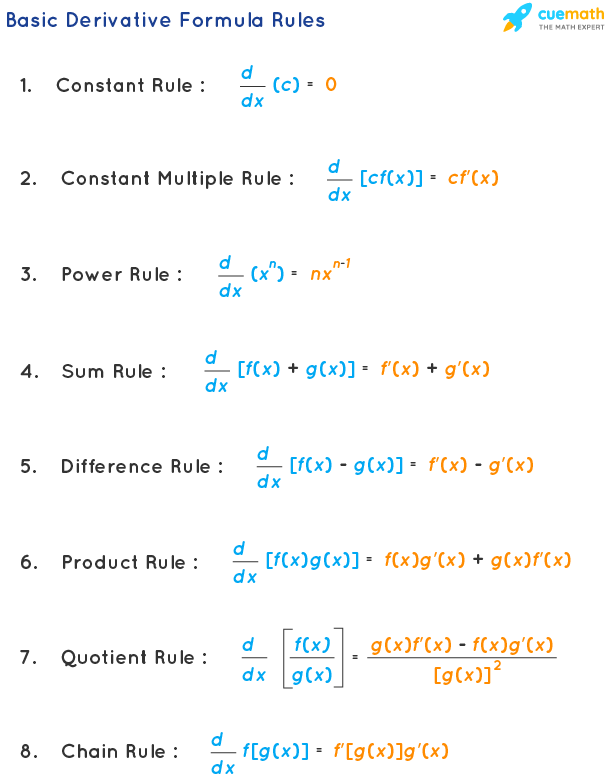
Rarely do you differentiate a plain $x$. Most calculus problems hand you composite functions where an entire algebraic expression sits inside the inverse trig function. That means you must deploy the chain rule.
Let's generalize the formulas for any differentiable function $u(x)$:
- $\frac{d}{dx}[\arcsin(u)] = \frac{u'}{\sqrt{1 - u^2}}$
- $\frac{d}{dx}[\arccos(u)] = -\frac{u'}{\sqrt{1 - u^2}}$
- $\frac{d}{dx}[\arctan(u)] = \frac{u'}{1 + u^2}$
For example, suppose you need to find the derivative of $f(x) = \arctan(5x^2)$.
Here, your inner function is $u = 5x^2$, and its derivative is $u' = 10x$. Applying the arctangent chain rule template:
$$f'(x) = \frac{10x}{1 + (5x^2)^2}$$
Simplify the denominator to finish the job:
$$f'(x) = \frac{10x}{1 + 25x^4}$$
Worked Examples: Step-by-Step Differentiation
Let's walk through two more scenarios to cement the workflow.
Example 1: Product Rule Involving Arcsine
Find the derivative of $h(x) = x^3 \arcsin(x)$.
Because this function multiplies a polynomial by an inverse trig function, you must use the product rule: $(fg)' = f'g + fg'$.
- Identify your parts: $f(x) = x^3$ and $g(x) = \arcsin(x)$.
- Take the individual derivatives: $f'(x) = 3x^2$ and $g'(x) = \frac{1}{\vphantom{b}\sqrt{1 - x^2}}$.
- Assemble the product rule expansion: $$h'(x) = 3x^2 \arcsin(x) + x^3 \left(\frac{1}{\sqrt{1 - x^2}}\right)$$
- Clean up the final expression: $$h'(x) = 3x^2 \arcsin(x) + \frac{x^3}{\sqrt{1 - x^2}}$$
Example 2: Nested Chain Rule with Exponential Functions
Find the derivative of $y = \arccos(e^{2x})$.
- Treat $u = e^{2x}$ as the inner function. Its derivative is $u' = 2e^{2x}$.
- Apply the arccosine derivative rule, which introduces a negative sign and a square root: $$\frac{dy}{dx} = -\frac{2e^{2x}}{\sqrt{1 - (e^{2x})^2}}$$
- Simplify the squared exponent in the denominator: $$\frac{dy}{dx} = -\frac{2e^{2x}}{\sqrt{1 - e^{4x}}}$$
For additional practice problems and interactive study materials, check out Lumen Learning Calculus.
Common Mistakes to Avoid
Calculus students frequently drop points on exams because of a few recurring slip-ups when working with these functions.
- Forgetting the chain rule multiplier: Students often write down the base derivative $\frac{1}{1 + u^2}$ and forget to multiply the numerator by $u'$. Always calculate the derivative of the inner function first.
- Confusing arcsine and arccosine signs: Remember that co-functions always produce negative derivatives. If you are differentiating $\arccos(x)$, the numerator must be $-1$.
- Ignoring domain restrictions: You can't plug values outside $[-1, 1]$ into arcsine or arccosine derivatives because you'll create a negative number inside the square root, resulting in imaginary numbers. Always check your domains.
- Misplacing absolute value bars: When differentiating $\text{arcsec}(x)$, don't drop the absolute value in $|x|$. It ensures consistency across negative inputs where the slope behaves differently than standard algebraic expectations.
Frequently Asked Questions
Why do inverse trig derivatives contain square roots?
The square roots come directly from the Pythagorean identity $\sin^2(y) + \cos^2(y) = 1$. When you use implicit differentiation to switch from a trigonometric function to its inverse, you convert trigonometric terms back into algebraic expressions using right triangle geometry, which generates radicals.
Is $\sin^{-1}(x)$ the same as $\frac{1}{\sin(x)}$?
No. The notation $\sin^{-1}(x)$ denotes the inverse sine function (arcsine), meaning the angle whose sine is $x$. A reciprocal function like $\frac{1}{\sin(x)}$ is actually $\csc(x)$. Never confuse exponentiation notation with inverse function notation.
Can I use these formulas for hyperbolic inverse functions?
No. Inverse hyperbolic functions like $\text{sinh}^{-1}(x)$ have their own distinct derivative formulas that feature different sign patterns and lack the trigonometric restrictions of circular functions.
Why aren't there six distinct integration formulas for these?
Integration is simply differentiation in reverse. Because integration relies on these exact derivative templates, recognizing patterns like $\frac{1}{1 + x^2}$ lets you instantly integrate back to arctangent, complete with a constant of integration $C$.