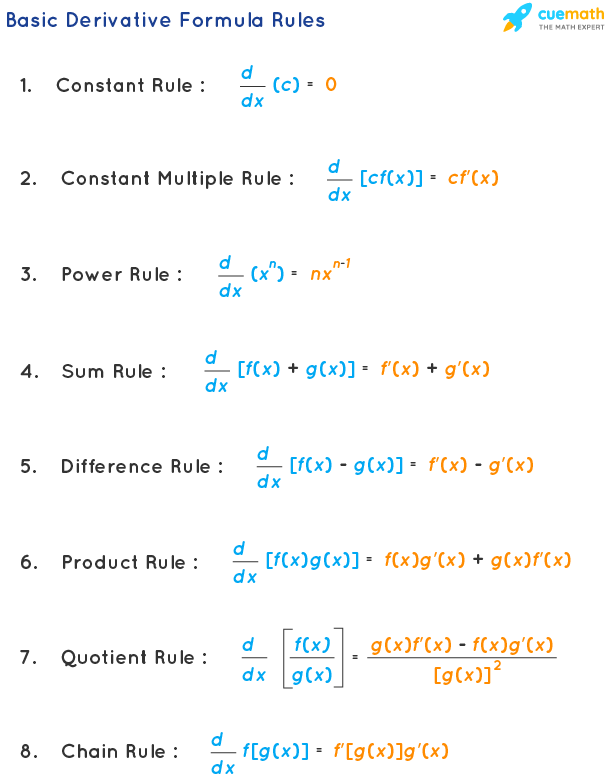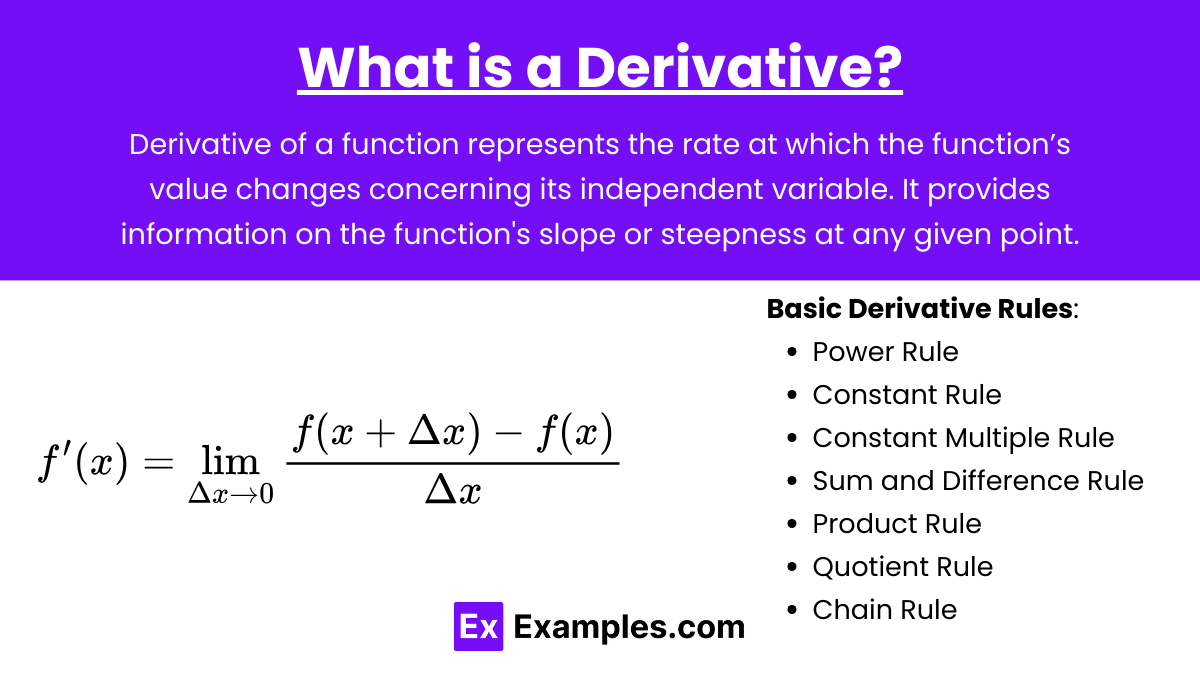
The derivative of the natural logarithm function, denoted as $\ln(x)$, is $\frac{1}{x}$ for all $x > 0$. This fundamental result means that the instantaneous rate of change of a natural logarithm at any positive input is simply the reciprocal of that input. Understanding this relationship bridges exponential growth and linear rates of change, forming a core pillar of differential calculus.
When you graph $\ln(x)$, you notice it starts with a steep vertical climb near zero, then flattens out into a slow, steady ascent as $x$ grows larger. Its derivative mirrors this behavior: when $x$ is small (like $0.1$), the rate of change is $10$, showing rapid growth. When $x$ is large (like $100$), the rate of change drops to $0.01$, showing sluggish growth. You'll use this derivative constantly in optimization problems, differential equations, and calculus-based data models.
Why the Derivative Equals One Over X
Proving why the derivative of $\ln(x)$ equals $\frac{1}{x}$ relies on its inverse relationship with the natural exponential function, $e^x$. Let's set up the function:
$$y = \ln(x)$$
By the definition of logarithms, this statement is equivalent to:
$$x = e^y$$
Next, take the derivative of both sides with respect to $x$ using implicit differentiation. The derivative of $x$ on the left side is $1$. On the right side, the derivative of $e^y$ with respect to $x$ requires the chain rule, giving $e^y \cdot \frac{dy}{dx}$:
$$1 = e^y \cdot \frac{dy}{dx}$$
Since we defined $x$ as $e^y$, we can substitute $x$ directly into the equation:
$$1 = x \cdot \frac{dy}{dx}$$
Solving for the rate of change $\frac{dy}{dx}$ yields:
$$\frac{dy}{dx} = \frac{1}{x}$$
This algebraic derivation is clean, but you can also prove it using the limit definition of a derivative or via the Fundamental Theorem of Calculus by defining $\ln(x)$ as the definite integral from $1$ to $x$ of $\frac{1}{t} , dt$.
Extending the Rule with the Chain Rule
In real problems, you rarely differentiate just $\ln(x)$ by itself. You often encounter composite functions like $\ln(u)$, where $u$ is an expression containing $x$. The chain rule adapts our base formula into a practical tool:
$$\frac{d}{dx}[\ln(u)] = \frac{1}{u} \cdot \frac{du}{dx} = \frac{u'}{u}$$
This formula states that the derivative of any natural log expression is the derivative of the inside function divided by the original inside function.
Step-by-Step Chain Rule Example
Let's find the derivative of $f(x) = \ln(3x^2 + 5)$.
- Identify the inside function: $u = 3x^2 + 5$.
- Find the derivative of the inside function: $u' = 6x$.
- Apply the log chain rule formula $\frac{u'}{u}$: $$\frac{d}{dx}[\ln(3x^2 + 5)] = \frac{6x}{3x^2 + 5}$$
This shortcut saves you from messy algebraic expansions and handles complex polynomial arguments instantly.
Logarithmic Differentiation for Complex Products
Sometimes you face monstrous algebraic expressions—like products of five terms or variables raised to variable powers—where standard quotient and product rules fail from sheer complexity. Logarithmic differentiation uses the properties of logarithms to turn multiplication and division into simple addition and subtraction before you take any derivatives.
For example, suppose you want to differentiate:
$$y = \frac{x^3 \sqrt{x+1}}{(2x - 3)^4}$$
- Take the natural log of both sides: $$\ln(y) = \ln\left(\frac{x^3 \sqrt{x+1}}{(2x - 3)^4}\right)$$
- Expand using log rules ($\ln(AB) = \ln(A) + \ln(B)$ and $\ln(A/B) = \ln(A) - \ln(B)$): $$\ln(y) = 3\ln(x) + \frac{1}{2}\ln(x+1) - 4\ln(2x-3)$$
- Differentiate both sides with respect to $x$ using implicit differentiation on the left: $$\frac{1}{y} \frac{dy}{dx} = \frac{3}{x} + \frac{1}{2(x+1)} - \frac{4(2)}{2x-3}$$
- Multiply both sides by $y$ to isolate $\frac{dy}{dx}$, substituting your original expression back in for $y$.
Calculus textbooks and instructional platforms like Khan Academy Calculus provide extensive practice sets for mastering these multi-step algebraic reductions.
Common Mistakes to Avoid
Calculus students frequently stumble on specific logarithm traps during exams and assignments. Watch out for these errors:
- Confusing log rules with power rules: Don't mistake $\ln(x)$ for $x^n$. The power rule ($nx^{n-1}$) does not apply to logarithmic functions.
- Forgetting the chain rule: If you differentiate $\ln(4x)$ and write only $\frac{1}{4x}$, you forgot to multiply by the derivative of the inside function ($4$). The correct derivative simplifies to $\frac{1}{x}$.
- Ignoring the domain restriction: You can't take the logarithm of zero or negative numbers in the real number system. Always check that your input $x > 0$ before evaluating $\ln(x)$ or its derivative.
- Misapplying log expansion properties: Remember that $\ln(a + b)$ cannot be split into $\ln(a) + \ln(b)$. Logarithms only split products, quotients, and exponents.
Frequently Asked Questions
What is the integral of 1/x?
The antiderivative of $\frac{1}{x}$ is $\ln|x| + C$. Notice the absolute value bars: they expand the domain of the integral to include negative numbers where $x < 0$, because the derivative of $\ln(-x)$ via the chain rule also yields $\frac{1}{x}$. You can verify integration formulas through interactive visual tools like Desmos Graphing Calculator to see how slope fields correspond to antiderivatives.
Why is the base e so special in calculus?
The number $e$ is the unique base where the exponential function $e^x$ is its own derivative. Because natural logarithms are the exact inverses of base-$e$ exponentials, their derivative simplifies cleanly to $\frac{1}{x}$ without requiring messy scaling constants like $\ln(10)$ that appear when differentiating base-$10$ logarithms.
What is the second derivative of lnx?
To find the second derivative, take the derivative of the first derivative, $\frac{1}{x}$ (which can be rewritten as $x^{-1}$). Using the power rule, the derivative is $-1x^{-2}$, or $-\frac{1}{x^2}$. This negative result proves that the graph of $\ln(x)$ is always concave down for all positive values of $x$.
How does logarithmic differentiation handle variable exponents?
When a function has a variable in both the base and the exponent, such as $y = x^x$, standard rules don't work. Taking the natural log of both sides brings the exponent down via the power property: $\ln(y) = x \ln(x)$. You can then differentiate implicitly using the product rule on the right side.