Finding the derivative of $1/x$ is a fundamental milestone when you're learning calculus. You'll encounter this reciprocal function everywhere from basic algebra derivatives to complex physics equations. The answer is $-1/x^2$, but understanding why takes a bit of mathematical mechanics.
In this guide, you'll learn how to derive $-1/x^2$ using limits from first principles, apply the power rule correctly, explore the geometric behavior of the curve, and avoid common algebraic traps that trip up students and practitioners alike.
What Is the Derivative of 1/x?
The short answer is that the derivative of $f(x) = \frac{1}{x}$ is:
$$f'(x) = -\frac{1}{x^2}$$
This expression tells you the exact slope of the tangent line to the hyperbola at any given input $x$. Because the derivative contains $x^2$ in the denominator and a negative sign in the numerator, the slope is always negative wherever the function is defined. As you move further away from the origin on either side of the y-axis, the curve flattens out, and the rate of change approaches zero.
Deriving 1/x Using First Principles
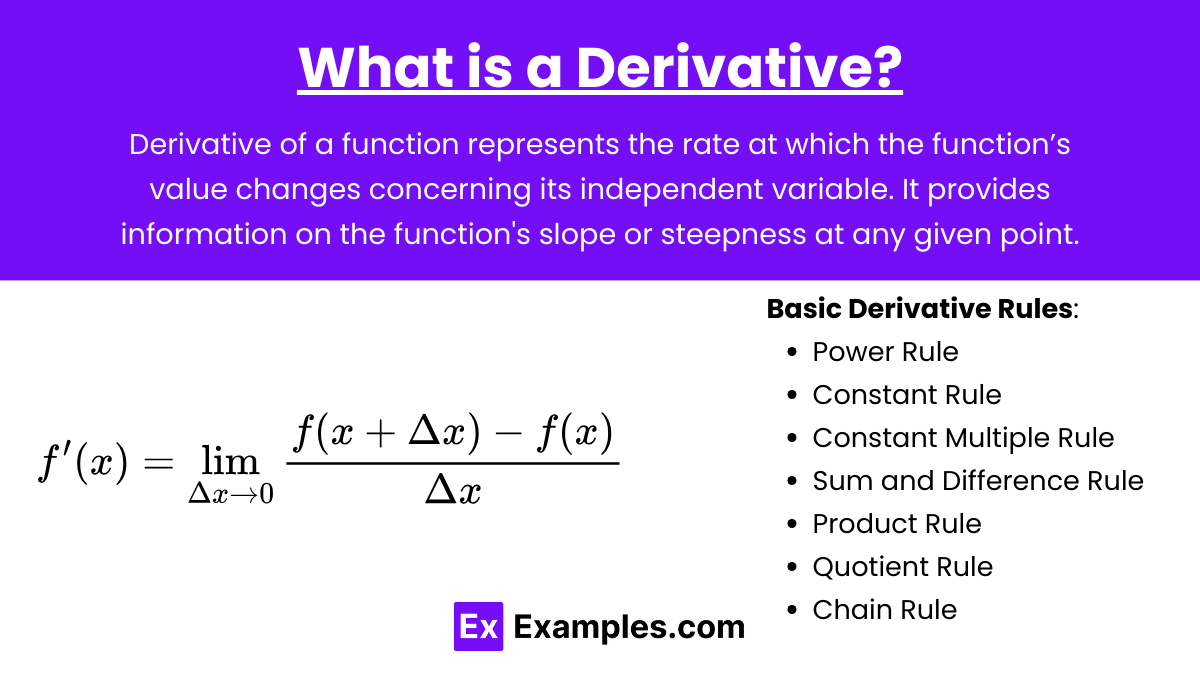
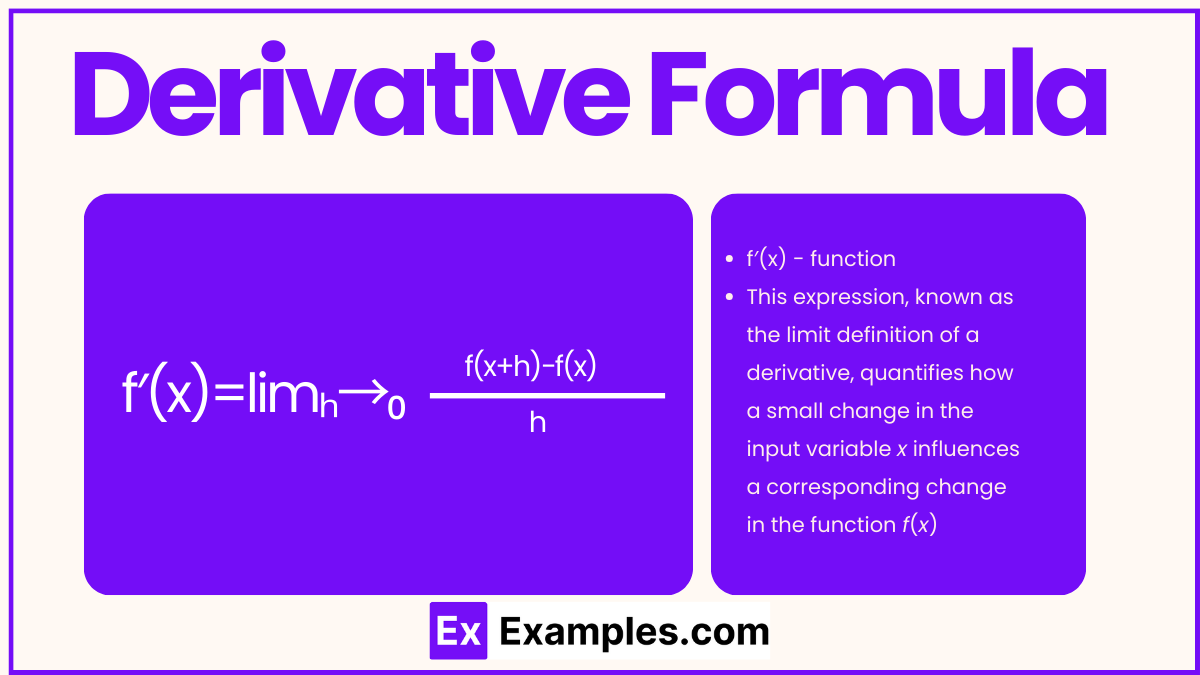
If you want to understand the true engine behind calculus, you can't rely solely on memorized shortcuts. You have to use the limit definition of the derivative, also known as the difference quotient.
The first principles formula is:
$$f'(x) = \lim_{h \to 0} \frac{f(x + h) - f(x)}{h}$$
Let's plug our function $f(x) = \frac{1}{x}$ into this equation:
$$f'(x) = \lim_{h \to 0} \frac{\frac{1}{x + h} - \frac{1}{x}}{h}$$
Step 1: Combine Fractions in the Numerator
To subtract the two fractions in the numerator, you need a common denominator, which is $x(x + h)$.
$$\frac{1}{x + h} - \frac{1}{x} = \frac{x}{x(x + h)} - \frac{x + h}{x(x + h)}$$
Now, combine the numerators over that single common denominator:
$$\frac{x - (x + h)}{x(x + h)} = \frac{x - x - h}{x(x + h)} = \frac{-h}{x(x + h)}$$
Step 2: Divide by h
Next, place this simplified numerator back over the original denominator $h$:
$$\frac{\frac{-h}{x(x + h)}}{h} = \frac{-h}{h \cdot x(x + h)}$$
The $h$ terms cancel out cleanly:
$$\frac{-1}{x(x + h)}$$
Step 3: Evaluate the Limit
Now you can take the limit as $h$ approaches zero by direct substitution:
$$\lim_{h \to 0} \frac{-1}{x(x + h)} = \frac{-1}{x(x + 0)} = -\frac{1}{x^2}$$
You've arrived at the exact result through pure algebraic rigor. For a deeper look into the historical development of limits and infinitesimals, you can explore resources from Mathigon.
The Shortcut: Applying the Power Rule
While first principles offer proof, the power rule saves time during practical calculations. You can rewrite $\frac{1}{x}$ using negative exponent notation:
$$f(x) = x^{-1}$$
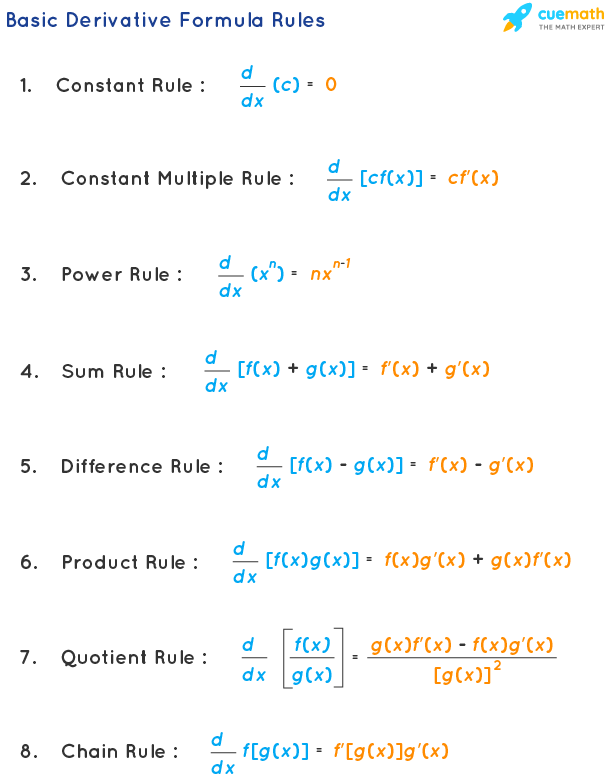
The general power rule states that for any real exponent $n$:
$$\frac{d}{dx}[x^n] = n x^{n - 1}$$
Set $n = -1$ and apply the formula:
$$f'(x) = (-1)x^{-1 - 1} = -1x^{-2}$$
Convert the negative exponent back into a fraction:
$$f'(x) = -\frac{1}{x^2}$$
This matches the first principles result instantly. According to documentation from Khan Academy, mastering exponent conversions is one of the most reliable ways to speed up polynomial and rational derivative calculations.
Geometric Interpretation and Graphing
To visualize what $-\frac{1}{x^2}$ means, look at the graph of $f(x) = \frac{1}{x}$. It forms two separate curves—one in the first quadrant and one in the third quadrant—divided by a vertical asymptote at $x = 0$.
- Strictly Decreasing: Because the derivative is $-\frac{1}{x^2}$ and $x^2$ is always positive for any real non-zero number, the entire fraction is negative. A negative derivative means the function values always drop as you move from left to right.
- Steepness Near Zero: When $x$ is close to $0$ (for example, $x = 0.1$), $x^2$ becomes tiny ($0.01$), making the derivative $-100$. This steep slope shows why the curve shoots sharply upward near the y-axis.
- Flattening at Infinity: When $x$ is large (for example, $x = 100$), $x^2$ is $10,000$, making the derivative $-0.0001$. The curve flattens out and runs nearly parallel to the x-axis.
Practical Applications in Physics and Economics
You might wonder why calculus teachers spend so much time on $\frac{1}{x}$. In real-world modeling, inverse relationships appear constantly.
Inverse-Square Laws in Physics
In physics, many field strengths drop off according to the square of the distance. If an electrostatic potential or gravitational potential energy function depends on $\frac{1}{r}$, taking its derivative yields an inverse-square force law. The negative sign indicates an attractive force pulling inward toward the source.
Average Cost Functions in Economics
In business analytics, a company's fixed overhead costs distributed across a growing number of manufactured units can be modeled with a reciprocal function. Differentiating this function lets economists calculate marginal costs—the exact expense of producing one additional unit as production scales.
Common Mistakes to Avoid
Even experienced students make errors when differentiating rational functions. Watch out for these pitfalls:
- Forgetting the Negative Sign: A common error is dropping the negative sign generated when you bring the exponent down via the power rule. Remember that reciprocal functions decrease, so their slopes must be negative.
- Confusing the Integral and Derivative: Mixing up calculus operations is easy. The integral of $\frac{1}{x}$ involves the natural logarithm ($\ln|x| + C$), whereas the derivative yields an algebraic fraction ($-\frac{1}{x^2}$). Keep these distinct in your notes.
- Ignoring Domain Restrictions: Neither the original function $\frac{1}{x}$ nor its derivative $-\frac{1}{x^2}$ is defined at $x = 0$. You cannot evaluate rates of change across a discontinuity.
Frequently Asked Questions
What is the second derivative of 1/x?
To find the second derivative, differentiate the first derivative ($-\frac{1}{x^2} = -x^{-2}$). Apply the power rule: $(-2)(-x^{-3}) = \frac{2}{x^3}$.
Can you use the quotient rule to find the derivative of 1/x?
Yes. If you treat $\frac{1}{x}$ as $u/v$ where $u = 1$ and $v = x$, the quotient rule formula $\frac{u'v - uv'}{v^2}$ yields $\frac{(0)(x) - (1)(1)}{x^2} = -\frac{1}{x^2}$.
Is the derivative of 1/x always negative?
Yes, for all points in its domain where $x \neq 0$. Because $x^2$ is always positive for any real nonzero input, the negative sign in the numerator ensures the result is strictly negative.
What happens to the derivative as x approaches infinity?
As $x$ grows larger, $x^2$ grows exponentially faster in the denominator. The overall fraction $-\frac{1}{x^2}$ approaches zero, meaning the tangent line of the hyperbola becomes nearly horizontal.