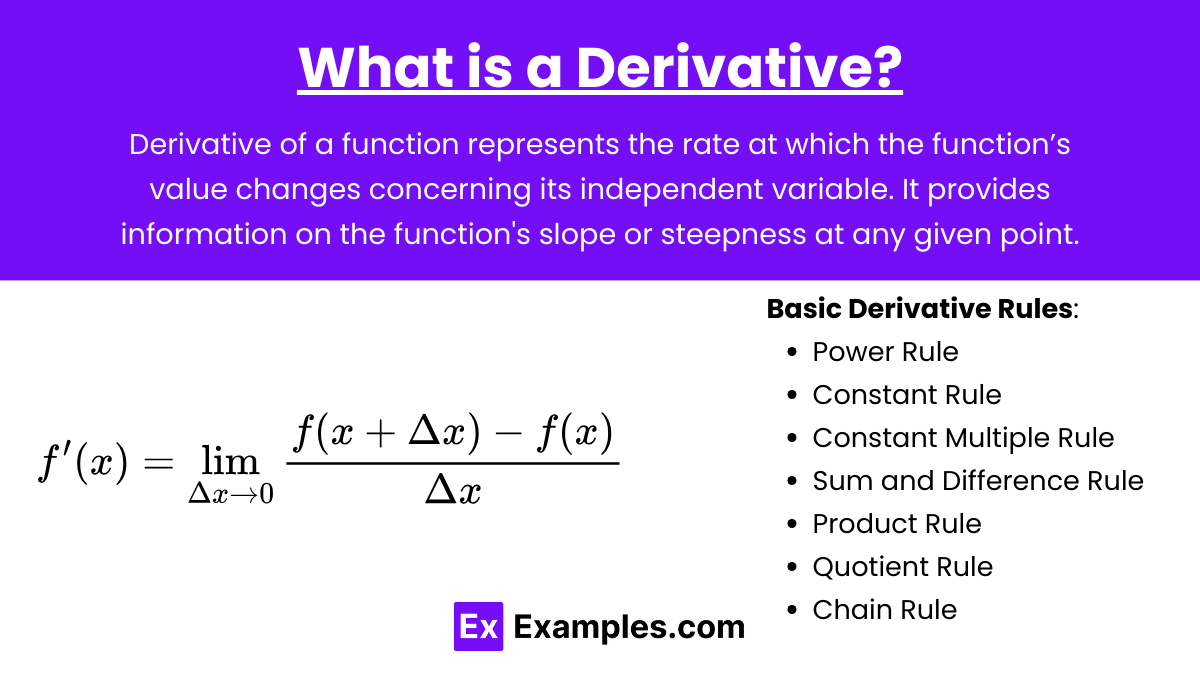
Finding the derivative of a function involving a square root is a standard calculus task that often trips up students who stick rigidly to basic polynomial rules. When a variable sits under a radical, standard exponent rules apply directly once you convert the radical into a fractional exponent. You'll use the power rule combined with the chain rule for more complex expressions.
Mastering this specific derivative lets you handle radical functions smoothly in physics, optimization problems, and related rates. Let's break down how to approach these derivatives, avoid common algebraic traps, and work through practical examples from simple root terms to nested functions.
Converting Radicals to Fractional Exponents
Before applying any calculus rules, rewrite the square root using exponent notation. The fundamental algebraic identity for a square root is:
$$\sqrt{x} = x^{\frac{1}{2}}$$
When you see a square root, your first instinct should be rewriting it. Calculus rules for powers—specifically the power rule—work seamlessly with fractions and negative numbers. If the expression is more complex, such as $\sqrt{f(x)}$, rewrite it as $(f(x))^{\frac{1}{2}}$.
This conversion shifts the problem from radical calculus into standard exponent calculus. It makes the upcoming application of the power rule and chain rule much more visible and less prone to sign errors.
The Basic Power Rule for Square Roots
Let's start with the simplest case: finding the derivative of $f(x) = \sqrt{x}$ with respect to $x$.
First, rewrite the function: $$f(x) = x^{\frac{1}{2}}$$
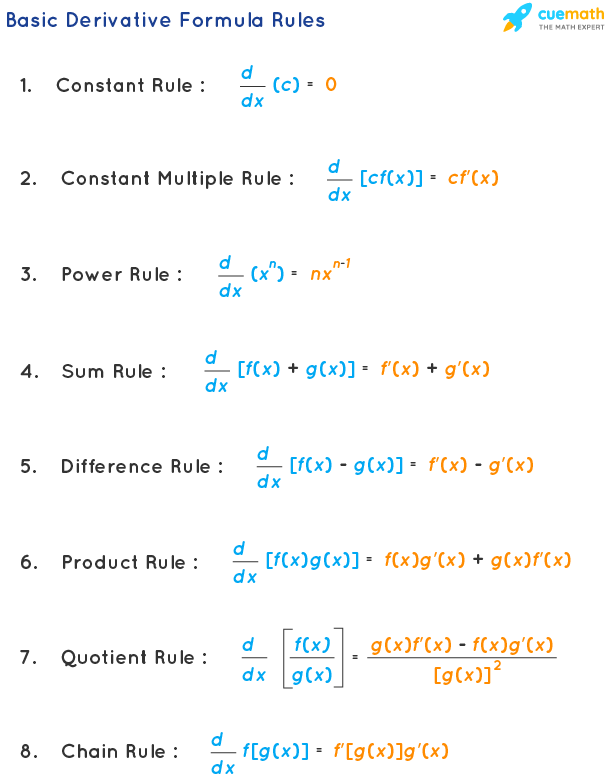
Next, apply the standard power rule, which states that $\frac{d}{dx}(x^n) = n x^{n-1}$: $$f'(x) = \frac{1}{2} x^{\frac{1}{2} - 1}$$
Simplify the exponent: $$f'(x) = \frac{1}{2} x^{-\frac{1}{2}}$$
Convert the negative fractional exponent back into a readable radical form: $$f'(x) = \frac{1}{2x^{\frac{1}{2}}} = \frac{1}{2\sqrt{x}}$$
This result is worth memorizing because it appears constantly across calculus problems: the derivative of $\sqrt{x}$ is $\frac{1}{2\sqrt{x}}$.
Working Through a Constant Multiple
What happens if there's a coefficient in front of the square root? Take $f(x) = 5\sqrt{x}$.
Using the constant multiple rule, you can factor out the constant and differentiate the radical part: $$f'(x) = 5 \cdot \left(\frac{1}{2\sqrt{x}}\right) = \frac{5}{2\sqrt{x}}$$
Always keep constants separate during the initial rewrite phase to prevent distribution errors.
Applying the Chain Rule to Complex Square Roots
Most exam questions don't just give you a bare $x$ under the radical. They give you a polynomial or an expression inside the square root, such as $\sqrt{3x^2 + 5}$. For these, you need the chain rule.
The chain rule states that the derivative of a composite function $f(g(x))$ is $f'(g(x)) \cdot g'(x)$. For a square root function of the form $y = \sqrt{u}$, where $u$ is a function of $x$, the derivative formula becomes:
$$\frac{d}{dx}(\sqrt{u}) = \frac{1}{2\sqrt{u}} \cdot \frac{du}{dx}$$
Let's walk through an example step-by-step: find the derivative of $y = \sqrt{4x^3 - 2x + 7}$.
- Identify the inner function ($u$): $$u = 4x^3 - 2x + 7$$
- Find the derivative of the inner function ($u'$): $$u' = 12x^2 - 2$$
- Set up the outer derivative using our base square root formula: $$\frac{dy}{dx} = \frac{1}{2\sqrt{u}} \cdot u'$$
- Substitute $u$ and $u'$ back into the expression: $$\frac{dy}{dx} = \frac{1}{2\sqrt{4x^3 - 2x + 7}} \cdot (12x^2 - 2)$$
- Simplify the algebraic fraction: $$\frac{dy}{dx} = \frac{12x^2 - 2}{2\sqrt{4x^3 - 2x + 7}} = \frac{6x^2 - 1}{\sqrt{4x^3 - 2x + 7}}$$
Notice how the denominator's 2 cancelled out with the factor of 2 pulled from the numerator. Always look for common factors to simplify your final answer.
Square Roots in Denominators
Sometimes the square root appears in the denominator of a fraction, such as $f(x) = \frac{1}{\sqrt{x}}$ or $f(x) = \frac{3}{\sqrt{x^2 + 1}}$.
You have two main paths here: the quotient rule or rewriting the expression with a negative fractional exponent. Rewriting is almost always faster and cleaner.
Let's differentiate $f(x) = \frac{1}{\sqrt{x}}$ using negative exponents:
- Rewrite the expression: $$f(x) = x^{-\frac{1}{2}}$$
- Apply the power rule: $$f'(x) = -\frac{1}{2} x^{-\frac{1}{2} - 1} = -\frac{1}{2} x^{-\frac{3}{2}}$$
- Convert back to a positive radical denominator: $$f'(x) = -\frac{1}{2x^{\frac{3}{2}}} = -\frac{1}{2x\sqrt{x}}$$
This technique saves you from managing the clumsy numerator derivatives required by the quotient rule.
Common Mistakes to Avoid
Calculus students frequently trip over a few mechanical errors when dealing with radicals. Keep these pitfalls in mind during practice sessions:
- Forgetting the chain rule: Differentiating $\sqrt{x^2 + 3}$ as $\frac{1}{2\sqrt{x^2 + 3}}$ and stopping there is an automatic point loss. You must multiply by the derivative of the inner function ($2x$).
- Incorrect exponent subtraction: Subtracting 1 from $\frac{1}{2}$ gives $-\frac{1}{2}$, not $\frac{1}{2}$. Write out the fraction subtraction ($\frac{1}{2} - \frac{2}{2}$) if you rush under test pressure.
- Distributing inside the radical: You cannot split $\sqrt{a + b}$ into $\sqrt{a} + \sqrt{b}$. Do not attempt to take derivatives term-by-term while the terms remain trapped under a single radical sign.
Frequently Asked Questions
What is the derivative of the square root of x?
The derivative of $\sqrt{x}$ is $\frac{1}{2\sqrt{x}}$. You find this by rewriting the square root as $x^{\frac{1}{2}}$ and applying the power rule.
How do you handle a square root in the denominator?
Convert the term into a negative fractional exponent before differentiating. For example, $\frac{1}{\sqrt{x}}$ becomes $x^{-\frac{1}{2}}$, making it easy to differentiate using the standard power rule.
Do I always need the chain rule for square roots?
You only need the chain rule if the expression inside the square root contains a variable function other than a bare $x$. If it's just $\sqrt{x}$, the basic power rule formula applies directly.
Can I use logarithmic differentiation for square root functions?
Yes. Taking the natural log of both sides of a complex equation involving square roots can turn cumbersome radical multiplication and division into manageable addition and subtraction. For more details on logarithmic properties, consult the Paul's Online Math Notes calculus modules.