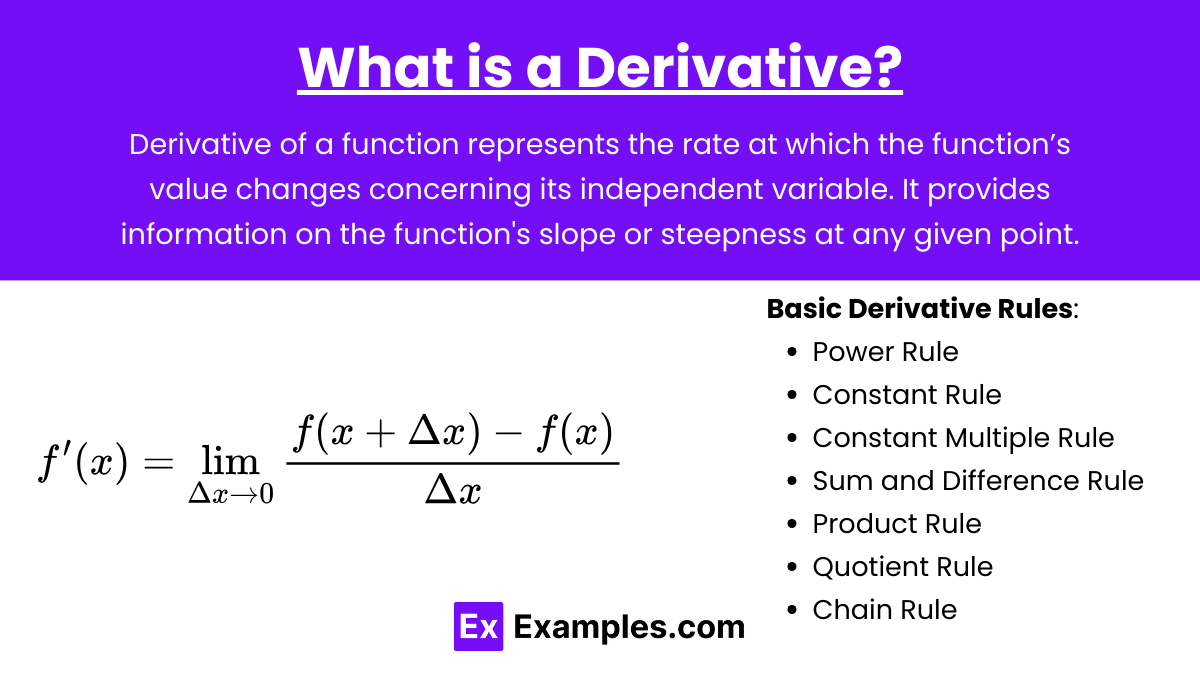
When you need to find the derivative of an infinite polynomial expression, calculus offers a surprisingly straightforward shortcut: term-by-term differentiation. You don't have to evaluate the entire infinite sum all at once. Instead, you differentiate each individual term just like you would with a standard polynomial, and the resulting series converges to the derivative of the original function within the same open interval.
Understanding how to differentiate a power series is essential for solving differential equations, approximating complex functions, and working with Taylor or Maclaurin series in advanced mathematics and engineering. Let's break down the mechanics, the radius of convergence, and common traps you need to avoid.
What is a Power Series?
A power series centered at $x = a$ is an infinite series of the form:
$$\sum_{n=0}^{\infty} c_n (x - a)^n = c_0 + c_1(x - a) + c_2(x - a)^2 + c_3(x - a)^3 + \dots$$
Here, $c_n$ represents the coefficients of the series, $x$ is the variable, and $a$ is a constant representing the center of the series. When $a = 0$, the expression simplifies to a Maclaurin series:
$$\sum_{n=0}^{\infty} c_n x^n = c_0 + c_1 x + c_2 x^2 + c_3 x^3 + \dots$$
Think of a power series as a polynomial that goes on forever. Because they behave like polynomials inside their interval of convergence, we can perform standard calculus operations on them term by term. For a deeper mathematical foundation on how infinite series behave, consult MIT OpenCourseWare Single Variable Calculus.
The Theorem for Term-by-Term Differentiation
The core principle behind differentiating power series relies on a powerful calculus theorem. If a power series has a positive radius of convergence $R$, then the function $f(x)$ defined by the sum is differentiable on the open interval $(a - R, a + R)$.
You can find the derivative simply by taking the derivative of each term:
$$f'(x) = \frac{d}{dx} \left[ \sum_{n=0}^{\infty} c_n (x - a)^n \right] = \sum_{n=0}^{\infty} \frac{d}{dx} [c_n (x - a)^n]$$
Applying the standard power rule to each term yields:
$$f'(x) = \sum_{n=1}^{\infty} n c_n (x - a)^{n-1}$$
Notice two critical changes when you take the derivative:
- The summation index starts at $n = 1$ instead of $n = 0$. The derivative of the constant term $c_0$ is zero, which eliminates the first term.
- The power of the binomial $(x - a)$ drops by one, and the exponent $n$ multiplies the coefficient.
Step-by-Step Differentiation Example
Let's walk through differentiating a well-known power series: the geometric series representation for $f(x) = \frac{1}{1 - x}$.
The geometric power series converges for $|x| < 1$:
$$\frac{1}{1 - x} = \sum_{n=0}^{\infty} x^n = 1 + x + x^2 + x^3 + x^4 + \dots$$
Suppose you want to find the power series representation for the derivative of this function using term-by-term differentiation.
Step 1: Write out the expanded series
Write down the first few terms of the series explicitly to visualize the structure: $$f(x) = 1 + x + x^2 + x^3 + x^4 + \dots$$
Step 2: Differentiate each term with respect to $x$
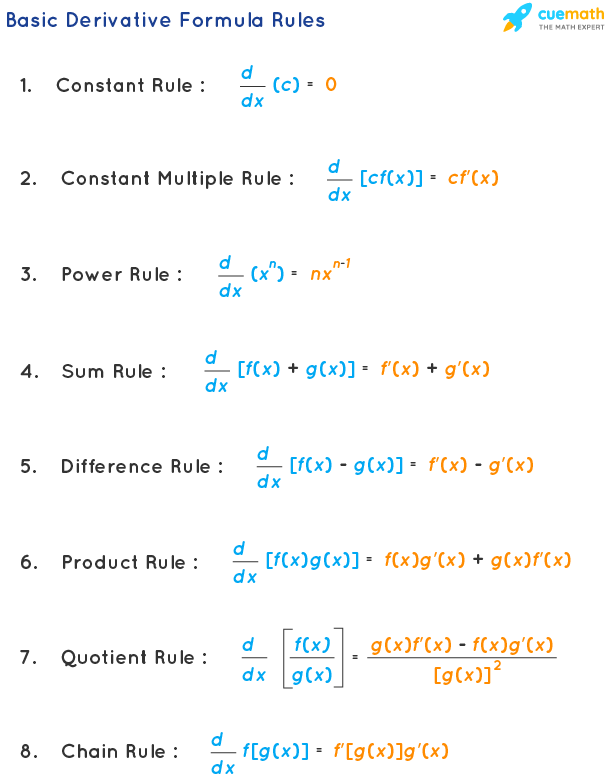
Apply the standard power rule ($\frac{d}{dx} x^n = n x^{n-1}$) to each term:
- Derivative of $1$ is $0$.
- Derivative of $x$ is $1$.
- Derivative of $x^2$ is $2x$.
- Derivative of $x^3$ is $3x^2$.
- Derivative of $x^4$ is $4x^3$.
Putting it together: $$f'(x) = 0 + 1 + 2x + 3x^2 + 4x^3 + \dots = \sum_{n=1}^{\infty} n x^{n-1}$$
Step 3: Verify with standard calculus rules
Using standard quotient rule or chain rule on $f(x) = (1 - x)^{-1}$: $$f'(x) = -1(1 - x)^{-2}(-1) = \frac{1}{(1 - x)^2}$$
Thus, the power series for $\frac{1}{(1 - x)^2}$ is $\sum_{n=1}^{\infty} n x^{n-1}$. Both methods yield the exact same result.
What Happens to the Radius of Convergence?
A common misconception is that differentiating a power series changes its interval of convergence. According to the Theorem for Power Series Differentiation, term-by-term differentiation does not change the radius of convergence $R$.
If the original series converges for $|x - a| < R$, the differentiated series also converges for $|x - a| < R$.
However, convergence at the exact endpoints of the interval ($x = a - R$ or $x = a + R$) can change. When you multiply terms by $n$ or shift the index, a series that previously converged conditionally at an endpoint might now diverge. Always test the endpoints separately using tests like the Ratio Test or Alternating Series Test if your application requires behavior at the boundaries.
Common Mistakes to Avoid
When working through complex homework problems or engineering calculations, watch out for these frequent pitfalls:
- Forgetting to shift the index: When you differentiate $\sum_{n=0}^{\infty} c_n x^n$, the $n=0$ term becomes zero. If you leave the summation starting at $n=0$, your first term will incorrectly show an extra zero or an undefined negative exponent term like $0x^{-1}$. Always start your differentiated summation at $n=1$.
- Dropping coefficients incorrectly: When applying the power rule to $c_n x^n$, remember to bring down the exponent $n$ to multiply the entire coefficient $c_n$, resulting in $n c_n x^{n-1}$.
- Assuming endpoint convergence remains identical: Never assume that if the original series converges at an endpoint, the derivative will automatically converge there too. The inclusion of the factor $n$ grows larger as $n$ approaches infinity, making endpoint divergence much more common after differentiation.
Frequently Asked Questions
Can you integrate power series the same way you differentiate them?
Yes. Term-by-term integration is valid within the exact same radius of convergence $R$. When you integrate a power series, you divide each term by the new exponent and add a constant of integration $C$, which typically corresponds to evaluating the function at the center $a$.
Why would anyone differentiate a power series instead of the closed-form function?
Many functions cannot be easily integrated or differentiated in their closed algebraic forms, or they are defined entirely by their power series solutions (such as Bessel functions in physics). Differentiating the series allows mathematicians and engineers to find polynomial approximations for derivatives of complex physical models.
Does term-by-term differentiation work for all infinite series?
No. It only applies to power series within their radius of convergence. General trigonometric series, such as arbitrary Fourier series, require much stricter conditions (like uniform convergence of the derivative series) before term-by-term differentiation is legally permitted.
How do you find the radius of convergence before differentiating?
You use the Ratio Test by taking the limit as $n$ approaches infinity of the absolute value of the ratio of the $(n+1)$-th term to the $n$-th term. Setting that limit strictly less than 1 gives you your radius of convergence $R$. For official academic problem sets and practice proofs, review the Paul's Online Math Notes Calculus II Guide.