Derivatives of inverse trig functions show up whenever you need to find rates of change involving angles, arcs, or inverse trigonometric ratios in calculus. If you've ever stared at an integral that suddenly resolves into an arctangent, you already know why mastering these six fundamental derivative formulas is non-negotiable for passing advanced math courses.
You can find the derivative of any standard inverse trigonometric function—arcsine, arccosine, arctangent, arccosecant, arcsecant, or arccotangent—by applying implicit differentiation and right-triangle geometry. Instead of memorizing blindly, let's break down the exact formulas, prove how they work, and look at how the chain rule changes everything when your input isn't just a simple $x$.
The Six Core Derivative Formulas
Before solving problems, you need the foundational formulas memorized and understood. Notice how the co-functions (cosine, cosecant, cotangent) simply mirror their counterparts with a negative sign.
Here are the standard formulas where $x$ represents the input variable:
- Arcsine: $\frac{d}{dx}(\arcsin x) = \frac{1}{\sqrt{1 - x^2}}$ for $-1 < x < 1$
- Arccosine: $\frac{d}{dx}(\arccos x) = \frac{-1}{\sqrt{1 - x^2}}$ for $-1 < x < 1$
- Arctangent: $\frac{d}{dx}(\arctan x) = \frac{1}{1 + x^2}$ for all real numbers $x$
- Arccosecant: $\frac{d}{dx}(\operatorname{arccsc} x) = \frac{-1}{|x|\sqrt{x^2 - 1}}$ for $|x| > 1$
- Arcsecant: $\frac{d}{dx}(\operatorname{arcsec} x) = \frac{1}{|x|\sqrt{x^2 - 1}}$ for $|x| > 1$
- Arccotangent: $\frac{d}{dx}(\operatorname{arccot} x) = \frac{-1}{1 + x^2}$ for all real numbers $x$
You'll use $\arcsin$, $\arccos$, and $\arctan$ in roughly ninety percent of your calculus homework. Focus your initial practice on those three before memorizing the secant and cosecant variants.
Where These Formulas Come From
Calculus textbooks often state these formulas as facts, but you can derive every single one using implicit differentiation. Let's look at how the derivative of $\arcsin x$ is born.
Suppose you have:
$$y = \arcsin x$$
By definition of an inverse function, you can rewrite this statement without the inverse notation:
$$\sin y = x$$
Now, take the derivative of both sides with respect to $x$ using implicit differentiation. The derivative of $\sin y$ is $\cos y \cdot \frac{dy}{dx}$, and the derivative of $x$ is $1$:
$$\cos y \cdot \frac{dy}{dx} = 1$$
Isolate $\frac{dy}{dx}$:
$$\frac{dy}{dx} = \frac{1}{\cos y}$$
We want our derivative in terms of $x$, not $y$. Since we know $\sin y = x$, we can construct a right triangle where the sine of angle $y$ is opposite over hypotenuse ($x / 1$). By the Pythagorean theorem, the adjacent side must be $\sqrt{1 - x^2}$.
Since $\cos y = \text{adjacent} / \text{hypotenuse}$, we get $\cos y = \sqrt{1 - x^2}$. Substitute that back into our derivative expression:
$$\frac{dy}{dx} = \frac{1}{\sqrt{1 - x^2}}$$
That is the exact mechanism behind every single inverse trig derivative. You can read more about foundational calculus proofs in the MIT OpenCourseWare Single Variable Calculus notes.
Applying the Chain Rule
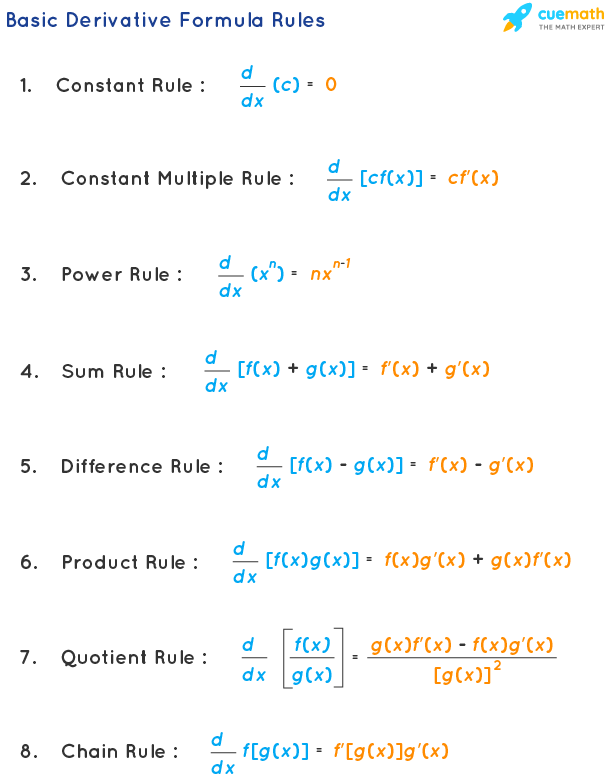
Real problems rarely hand you a clean $x$. They give you functions inside functions, meaning you must pair these derivative rules with the chain rule. If your input is an expression like $u(x)$ instead of $x$, you multiply the base derivative by the derivative of that inner expression ($u'$).
Here is how the main three look with the chain rule applied:
- $\frac{d}{dx}(\arcsin u) = \frac{u'}{\sqrt{1 - u^2}}$
- $\frac{d}{dx}(\arccos u) = \frac{-u'}{\sqrt{1 - u^2}}$
- $\frac{d}{dx}(\arctan u) = \frac{u'}{1 + u^2}$
Step-by-Step Example: Differentiating an Arctangent
Let's find the derivative of $f(x) = \arctan(3x^2)$.
- Identify the inner function ($u$): Here, $u = 3x^2$.
- Find the derivative of the inner function ($u'$): Using the power rule, $u' = 6x$.
- Apply the arctangent chain rule template: Plug $u$ and $u'$ into $\frac{u'}{1 + u^2}$.
- Substitute and simplify:
$$f'(x) = \frac{6x}{1 + (3x^2)^2}$$
Squaring the denominator term gives us our final answer:
$$f'(x) = \frac{6x}{1 + 9x^4}$$
This pattern repeats across all trigonometric derivatives. For additional practice problems and calculus resources, check out the Khan Academy Calculus Curriculum.
Common Mistakes to Avoid
Students routinely lose points on exams due to a few avoidable mechanical errors. Keep these pitfalls in mind while working through problem sets:
- Forgetting the negative sign on co-functions: Just like standard trig derivatives, any inverse trig derivative starting with "co-" (arccosine, arccosecant, arccotangent) has a negative numerator. Don't drop those negative signs.
- Failing to square the entire inner term: When applying the arctangent or arcsine rule with a composite function, students often forget to wrap the entire $u$ expression in parentheses before squaring it in the denominator.
- Ignoring domain restrictions: Taking the derivative blindly outside the valid domain of an inverse function leads to undefined values or extraneous answers. Always check your inputs.
Frequently Asked Questions
Why do inverse trig derivatives result in algebraic expressions instead of trigonometric ones?
Because inverse trigonometric functions output angles, and their derivatives measure the slope of those angle relationships. By converting the resulting trigonometric ratios back into side lengths using right triangles and Pythagorean identities, we eliminate the trig functions entirely from the final derivative formula.
Do I need to memorize the formulas for arccsec, arccsc, and arccot?
Most professors require them, but they appear much less frequently in standard calculus coursework because they can be rewritten using logarithmic or simpler inverse trigonometric identities. Focus heavily on arcsin, arccos, and arctan first.
How do inverse trig derivatives connect to integrals?
Every derivative formula reads in reverse as an integration formula. For instance, because the derivative of $\arctan x$ is $\frac{1}{1 + x^2}$, integrating $\frac{1}{1 + x^2}$ directly yields $\arctan x + C$. This makes these rules vital for solving complex calculus integration problems.