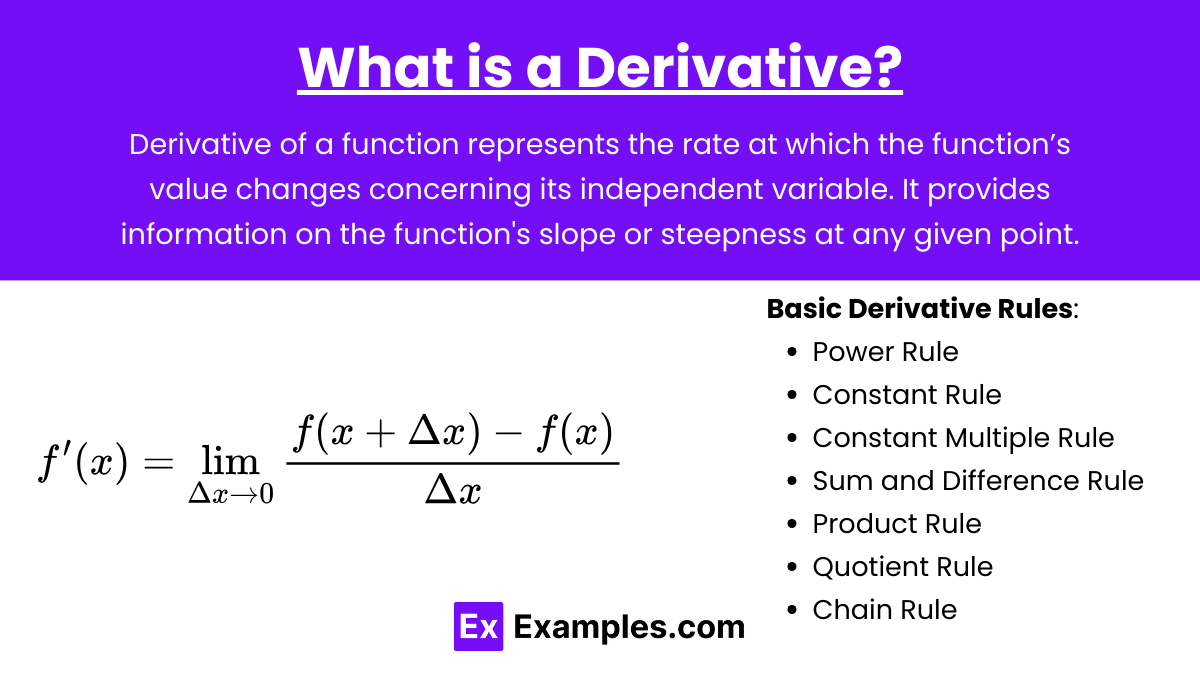
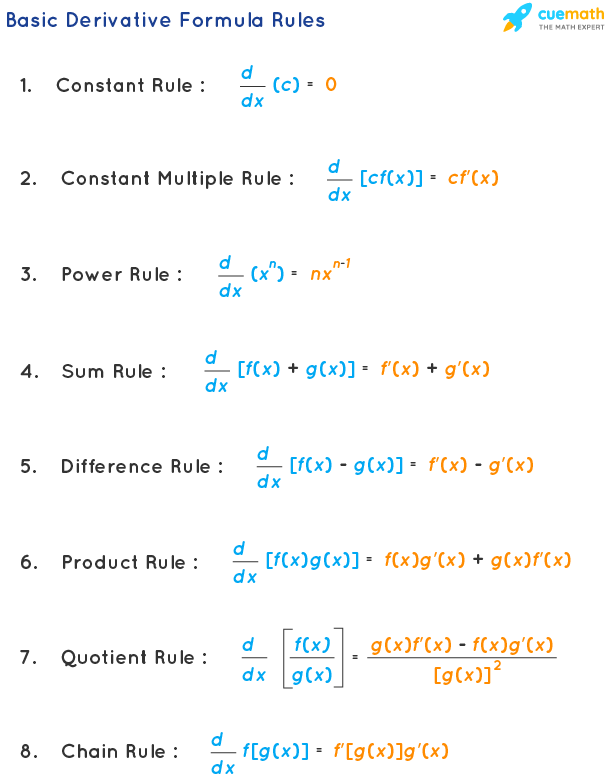
Finding the derivative of a natural logarithm function is a foundational calculus skill. At its core, the derivative of the basic natural logarithmic function with respect to $x$ is $\frac{1}{x}$. When dealing with more complex inner functions or variables tucked away inside exponents, this rule expands using the chain rule and logarithmic properties.
If you're trying to master how to differentiate natural logs without getting bogged down in messy algebra, this guide breaks down the core formulas, step-by-step procedures, and real calculation strategies you need to solve complex problems cleanly.
The Basic Natural Logarithm Derivative Rule
The fundamental rule states that for $x > 0$, the derivative of the natural logarithm function is:
$$\frac{d}{dx}[\ln(x)] = \frac{1}{x}$$
Why does this work? The natural logarithm function, $\ln(x)$, is the inverse of the natural exponential function, $e^x$. Using implicit differentiation or the inverse function theorem on $y = \ln(x)$ (which rewrites as $e^y = x$), we differentiate both sides with respect to $x$:
$$e^y \cdot \frac{dy}{dx} = 1$$
Solving for $\frac{dy}{dx}$ gives:
$$\frac{dy}{dx} = \frac{1}{e^y}$$
Since $e^y = x$, substituting $x$ back in yields $\frac{1}{x}$.
It's important to remember the domain restriction: because you cannot take the logarithm of a non-positive number in real numbers, the broader rule for any differentiable function involving negative inputs uses absolute value bars:
$$\frac{d}{dx}[\ln|x|] = \frac{1}{x}$$
Handling the Chain Rule with Natural Logs
Rarely do you encounter a pure, unmodified $\ln(x)$ in advanced calculus problems. Instead, the argument of the logarithm is usually a function of $x$, denoted as $g(x)$.
When applying the chain rule, the derivative of $\ln(g(x))$ is:
$$\frac{d}{dx}[\ln(g(x))] = \frac{1}{g(x)} \cdot g'(x) = \frac{g'(x)}{g(x)}$$
In plain English: you put the derivative of the inside function in the numerator, and the original inside function stays in the denominator.
Step-by-Step Example: Composite Function
Find the derivative of $f(x) = \ln(3x^2 + 5x - 2)$.
- Identify the inside function: Let $g(x) = 3x^2 + 5x - 2$.
- Find the derivative of the inside function: $g'(x) = 6x + 5$.
- Apply the chain rule formula: Place $g'(x)$ over $g(x)$.
$$f'(x) = \frac{6x + 5}{3x^2 + 5x - 2}$$
You've calculated the derivative in three clean lines without expanding any clumsy expressions.
Logarithmic Differentiation for Complex Functions
When a function consists of messy products, quotients, or variables in both the base and the exponent, direct differentiation using the product or quotient rule becomes a nightmare. This is where logarithmic differentiation shines. By taking the natural log of both sides first, you can turn multiplication into addition, division into subtraction, and exponents into coefficients.
The standard four-step workflow for logarithmic differentiation looks like this:
- Take the natural logarithm of both sides of the equation: $\ln(y) = \ln(f(x))$.
- Apply logarithm properties to expand and simplify the right side completely.
- Differentiate both sides implicitly with respect to $x$, remembering that the left side always yields $\frac{1}{y} \frac{dy}{dx}$.
- Isolate $\frac{dy}{dx}$ by multiplying both sides by $y$, then substitute your original expression for $y$ back into the final answer.
Logarithm Properties Cheat Sheet
Before diving into complex examples, make sure you know these three expansion rules backward and forward:
- Product Rule: $\ln(ab) = \ln(a) + \ln(b)$
- Quotient Rule: $\ln\left(\frac{a}{b}\right) = \ln(a) - \ln(b)$
- Power Rule: $\ln(a^r) = r \cdot \ln(a)$
Example: Variable Bases and Exponents
Let's find the derivative of $y = x^x$ for $x > 0$. Standard power rules don't apply because the exponent isn't a constant, and exponential rules don't apply because the base isn't a constant.
- Take the natural log of both sides: $$\ln(y) = \ln(x^x)$$
- Bring the exponent down using the power property: $$\ln(y) = x \cdot \ln(x)$$
- Differentiate both sides implicitly. Use the product rule on the right side: $$\frac{1}{y} \frac{dy}{dx} = (1) \cdot \ln(x) + x \cdot \left(\frac{1}{x}\right)$$ $$\frac{1}{y} \frac{dy}{dx} = \ln(x) + 1$$
- Solve for $\frac{dy}{dx}$ by multiplying by $y$: $$\frac{dy}{dx} = y \cdot (\ln(x) + 1)$$
- Substitute $x^x$ back in for $y$: $$\frac{dy}{dx} = x^x(\ln(x) + 1)$$
For more rigorous proofs and alternative perspectives on calculus definitions, you can reference the LibreTexts Calculus Resource.
Common Mistakes to Avoid
Even experienced calculus students make preventable errors when working with logarithms. Keep these pitfalls in mind during exams and homework sets:
- Forgetting the chain rule: If your function is $\ln(5x)$, the derivative is NOT just $\frac{1}{x}$. You must multiply by the derivative of the inside function, yielding $\frac{5}{5x} = \frac{1}{x}$.
- Distributing logs across addition: An expression like $\ln(a + b)$ cannot be split into $\ln(a) + \ln(b)$. Logarithm properties only split products, quotients, and powers. Attempting to split a sum will invalidate your entire calculation.
- Skipping algebraic simplification: While you can differentiate a massive fraction using the quotient rule after logarithmic expansion, failing to expand first leaves you with brutal algebra that invites careless arithmetic errors. Always use log properties to flatten expressions before you differentiate.
Frequently Asked Questions
Why do we use base $e$ instead of base 10 for calculus?
The constant $e$ makes calculus clean. If you differentiate $\log_{10}(x)$, you get $\frac{1}{x \ln(10)}$. That extra $\ln(10)$ in the denominator is an unnecessary scaling factor. Because the derivative of $\ln(x)$ is simply $\frac{1}{x}$ without any extra constants, base $e$ is the natural choice for rates of change.
Can I take the derivative of a negative log input?
Real-valued natural logarithms require a positive input because $e$ raised to any real power is always positive. If a domain allows negative values, absolute value bars are included ($\ln|x|$), meaning the derivative remains $\frac{1}{x}$ for both positive and negative values of $x$ (excluding zero).
When must I use logarithmic differentiation instead of standard rules?
You must use logarithmic differentiation when a function has a variable base raised to a variable exponent (like $x^{\sin(x)}$). It is also heavily recommended for products and quotients involving four or more terms, as it converts painful multiplication and division into easy addition and subtraction.
How do I check my derivative work?
You can often verify simpler chain-rule problems by graphing the original function and its calculated derivative side-by-side or by testing specific numerical points using a graphing calculator to ensure the slope matches the evaluated derivative value. To explore more practice problems and structured lesson plans, visit Study.com Calculus Guides.