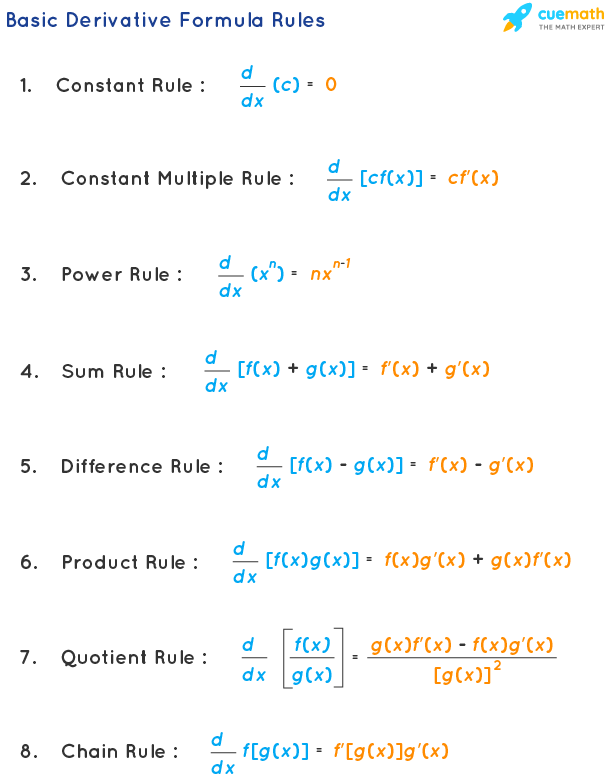
Mastering arc trig derivatives unlocks the gateway to advanced integration techniques and higher-level calculus. When you encounter inverse trigonometric functions like arcsin(x), arccos(x), and arctan(x), standard power rules fall short. You need specific algebraic relationships and geometric proofs to differentiate these functions accurately.
Every inverse trigonometric derivative relies on a fundamental principle: if $y = \arcsin(x)$, then $\sin(y) = x$ within a restricted domain. By applying implicit differentiation to this rewritten trigonometric equation, you can derive the exact slope formula without memorizing blind formulas. Let's break down the core formulas, explore how they work, and look at practical applications.
The Core Arc Trig Derivatives Formulas
Before diving into complex problem-solving, you need a firm grasp of the six standard inverse trigonometric derivatives. Notice how the derivatives of co-functions (arccos, arccot, arccsc) are simply the negative counterparts of their direct counterparts (arcsin, arctan, arcsec).
- Derivative of $\arcsin(x)$: $\frac{1}{\sqrt{1 - x^2}}$ for $-1 < x < 1$
- Derivative of $\arccos(x)$: $-\frac{1}{\sqrt{1 - x^2}}$ for $-1 < x < 1$
- Derivative of $\arctan(x)$: $\frac{1}{1 + x^2}$ for all real numbers $x$
- Derivative of $\text{arccot}(x)$: $-\frac{1}{1 + x^2}$ for all real numbers $x$
- Derivative of $\text{arcsec}(x)$: $\frac{1}{|x|\sqrt{x^2 - 1}}$ for $|x| > 1$
- Derivative of $\text{arccsc}(x)$: $-\frac{1}{|x|\sqrt{x^2 - 1}}$ for $|x| > 1$
These formulas appear frequently in calculus, particularly when evaluating integrals that result in inverse trigonometric functions. Memorizing them is essential, but understanding why they take these forms prevents careless sign errors during exams.
Proving the Derivative of Arcsin(x)
Proofs provide the structural foundation for calculus. Let's walk through the proof for the derivative of $y = \arcsin(x)$ step by step.
Start with the equation: $$y = \arcsin(x)$$
Apply the sine function to both sides to eliminate the inverse: $$\sin(y) = x$$
Differentiate both sides implicitly with respect to $x$: $$\frac{d}{dx}[\sin(y)] = \frac{d}{dx}[x]$$ $$\cos(y) \cdot \frac{dy}{dx} = 1$$
Solve for $\frac{dy}{dx}$: $$\frac{dy}{dx} = \frac{1}{\cos(y)}$$
Express $\cos(y)$ in terms of $x$ using the Pythagorean trigonometric identity $\sin^2(y) + \cos^2(y) = 1$: $$\cos(y) = \pm\sqrt{1 - \sin^2(y)}$$
Since $\sin(y) = x$, substitute $x$ into the radical expression. The principal range of arcsin is $[-\frac{\pi}{2}, \frac{\pi}{2}]$, where cosine is strictly positive, so we choose the positive root: $$\cos(y) = \sqrt{1 - x^2}$$
Substitute this back into the derivative expression: $$\frac{dy}{dx} = \frac{1}{\sqrt{1 - x^2}}$$
📖 Related: Integral of Secant: Step-by-Step
You can use a similar process for all other inverse trigonometric functions by pairing implicit differentiation with appropriate right-triangle geometry or trigonometric identities. For a deeper look into the historical development of calculus notation and rigorous proofs, check out MathWorld's Calculus Resources.
Applying the Chain Rule to Arc Trig Functions
Real-world calculus problems rarely feature isolated variables like $x$. You'll encounter composite functions where $x$ is replaced by an algebraic expression, such as $3x^2$ or $e^x$. The chain rule is mandatory here.
When differentiating a composite inverse trigonometric function, apply the standard derivative formula to the inner function, then multiply by the derivative of that inner function.
Example 1: Differentiating Arcsin with a Chain
Find the derivative of $f(x) = \arcsin(5x^2)$.
- Identify the outer function ($\arcsin(u))$ and the inner function ($u = 5x^2$).
- Recall the derivative formula for arcsin: $\frac{1}{\sqrt{1 - u^2}}$.
- Substitute $5x^2$ in place of $u$: $$\frac{1}{\sqrt{1 - (5x^2)^2}}$$
- Multiply by the derivative of the inner function, which is $\frac{d}{dx}[5x^2] = 10x$.
- Simplify the final expression: $$f'(x) = \frac{10x}{\sqrt{1 - 25x^4}}$$
Example 2: Differentiating Arctan with a Chain
Find the derivative of $g(x) = \arctan(\ln(x))$.
- Identify the outer function ($\arctan(u)$) and the inner function ($u = \ln(x)$).
- Recall the derivative formula for arctan: $\frac{1}{1 + u^2}$.
- Substitute $\ln(x)$ in place of $u$: $$\frac{1}{1 + (\ln(x))^2}$$
- Multiply by the derivative of the inner function, which is $\frac{1}{x}$.
- Combine terms: $$g'(x) = \frac{1}{x(1 + (\ln(x))^2)}$$
Practicing these variations helps you avoid missing the chain rule multiplier—a common mistake students make during timed tests. You can verify complex derivative steps using interactive graphing tools provided by educational platforms like Desmos Calculator.
Common Mistakes to Avoid
Even experienced calculus students stumble on arc trig derivatives due to minor algebraic oversights. Keep these pitfalls in mind:
- Forgetting Domain Restrictions: Inverse trig functions have strict input domains. For instance, $\arcsin(x)$ only accepts inputs between $-1$ and $1$. If an inner function produces values outside this range, the derivative is undefined at those points.
- Dropping Chain Rule Multipliers: Forgetting to multiply by the derivative of the inner function is the number one source of lost points. Always treat the argument of an arc trig function as a distinct entity.
- Confusing Sign Conventions: Remember that co-functions (arccos, arccot, arccsc) always carry a negative sign in their derivative formulas. Don't let similar radical structures trick you into dropping the negative.
- Mistaking Inverses for Exponents: Remember that $\sin^{-1}(x)$ means arcsin($x$), not $\frac{1}{\sin(x)}$. Confusing inverse notation with reciprocal notation ruins the entire derivative setup.
Frequently Asked Questions
Why do arccos and arcsin have identical derivative formulas except for a negative sign?
Because cosine and sine are co-functions related by phase shifts. Graphically, the slope of $\arccos(x)$ mirrors the slope of $\arcsin(x)$ with an inverted sign due to the downward-sloping nature of the arccos curve across its domain.
When should I use trigonometric substitution versus direct arc trig derivatives?
Use direct arc trig derivatives when you are differentiating an existing function. Use trigonometric substitution when you are working backward during integration—such as encountering integrals containing $\sqrt{a^2 - x^2}$—where recognizing the derivative form helps you evaluate the antiderivative.
Why is the absolute value required in the denominator for arcsec derivatives?
The absolute value $|x|$ ensures that the derivative remains valid across both positive and negative branches of the secant function's domain. Since secant has a range that yields positive values for positive angles and negative values for negative angles in certain contexts, the absolute value guarantees real, positive denominator outputs for valid inputs where $|x| > 1$.
How do I handle inverse trig functions with bases other than e?
When dealing with expressions like $\arctan(a^x)$, you combine the arctan derivative rule with exponential derivative rules, multiplying the final fraction by $a^x \ln(a)$ according to the chain rule.