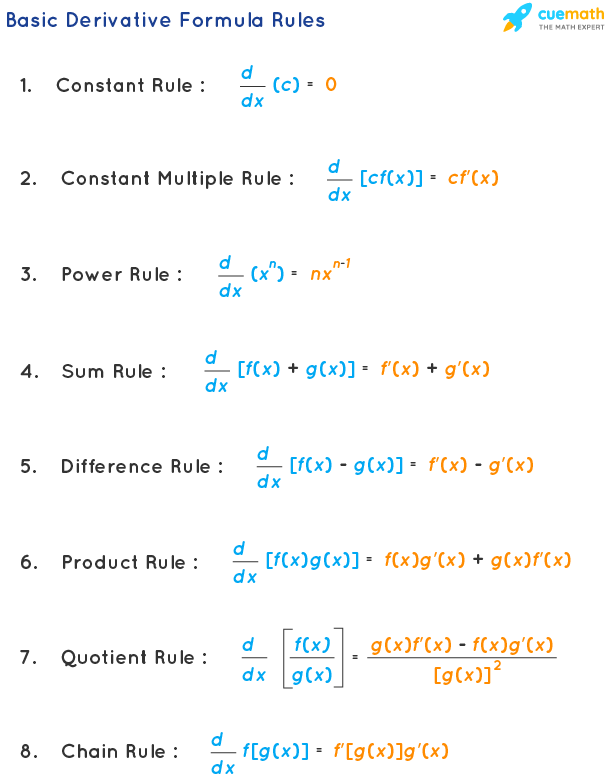
Mastering inverse trigonometric derivatives requires moving past memorization and understanding the underlying geometry of restricted domains and implicit differentiation. If you try to memorize formulas like $1/\sqrt{1-x^2}$ or $1/(1+x^2)$ without context, sign errors will trip you up on exams. Every single one of these six core formulas stems directly from the chain rule and the Pythagorean identity.
Let's break down the mechanics, examine how the proofs work, apply the chain rule to composite functions, and clear up the common pitfalls that cost points on calculus tests.
The Core Six Inverse Trig Derivative Formulas
Before diving into proofs, here is the reference set. Notice how functions starting with "co" (arccos, arccot, arccsc) always carry a negative sign, mirroring what happens with standard trigonometric derivatives.
- $\frac{d}{dx}[\arcsin(x)] = \frac{1}{\sqrt{1-x^2}}$ for $-1 < x < 1$
- $\frac{d}{dx}[\arccos(x)] = -\frac{1}{\sqrt{1-x^2}}$ for $-1 < x < 1$
- $\frac{d}{dx}[\arctan(x)] = \frac{1}{1+x^2}$ for all real numbers $x$
- $\frac{d}{dx}[\text{arccot}(x)] = -\frac{1}{1+x^2}$ for all real numbers $x$
- $\frac{d}{dx}[\text{arcsec}(x)] = \frac{1}{|x|\sqrt{x^2-1}}$ for $|x| > 1$
- $\frac{d}{dx}[\text{arccsc}(x)] = -\frac{1}{|x|\sqrt{x^2-1}}$ for $|x| > 1$
Why Domain Restrictions Matter
Trigonometric functions are periodic, meaning they repeat infinitely. Because they fail the horizontal line test, they aren't one-to-one, so strict inverses cannot exist across their entire natural domains. Similar insight regarding this has been provided by BBC.
To build inverse functions, mathematicians restrict the domains:
- Sine is restricted to $[-\frac{\pi}{2}, \frac{\pi}{2}]$ so arcsine can map back to that interval.
- Cosine is restricted to $[0, \pi]$ for arccosine.
- Tangent is restricted to $(-\frac{\pi}{2}, \frac{\pi}{2})$ for arctangent.
These restricted intervals dictate whether square roots in our derivative proofs yield positive or negative signs.
Proof by Implicit Differentiation: Arcsine and Arctangent
Let's look at how the derivative of arcsine is derived using implicit differentiation.
- Set up the function: Let $y = \arcsin(x)$.
- Rewrite: Apply sine to both sides to get $\sin(y) = x$, where $y \in [-\frac{\pi}{2}, \frac{\pi}{2}]$.
- Differentiate implicitly: Take the derivative with respect to $x$ on both sides: $\cos(y) \cdot \frac{dy}{dx} = 1$.
- Solve for the derivative: $\frac{dy}{dx} = \frac{1}{\cos(y)}$.
- Convert to $x$: Use the Pythagorean identity $\sin^2(y) + \cos^2(y) = 1$, which gives $\cos(y) = \pm\sqrt{1 - \sin^2(y)}$.
- Choose the sign: Because $y$ is restricted to $[-\frac{\pi}{2}, \frac{\pi}{2}]$, cosine is non-negative on this interval. We select the positive root: $\cos(y) = \sqrt{1 - x^2}$.
- Final formula: Substituting this back gives $\frac{d}{dx}[\arcsin(x)] = \frac{1}{\sqrt{1-x^2}}$.
The proof for arctangent follows the same logic but uses $\tan(y) = x$ and the identity $1 + \tan^2(y) = \sec^2(y)$. Because secant squared is always positive, arctangent requires no sign choice and yields $\frac{1}{1+x^2}$ across all real numbers.
Integrating the Chain Rule for Composite Functions
On actual exams, you rarely see a bare $x$ inside an inverse trigonometric function. You'll see composite functions like $\arctan(3x^2)$ or $\arcsin(\sqrt{x})$.
When an inner function $u(x)$ is present, apply the chain rule by multiplying the base derivative by the derivative of that inner function:
$$\frac{d}{dx}[\arcsin(u)] = \frac{1}{\sqrt{1-u^2}} \cdot \frac{du}{dx}$$
For example, let's differentiate $f(x) = \arctan(3x^2)$:
- Identify the outer function as $\arctan(u)$ and the inner function as $u = 3x^2$.
- Apply the standard arctan derivative formula, substituting $3x^2$ into $u$: $\frac{1}{1 + (3x^2)^2} = \frac{1}{1 + 9x^4}$.
- Multiply by the derivative of the inner function, which is $\frac{d}{dx}[3x^2] = 6x$.
- Combine terms to get the final answer: $\frac{6x}{1 + 9x^4}$.
For more practice on foundational calculus techniques, you can explore resources like MIT OpenCourseWare or Paul's Online Math Notes.
Common Mistakes to Avoid
- Confusing exponents with inverses: Writing $\sin^{-1}(x)$ often misleads students into treating it as a reciprocal. Remember that $\sin^{-1}(x)$ means arcsine, whereas $(\sin(x))^{-1}$ equals $\csc(x)$.
- Dropping the chain factor: Forgetting to multiply by $\frac{du}{dx}$ is the single most frequent error in homework and exam problems. Always treat the inner argument as a separate layer that requires differentiation.
- Ignoring absolute value bars in arcsecant: When differentiating $\text{arcsec}(x)$, omitting the absolute value in $|x|\sqrt{x^2-1}$ leads to incorrect answers when evaluating negative inputs.
Frequently Asked Questions
Why do cofunctions like arccos and arccot have negative derivatives?
Cofunctions relate to their base functions through horizontal and vertical shifts (for instance, $\arccos(x) = \frac{\pi}{2} - \arcsin(x)$). When you differentiate constants and subtracted terms, the derivative of arcsine picks up a negative sign, which transfers directly to arccosine, arccotangent, and arccosecant.
Are inverse trig derivatives tested heavily on calculus exams?
Yes. They frequently appear in both differential calculus (combined with the chain rule and product rule) and integral calculus, where recognizing forms like $\int \frac{1}{1+x^2} , dx$ is essential for solving complex integration problems.
Can inverse trig functions be evaluated without a calculator for special angles?
Yes. Memorizing standard unit circle values allows you to evaluate expressions like $\arcsin(\frac{\sqrt{3}}{2})$ by finding the angle within the restricted domain whose sine equals $\frac{\sqrt{3}}{2}$, which is $\frac{\pi}{3}$.
What is the difference between arcsecant conventions?
Depending on the textbook or software, the derivative of $\text{arcsec}(x)$ is sometimes written with absolute value bars as $\frac{1}{|x|\sqrt{x^2-1}}$ and sometimes without them by assuming a restricted positive domain. Check which convention your specific course or exam board enforces.