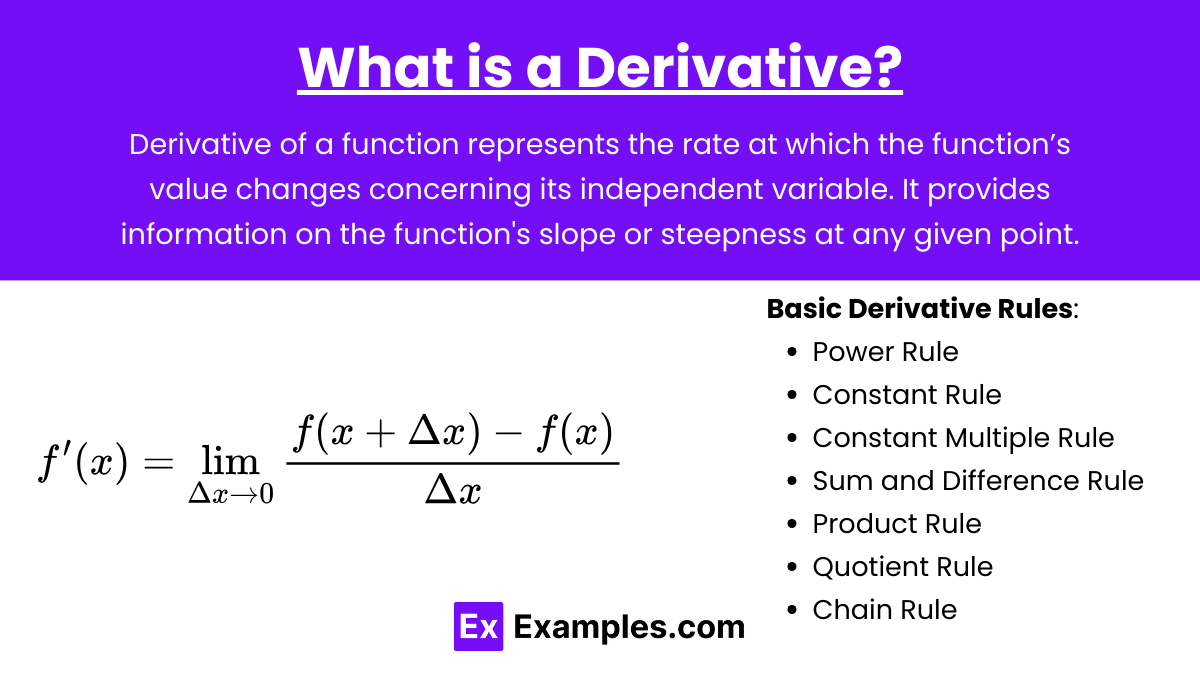
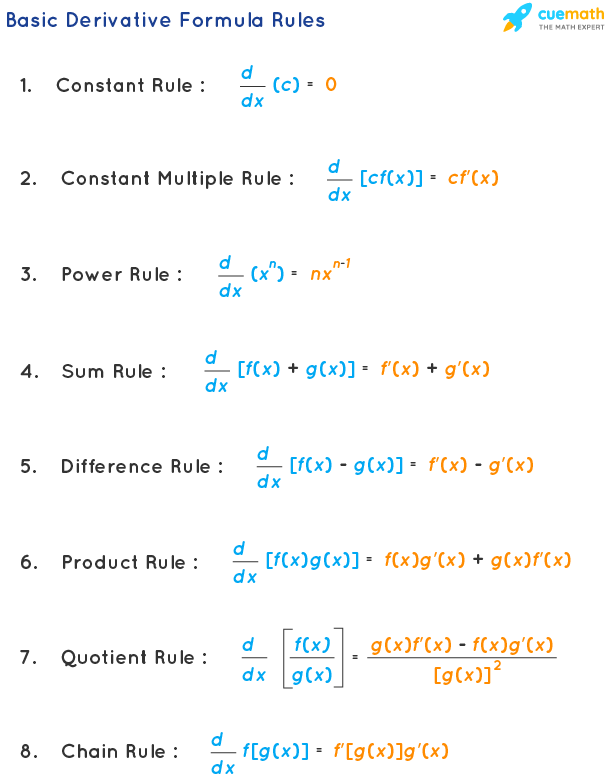
When you need to match a function with its derivative on an exam or homework assignment, you don't have to guess. You can solve it quickly by checking four visual and algebraic checkpoints: intercepts, critical points, asymptotes, and end behavior.
Finding the correct derivative graph or equation comes down to systematic elimination. If you know how original curves create slope patterns, you'll spot the right match in seconds. Let's break down the exact rules and examples you need to master this core connection.
The Foundation: How Function Shapes Create Derivative Graphs
Every point on a derivative graph represents the slope of the original function at that exact x-value. Before looking at specific function families, internalize these three baseline rules:
- Increasing to Positive: Whenever an original function goes up from left to right, its derivative stays above the x-axis ($f'(x) > 0$).
- Decreasing to Negative: Whenever an original function drops from left to right, its derivative stays below the x-axis ($f'(x) < 0$).
- Peaks and Valleys to Zeros: Local maximums and minimums on the original curve have a slope of zero. That means the derivative graph must cross or touch the x-axis ($f'(x) = 0$) at those exact x-coordinates.
If a curve hits a flat peak at $x = 3$, you can immediately scan the choices for a derivative graph that passes through $(3, 0)$.
Matching Common Function Families
Different algebraic families leave signature clues in their derivatives. Recognizing these templates saves you from differentiating every single term manually.
Polynomials and Degree Shifts
When you differentiate a polynomial, its degree drops by one. A cubic function like $f(x) = x^3 - 3x$ yields a quadratic derivative $f'(x) = 3x^2 - 3$.
If the original function is an 'S'-shaped cubic curve with two local turning points, its derivative must be a parabola with two x-intercepts. If the parabola opens upward, the outer edges of the cubic function must point upward and downward accordingly. You can read more about polynomial behavior at Khan Academy Calculus.
Trigonometric Shifts
Trigonometric matching relies entirely on cyclic phase shifts.
- The derivative of $f(x) = \sin(x)$ is $f'(x) = \cos(x)$.
- The derivative of $f(x) = \cos(x)$ is $f'(x) = -\sin(x)$.
When matching sine or cosine curves, check the origin. A standard sine wave starts at zero and heads upward, meaning its slope is steepest positive right at $x = 0$. That matches a cosine wave, which starts at a maximum value of $1$.
Exponential and Logarithmic Curves
Exponential functions are self-replicating under differentiation. If $f(x) = e^{kx}$, then $f'(x) = ke^{kx}$. The derivative keeps the exact same exponential shape, only scaled by a constant factor. If you see an exponential growth curve, its derivative graph will look nearly identical, just stretched or compressed vertically.
Step-by-Step Matching Strategy
When faced with a multiple-choice question showing four graphs and one function (or vice versa), use this four-step elimination checklist:
- Scan the x-intercepts of the derivative: Look at where the derivative crosses zero. Drop any options where those zero points don't line up with the local peaks and valleys of the original function.
- Check the signs: If the original function rises between $x = 1$ and $x = 4$, cross out any derivative graph that dips below the x-axis in that interval.
- Analyze asymptotic behavior: If a rational function has a vertical asymptote, the derivative will blow up to infinity or negative infinity near that same x-value.
- Test a single point: Pick an easy coordinate like $x = 0$ or $x = 1$. Calculate the slope manually using your derivative formula, then verify which option matches that output value.
For instance, take $f(x) = x^2$. At $x = 2$, the slope is $2(2) = 4$. If one candidate derivative graph shows a negative value at $x = 2$, eliminate it instantly. You can explore more rigorous proofs and practice problems through MIT OpenCourseWare.
Common Mistakes to Avoid
Students often fall into predictable traps when pairing functions with their rates of change. Watch out for these errors:
- Confusing peaks with zeros on the wrong graph: Remember that the derivative equals zero at the original function's peaks. Don't look for peaks on the derivative graph to find zeros; look for x-axis crossings.
- Ignoring the chain rule scaling factor: For composite functions like $f(x) = \sin(2x)$, forgetting the internal multiplier ($2$) will lead you to choose the wrong amplitude for your derivative graph.
- Failing to check concavity: The second derivative tells you about the original curve's bending behavior. If a function is concave down (frowning), its first derivative must be decreasing, meaning the slope of the derivative is negative.
Frequently Asked Questions
What does a negative derivative mean for the original graph?
A negative derivative means the original function is sloping downward from left to right at that point. As you move forward along the x-axis, the y-values are decreasing.
How do inflection points appear on a derivative graph?
An inflection point is where the original graph changes concavity (from bending upward to bending downward, or vice versa). On the derivative graph, an inflection point corresponds to a local maximum or minimum.
Can a derivative graph be discontinuous while the function is continuous?
Yes. A classic example is $f(x) = |x|$. At $x = 0$, the function forms a sharp V-corner. While you can draw the function without lifting your pen, the derivative has a jump discontinuity because the slope abruptly changes from $-1$ to $1$.
How do I match rational functions with their derivatives?
Use the quotient rule to find the derivative, and pay close attention to the denominator. Any vertical asymptotes present in the original function will typically result in squared or higher-power asymptotes in the derivative, often matching the same restricted x-values.