Finding the derivative of square root of x is one of those foundational calculus skills that appears everywhere, from basic homework problems to complex physics applications. If you need the direct answer, the derivative of $\sqrt{x}$ with respect to $x$ is $\frac{1}{2\sqrt{x}}$.
Knowing the formula is only half the battle. To truly master calculus, you need to understand how this derivative is derived using both the power rule and the limit definition, how to handle related functions, and where students commonly trip up during exams.
Understanding the Core Result
When you differentiate $f(x) = \sqrt{x}$, you are measuring the instantaneous rate of change of the square root function at any given point $x$. As $x$ grows larger, $\sqrt{x}$ grows more slowly, which means the slope of the curve decreases.
The resulting derivative, $\frac{1}{2\sqrt{x}}$, reflects this behavior. When $x$ is small (close to 0), the denominator is small, making the derivative very large—indicating a steep vertical climb near the origin. As $x$ increases toward infinity, the denominator grows, and the derivative approaches zero, flattening out just like the graph of the square root function itself.
Proof 1: Using the Power Rule
The fastest and most common way to find the derivative is by rewriting the square root as a fractional exponent.
- Rewrite the radical expression: $\sqrt{x} = x^{1/2}$.
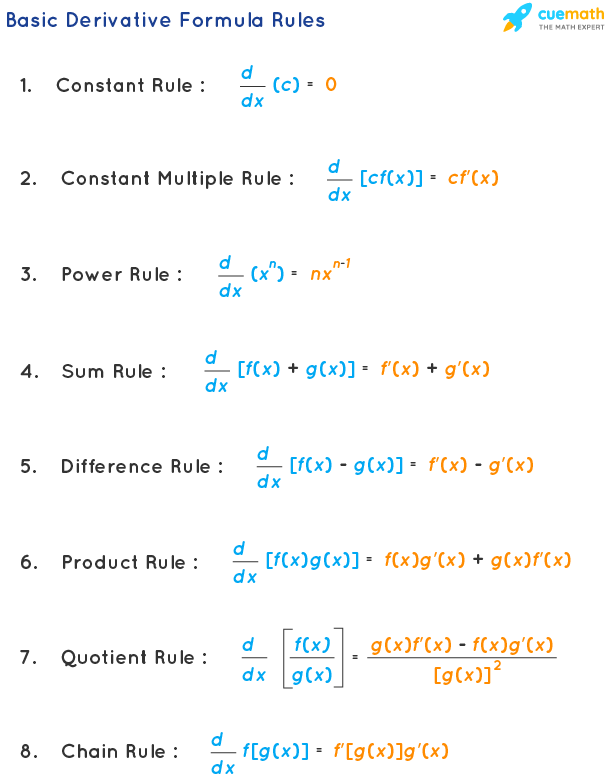
- Apply the power rule, which states that $\frac{d}{dx}(x^n) = n x^{n-1}$.
- Bring the exponent to the front: $\frac{1}{2} x^{(1/2 - 1)}$.
- Simplify the exponent: $\frac{1}{2} - 1 = -\frac{1}{2}$, giving you $\frac{1}{2} x^{-1/2}$.
- Convert the negative exponent back to a fraction and a radical: $\frac{1}{2x^{1/2}} = \frac{1}{2\sqrt{x}}$.
This technique works for any root function. For a deeper look at algebraic rules in calculus, review the standard calculus guides on Khan Academy Calculus.
Proof 2: Using the Limit Definition
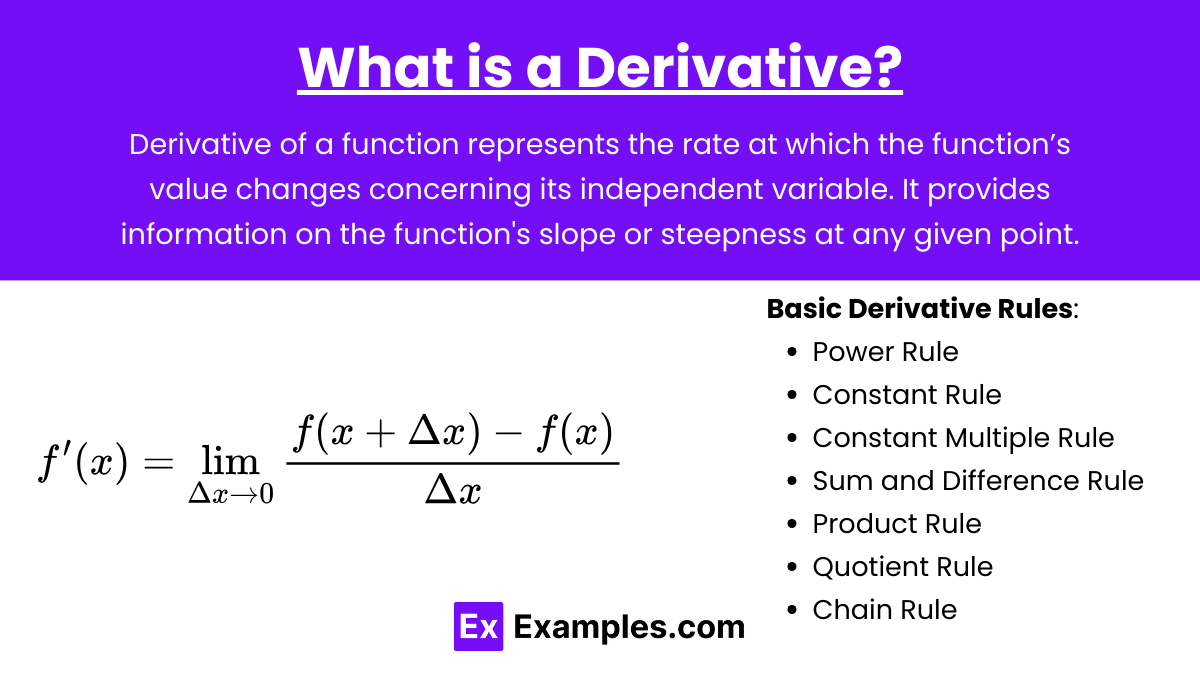
If you are taking an introductory calculus course, your professor will likely require you to prove this derivative from first principles using the limit definition:
$$f'(x) = \lim_{h \to 0} \frac{f(x+h) - f(x)}{h}$$
Substitute $\sqrt{x}$ into the limit:
$$\lim_{h \to 0} \frac{\sqrt{x+h} - \sqrt{x}}{h}$$
To evaluate this limit without running into a division-by-zero error, multiply the numerator and the denominator by the conjugate of the numerator, which is $(\sqrt{x+h} + \sqrt{x})$:
$$\lim_{h \to 0} \frac{(\sqrt{x+h} - \sqrt{x})(\sqrt{x+h} + \sqrt{x})}{h(\sqrt{x+h} + \sqrt{x})}$$
Expand the numerator using the difference of squares formula $(a-b)(a+b) = a^2 - b^2$:
$$\lim_{h \to 0} \frac{(x+h) - x}{h(\sqrt{x+h} + \sqrt{x})}$$
Simplify the numerator by canceling out $x$:
$$\lim_{h \to 0} \frac{h}{h(\sqrt{x+h} + \sqrt{x})}$$
Cancel the $h$ terms from the top and bottom:
$$\lim_{h \to 0} \frac{1}{\sqrt{x+h} + \sqrt{x}}$$
Now, substitute $0$ for $h$:
$$\frac{1}{\sqrt{x+0} + \sqrt{x}} = \frac{1}{2\sqrt{x}}$$
This geometric and analytical approach aligns with standard university curricula found in resources like MIT OpenCourseWare Single Variable Calculus.
Applying the Chain Rule to Square Roots
Real-world calculus problems rarely hand you a plain $\sqrt{x}$. Instead, you encounter composite functions like $\sqrt{3x^2 + 5}$. To handle these, combine the power rule result with the chain rule.
The generalized formula for the derivative of a square root function with an inner function $u(x)$ is:
$$\frac{d}{dx} \sqrt{u(x)} = \frac{1}{2\sqrt{u(x)}} \cdot u'(x)$$
Step-by-Step Example
Find the derivative of $f(x) = \sqrt{4x^3 - 2x}$.
- Identify the inner function: $u = 4x^3 - 2x$.
- Find the derivative of the inner function: $u' = 12x^2 - 2$.
- Apply the square root derivative formula, placing the derivative of the inside on top: $$\frac{12x^2 - 2}{2\sqrt{4x^3 - 2x}}$$
- Simplify the fraction by factoring out a 2 from the numerator: $$\frac{6x^2 - 1}{\sqrt{4x^3 - 2x}}$$
Common Mistakes to Avoid
Calculus students frequently make predictable errors when differentiating square roots. Watch out for these traps:
- Forgetting the denominator coefficient: Students often write $\frac{1}{\sqrt{x}}$ instead of $\frac{1}{2\sqrt{x}}$. Always remember the factor of 2 brought down by the power rule.
- Mismanaging negative exponents: When converting $x^{-1/2}$ back to radical form, make sure the $x$ ends up in the denominator alongside the 2, rather than floating in the numerator.
- Skipping the chain rule: If the expression under the radical is anything other than a standalone $x$, you must multiply your final result by the derivative of the inner term. Skipping this step invalidates the entire answer.
Frequently Asked Questions
What is the second derivative of the square root of x?
To find the second derivative, differentiate the first derivative, $\frac{1}{2}x^{-1/2}$, one more time. Bring down the $-\frac{1}{2}$ using the power rule to get $-\frac{1}{4}x^{-3/2}$, which simplifies to $-\frac{1}{4x\sqrt{x}}$ or $-\frac{1}{4x^{3/2}}$.
Where is the derivative of the square root of x undefined?
The derivative is undefined at $x = 0$. If you look at the formula $\frac{1}{2\sqrt{x}}$, plugging in $0$ puts a zero in the denominator, resulting in division by zero. Graphically, the tangent line to the curve at the origin is completely vertical, meaning the slope approaches infinity.
Can I use the chain rule on fractional powers other than one-half?
Yes. The same logic applies to cube roots, fourth roots, and beyond. For instance, the cube root $\sqrt[3]{x}$ can be written as $x^{1/3}$, and its derivative is $\frac{1}{3}x^{-2/3}$ or $\frac{1}{3\sqrt[3]{x^2}}$.
How do I integrate the square root of x instead?
Integration is the reverse of differentiation. To find the integral of $\sqrt{x}$, rewrite it as $x^{1/2}$, add 1 to the exponent to get $x^{3/2}$, and divide by the new exponent. This gives $\frac{2}{3}x^{3/2} + C$, or $\frac{2}{3}\sqrt{x^3} + C$.