Finding the derivative of the square root of $x$ is a fundamental calculus skill that bridges basic algebraic manipulation with core differentiation theorems. Whether you're working through homework problems or analyzing rates of change in physics, knowing how to differentiate $f(x) = \sqrt{x}$ quickly and correctly saves time. You'll encounter this function frequently when dealing with radical expressions, curve sketching, and optimization problems.
Instead of treating this radical as an isolated exception, we can solve it using established calculus principles. By converting the radical into an exponent, applying the power rule, or using the first principles limit definition, you'll see why the result is always $\frac{1}{2\sqrt{x}}$. Let's break down the exact mechanics behind this derivative, explore common variations, and look at practical applications.
Core Definition and Direct Answer
The derivative of the square root of $x$ with respect to $x$ is:
$$\frac{d}{dx}(\sqrt{x}) = \frac{1}{2\sqrt{x}}$$
This formula tells you the exact slope of the curve $y = \sqrt{x}$ at any given point $x > 0$. Notice that as $x$ gets larger, the denominator grows, which means the derivative shrinks. That matches the visual behavior of the square root graph: it climbs steeply right after the origin, then flattens out gradually as it moves to the right.
To understand where this comes from, we look at the two primary methods used to prove it: rewriting via fractional exponents and using the limit definition of a derivative.
Method 1: The Power Rule Approach
The cleanest and fastest way to find the derivative of $\sqrt{x}$ is to rewrite the radical using exponent rules. In algebra, any square root can be expressed as a fractional exponent where the index of the root becomes the denominator.
For $x \ge 0$, we can rewrite the function as:
$$\sqrt{x} = x^{\frac{1}{2}}$$
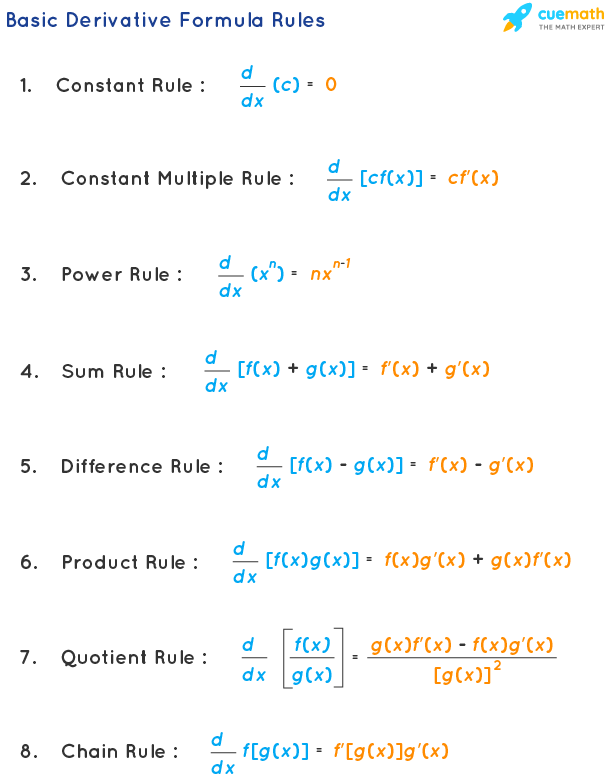
Now, we apply the standard power rule of calculus, which states that for any real number $n$:
$$\frac{d}{dx}(x^n) = n x^{n - 1}$$
Let's plug in $n = \frac{1}{2}$:
- Bring the exponent to the front: $\frac{1}{2} x^{\frac{1}{2} - 1}$
- Subtract $1$ from the exponent: $\frac{1}{2} - 1 = -\frac{1}{2}$
- Combine the terms: $\frac{1}{2} x^{-\frac{1}{2}}$
Because negative exponents indicate reciprocal values, we can rewrite $x^{-\frac{1}{2}}$ as $\frac{1}{x^{\frac{1}{2}}}$. Substituting that back gives us:
$$\frac{1}{2} \cdot \frac{1}{x^{\frac{1}{2}}} = \frac{1}{2\sqrt{x}}$$
This approach is efficient and works seamlessly for higher-order roots as well, such as cube roots or fourth roots.
Method 2: Proof from First Principles
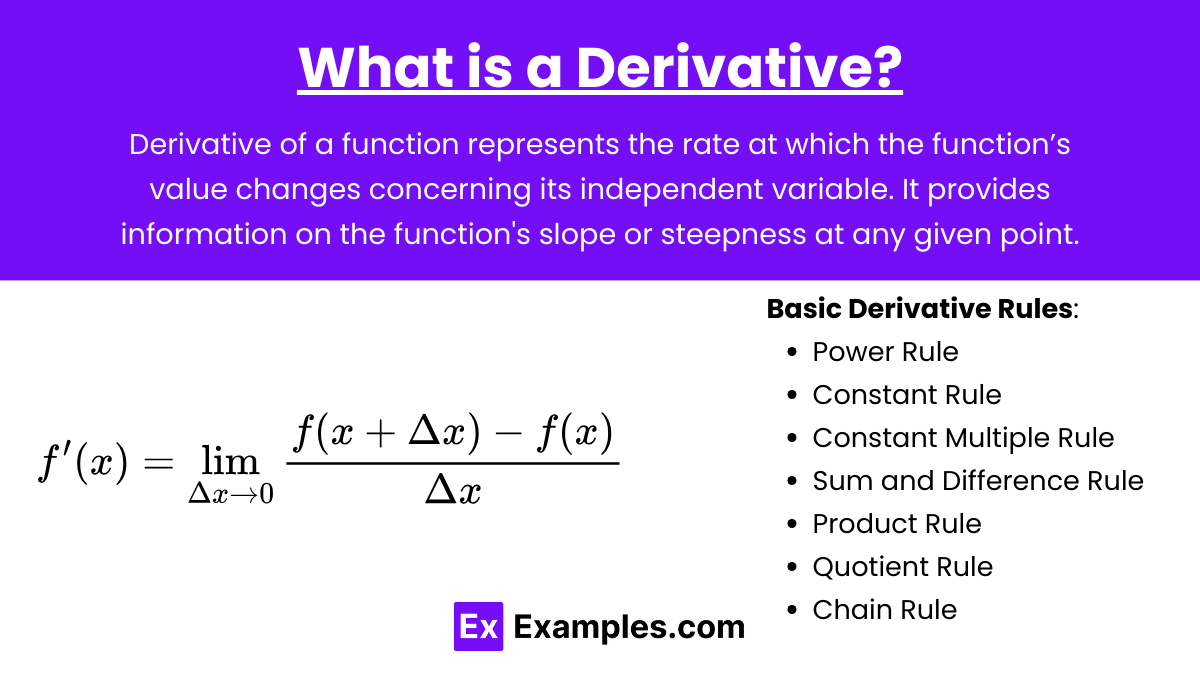
If you need to prove this result from scratch without relying on pre-established exponent shortcuts, you must use the limit definition of the derivative. This method evaluates the slope of the secant line as the interval approaches zero.
The limit definition is:
$$f'(x) = \lim_{h \to 0} \frac{f(x+h) - f(x)}{h}$$
For our function, $f(x) = \sqrt{x}$, so we substitute that in:
$$f'(x) = \lim_{h \to 0} \frac{\sqrt{x+h} - \sqrt{x}}{h}$$
Direct substitution yields a division by zero error ($0/0$), so we use algebraic conjugation. We multiply the numerator and the denominator by the conjugate of the numerator, which is $(\sqrt{x+h} + \sqrt{x})$:
$$f'(x) = \lim_{h \to 0} \frac{(\sqrt{x+h} - \sqrt{x})(\sqrt{x+h} + \sqrt{x})}{h(\sqrt{x+h} + \sqrt{x})}$$
Expanding the numerator using the difference of squares formula $(a-b)(a+b) = a^2 - b^2$:
$$(\sqrt{x+h})^2 - (\sqrt{x})^2 = (x + h) - x = h$$
Now, substitute that simplified numerator back into our limit expression:
$$f'(x) = \lim_{h \to 0} \frac{h}{h(\sqrt{x+h} + \sqrt{x})}$$
Cancel out the $h$ terms from the numerator and denominator:
$$f'(x) = \lim_{h \to 0} \frac{1}{\sqrt{x+h} + \sqrt{x}}$$
Evaluate the limit by letting $h \to 0$:
$$f'(x) = \frac{1}{\sqrt{x+0} + \sqrt{x}} = \frac{1}{\sqrt{x} + \sqrt{x}} = \frac{1}{2\sqrt{x}}$$
The math holds up, giving us the exact same result through pure geometric limit analysis. You can review more foundational calculus proofs directly through educational resources like Khan Academy Calculus.
Handling Composite Functions: The Chain Rule
In real-world calculus problems, you rarely see just a plain $x$ under the radical. Instead, you'll encounter functions like $\sqrt{3x^2 + 5}$ or $\sqrt{\sin(x)}$. To differentiate these, you must combine the power rule with the chain rule.
The chain rule states that the derivative of a composite function $f(g(x))$ is $f'(g(x)) \cdot g'(x)$. For square roots, this creates a reliable shortcut formula:
$$\frac{d}{dx}(\sqrt{u}) = \frac{1}{2\sqrt{u}} \cdot \frac{du}{dx}$$
Step-by-Step Example
Let's find the derivative of $y = \sqrt{4x^3 - 2x + 7}$.
- Identify the inner function: Let $u = 4x^3 - 2x + 7$.
- Find the derivative of the inner function: $\frac{du}{dx} = 12x^2 - 2$.
- Apply the square root derivative template: $\frac{1}{2\sqrt{u}} \cdot \frac{du}{dx}$.
- Substitute $u$ and $\frac{du}{dx}$ back in:
$$\frac{1}{2\sqrt{4x^3 - 2x + 7}} \cdot (12x^2 - 2)$$
- Simplify the expression by factoring out a $2$ from the numerator:
$$\frac{2(6x^2 - 1)}{2\sqrt{4x^3 - 2x + 7}} = \frac{6x^2 - 1}{\sqrt{4x^3 - 2x + 7}}$$
This streamlined pattern appears constantly in optimization tests and physics kinematics.
Common Mistakes to Avoid
Even experienced students make avoidable errors when dealing with radical derivatives. Keep these pitfalls in mind:
- Forgetting the denominator coefficient: A common slip-up is dropping the $2$ in the denominator and writing $\frac{1}{\sqrt{x}}$ instead of $\frac{1}{2\sqrt{x}}$. Always remember that bringing down the exponent $\frac{1}{2}$ creates that constant multiplier.
- Failing to apply the chain rule: If the expression inside the radical has its own variable components, you cannot just take the derivative of the outer root and stop. You must multiply by the derivative of the inner contents every single time.
- Misinterpreting the domain: The function $f(x) = \sqrt{x}$ has a domain of $x \ge 0$. However, its derivative $f'(x) = \frac{1}{2\sqrt{x}}$ has a domain of $x > 0$. At $x = 0$, the derivative is undefined because the tangent line is vertical (an infinite slope).
For deeper mathematical definitions and formal notation standards, you can consult publications hosted by organizations like the National Institute of Standards and Technology.
Frequently Asked Questions
Why is the derivative undefined at $x = 0$?
If you plug $x = 0$ into $\frac{1}{2\sqrt{x}}$, you get division by zero. Graphically, the curve $y = \sqrt{x}$ starts at the origin with a vertical tangent line. A vertical line has an undefined, infinite slope, which is why the derivative does not exist at that precise point.
How do I find higher-order derivatives of $\sqrt{x}$?
You continue applying the power rule sequentially. Starting with $f(x) = x^{1/2}$, the first derivative is $\frac{1}{2}x^{-1/2}$. The second derivative multiplies by $-\frac{1}{2}$, giving $-\frac{1}{4}x^{-3/2}$, and so on. Each successive derivative alternates signs and increases the power of the denominator.
Can I use logarithmic differentiation for square roots?
Yes. Taking the natural log of $y = \sqrt{x}$ gives $\ln(y) = \frac{1}{2}\ln(x)$. Differentiating both sides implicitly yields $\frac{1}{y} y' = \frac{1}{2x}$, which simplifies to $y' = \frac{y}{2x} = \frac{\sqrt{x}}{2x} = \frac{1}{2\sqrt{x}}$. It's a longer path for a simple root, but useful for complex products involving multiple radicals.