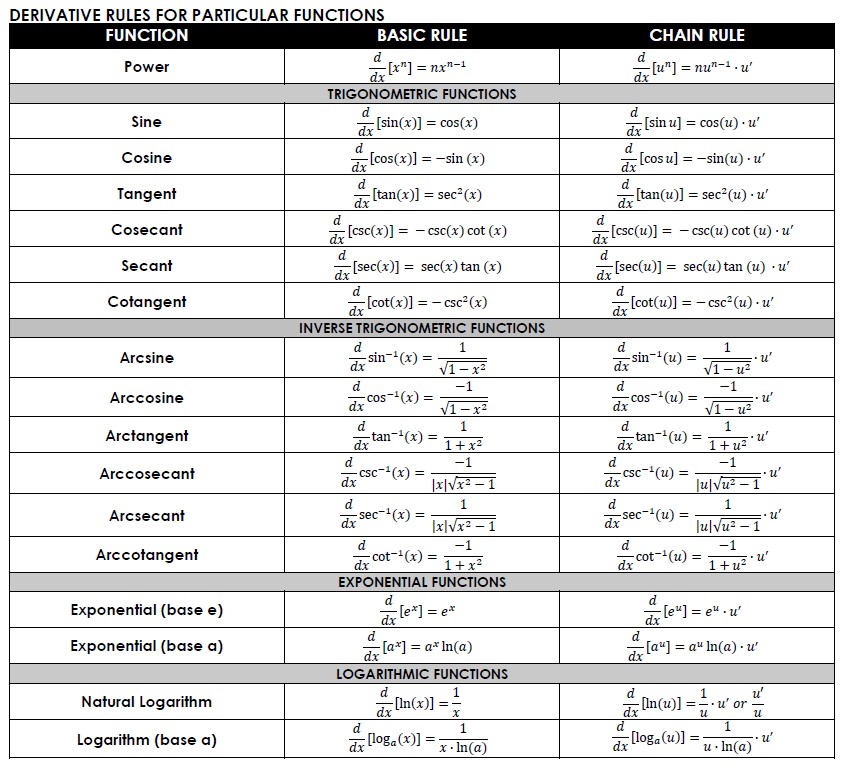
The derivative of natural log of x is $1/x$, a core result in calculus that describes how logarithmic growth flattens out as values increase. This rule applies for all $x > 0$. When you differentiate $\ln(x)$, you are finding the instantaneous rate of change of the natural logarithm function at any given point on its curve.
If you are working through differential calculus, this rule appears everywhere. It connects exponential growth, geometric tangents, and rates of change in fields ranging from physics to economics. Let's break down why this rule works, how to prove it, and how to apply it to more complex composite functions without getting bogged down in theory.
Understanding the Derivative of Natural Logarithm
To see what $1/x$ means graphically, picture the curve of $y = \ln(x)$. The function starts at negative infinity as $x$ approaches zero from the right, crosses the $x$-axis at $x = 1$, and climbs steadily upward toward infinity. However, it climbs at a continuously decreasing rate.
At $x = 1$, the slope of the tangent line is exactly $1/1 = 1$. When you move further right to $x = 10$, the slope drops to $1/10 = 0.1$. The function is still growing, but it gets flatter and flatter. This behavior matches the $1/x$ output: as your input $x$ gets larger, the derivative gets smaller. To read more about the context of this, Associated Press provides an informative breakdown.
The domain for $\ln(x)$ is strictly restricted to positive numbers. You can't take the natural log of zero or a negative number in real-valued calculus, meaning your input $x$ must be greater than zero. Consequently, the domain of the derivative is also $x > 0$.
Proof Using the Limit Definition
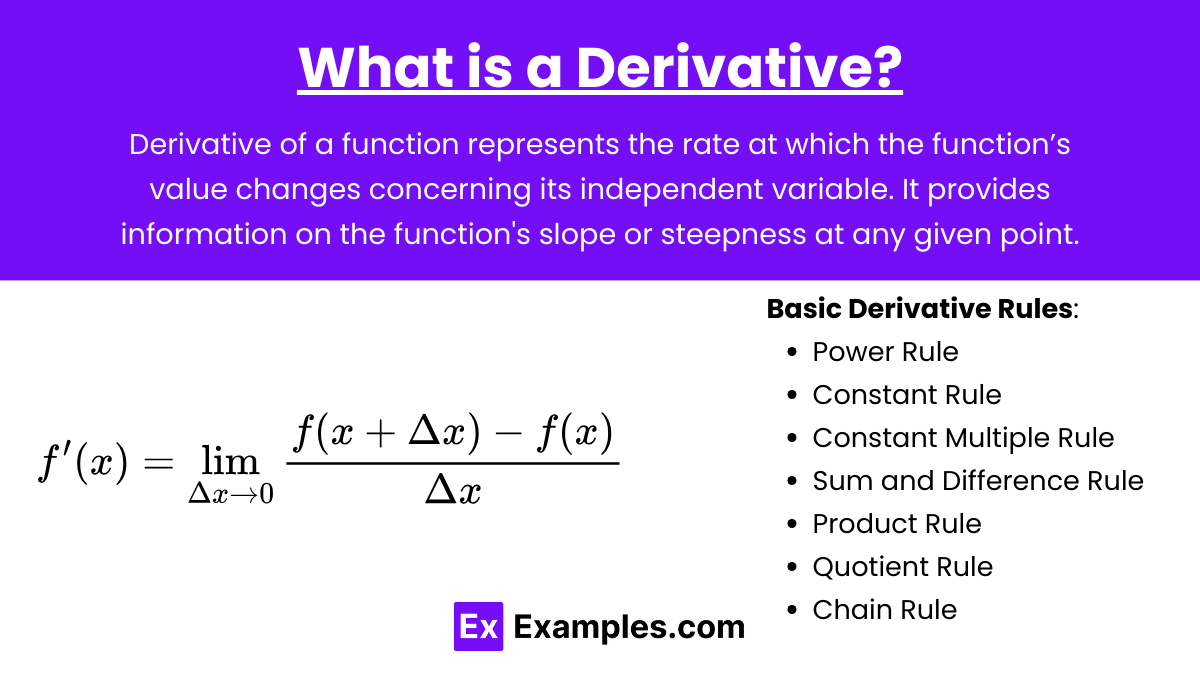
You don't have to accept this rule on faith. We can derive it using the fundamental limit definition of a derivative:
$$f'(x) = \lim_{h \to 0} \frac{f(x+h) - f(x)}{h}$$
Substitute $\ln(x)$ into the formula:
$$\frac{d}{dx}[\ln(x)] = \lim_{h \to 0} \frac{\ln(x+h) - \ln(x)}{h}$$
Using logarithm subtraction rules, combine the terms in the numerator:
$$\lim_{h \to 0} \frac{1}{h} \ln\left(\frac{x+h}{x}\right)$$
Simplify the fraction inside the argument:
$$\lim_{h \to 0} \frac{1}{h} \ln\left(1 + \frac{h}{x}\right)$$
Rewrite the coefficient $1/h$ as an exponent using logarithm rules:
$$\lim_{h \to 0} \ln\left(1 + \frac{h}{x}\right)^{\frac{1}{h}}$$
Let $n = x/h$. As $h$ approaches zero, $n$ approaches infinity. With substitution and limits involving Euler's number $e$, this expression simplifies cleanly to $1/x$. This confirms the rate of change of the natural log function.
Applying the Chain Rule to Logarithmic Functions
Rarely do you encounter pure $\ln(x)$ out in the wild. More often, you have a function nested inside the logarithm, requiring the chain rule.
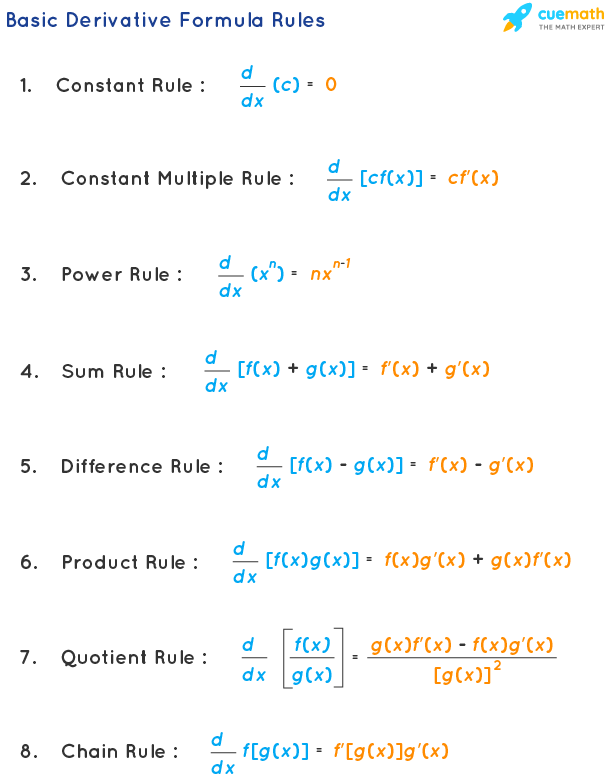
The generalized rule states that if you have a differentiable function $g(x)$, then:
$$\frac{d}{dx}[\ln(g(x))] = \frac{1}{g(x)} \cdot g'(x) = \frac{g'(x)}{g(x)}$$
Step-by-Step Example: Differentiating $\ln(3x^2 + 5)$
- Identify the inner function: $g(x) = 3x^2 + 5$.
- Find the derivative of the inner function: $g'(x) = 6x$.
- Apply the logarithmic template: put the derivative on top and the original inner function on the bottom.
- Write the final result: $\frac{6x}{3x^2 + 5}$.
This pattern makes quick work of complex expressions that would otherwise require tedious algebraic manipulation.
Logarithmic Differentiation for Complex Products
Sometimes you need to find the derivative of a monstrous function involving products, quotients, and exponents. Logarithmic differentiation is a technique that uses the properties of logarithms to turn multiplication and division into simpler addition and subtraction.
Consider $y = x^x$. Standard power rules don't apply because the exponent is a variable, and standard exponential rules don't apply because the base is also a variable.
- Take the natural log of both sides: $\ln(y) = \ln(x^x)$.
- Bring the exponent down using log rules: $\ln(y) = x \ln(x)$.
- Differentiate both sides implicitly with respect to $x$. The left side becomes $\frac{1}{y} \frac{dy}{dx}$. The right side requires the product rule: $$\frac{1}{y} \frac{dy}{dx} = (1)\ln(x) + x\left(\frac{1}{x}\right)$$ $$\frac{1}{y} \frac{dy}{dx} = \ln(x) + 1$$
- Solve for $\frac{dy}{dx}$ by multiplying both sides by $y$: $$\frac{dy}{dx} = y(\ln(x) + 1)$$
- Substitute the original expression back in for $y$: $$\frac{dy}{dx} = x^x(\ln(x) + 1)$$
This method transforms intimidating calculus problems into manageable algebra.
Common Mistakes to Avoid
When working with logarithmic derivatives, students often fall into a few predictable traps:
- Forgetting the chain rule: If you differentiate $\ln(5x)$, don't just write $1/(5x)$ and walk away. You must multiply by the derivative of the inner function ($5$), which simplifies back to $1/x$. Always check if an inner function needs attention.
- Ignoring the absolute value domain: In more advanced calculus, you might see $\frac{d}{dx}[\ln|x|] = 1/x$ for all non-zero $x$. If you drop absolute value bars during related integration steps, you can inadvertently restrict your domain or introduce mathematical errors with negative inputs.
- Confusing log bases: The derivative rule $1/x$ applies specifically to the natural logarithm (base $e$). If you are differentiating a base-10 logarithm like $\log_{10}(x)$, you must include a scaling factor: $\frac{1}{x \ln(10)}$.
Frequently Asked Questions
Why is the derivative of $\ln(x)$ not $1/x \ln(x)$?
People sometimes confuse differentiation rules for exponential functions like $a^x$ with logarithms. Exponential functions pull in a $\ln(a)$ multiplier, but logarithmic functions require a division factor linked to the change of base formula, which for natural log base $e$ results in $\ln(e) = 1$.
Can you take the derivative of $\ln(0)$?
No. The function $\ln(x)$ is undefined at $x = 0$ because there is a vertical asymptote. As $x$ approaches zero from the positive side, the function drops toward negative infinity, and the slope becomes infinitely steep.
How does this rule apply to negative numbers?
In standard real calculus, you cannot take the natural log of a negative number, so the derivative doesn't exist there. Complex analysis expands logarithms to negative and complex numbers using Euler's formula, but that extends beyond standard differential calculus.
What is the second derivative of $\ln(x)$?
Since the first derivative is $x^{-1}$, you can apply the standard power rule to find the second derivative. Bring down the exponent and subtract one, yielding $-1/x^2$. This tells you that the original graph is always concave down.