Finding the rate of change for logarithmic growth is a fundamental task in calculus. The derivative of ln x is simply $\frac{1}{x}$, a remarkably clean result for a transcendental function. This core rule appears everywhere from compound interest calculations in finance to modeling population decay in biology.
Knowing that the derivative is $\frac{1}{x}$ is only half the battle. You'll need to understand how to apply the chain rule, handle absolute values inside logarithms, and manage logarithmic differentiation for complex algebraic expressions. Let's break down the mechanics behind this formula, look at rigorous proofs, and work through practical examples.
The Core Formula and Basic Derivative
At its simplest, the derivative with respect to $x$ of the natural logarithm function is:
$$\frac{d}{dx}(\ln x) = \frac{1}{x}$$
This rule holds true for all $x > 0$ because the natural logarithm function is only defined for positive real numbers. If you try to input zero or a negative number, the function is undefined.
To see this in action, let's look at a quick evaluation. If you want to find the slope of the tangent line to the curve $y = \ln x$ at $x = 4$, you substitute $4$ into $\frac{1}{x}$. The slope is $\frac{1}{4}$. At $x = 10$, the slope flattens out to $\frac{1}{10}$. As $x$ grows larger, the rate of change shrinks closer to zero, which matches the slow, steady upward crawl of the logarithmic graph.
Domain Restrictions and Absolute Values
Calculus problems frequently introduce absolute values to expand the domain of allowable inputs. When you encounter $\ln|x|$, the derivative rule changes slightly to accommodate negative numbers:
$$\frac{d}{dx}(\ln|x|) = \frac{1}{x}$$
This works for all $x \neq 0$. If $x > 0$, $|x| = x$, so the derivative is $\frac{1}{x}$. If $x < 0$, $|x| = -x$. Using the chain rule, the derivative becomes $\frac{1}{-x} \cdot (-1)$, which simplifies back to $\frac{1}{x}$. This minor detail saves you from domain errors when integrating or differentiating functions with negative inputs.
Proof Using the Limit Definition
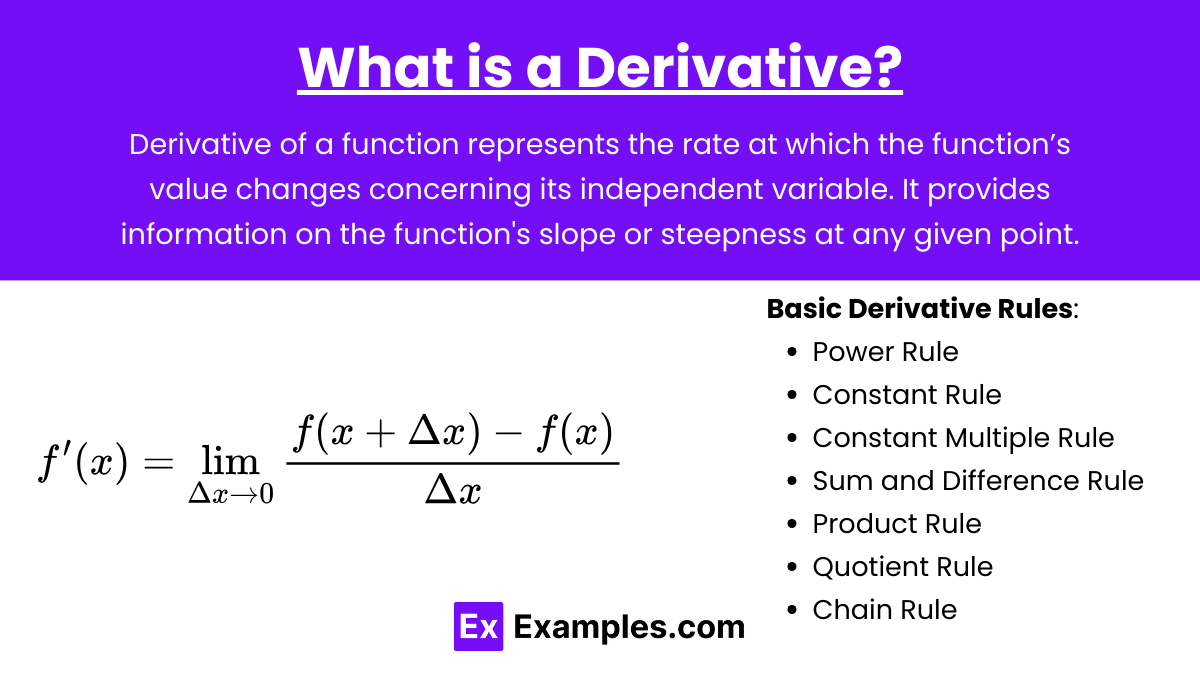
Why does the derivative of $\ln x$ equal $\frac{1}{x}$? We can prove this using the limit definition of a derivative and the properties of logarithms.
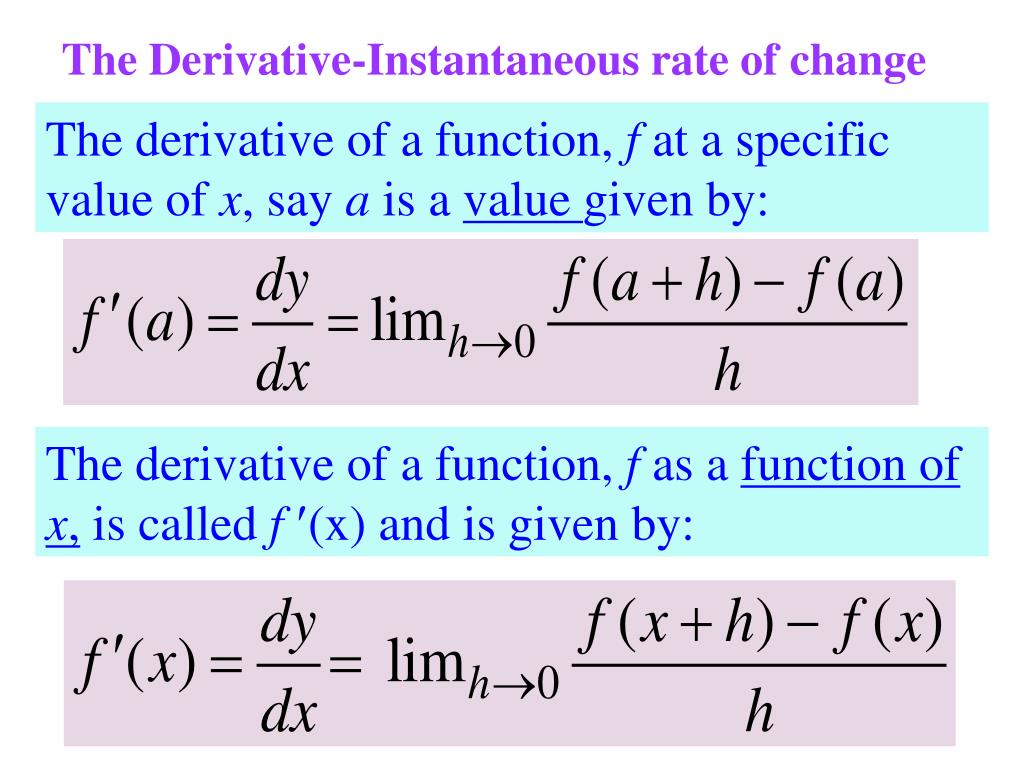
Recall the limit definition:
$$f'(x) = \lim_{h \to 0} \frac{f(x+h) - f(x)}{h}$$
Substitute $f(x) = \ln x$ into the formula:
$$\frac{d}{dx}(\ln x) = \lim_{h \to 0} \frac{\ln(x+h) - \ln(x)}{h}$$
Use the logarithm quotient rule, $\ln a - \ln b = \ln\left(\frac{a}{b}\right)$:
$$\frac{d}{dx}(\ln x) = \lim_{h \to 0} \frac{1}{h} \ln\left(\frac{x+h}{x}\right)$$
Rewrite the fraction inside the argument:
$$\frac{d}{dx}(\ln x) = \lim_{h \to 0} \frac{1}{h} \ln\left(1 + \frac{h}{x}\right)$$
Use the power rule for logarithms, $a \ln b = \ln(b^a)$:
$$\frac{d}{dx}(\ln x) = \lim_{h \to 0} \ln\left(1 + \frac{h}{x}\right)^{\frac{1}{h}}$$
Let $n = \frac{x}{h}$, which means $\frac{1}{h} = \nobreak \frac{n}{x}$ and $n \to \infty$ as $h \to 0$. Substituting these values gives:
$$\frac{d}{dx}(\ln x) = \lim_{n \to \infty} \ln\left(1 + \frac{1}{n}\right)^{\frac{n}{x}}$$
Using exponent rules, we can pull the factor outside the logarithm:
$$\frac{d}{dx}(\ln x) = \lim_{n \to \infty} \frac{1}{x} \ln\left(1 + \frac{1}{n}\right)^n$$
Since the limit depends on $n$ and $\frac{1}{x}$ is a constant relative to $n$, we can move it outside the limit operator:
$$\frac{d}{dx}(\ln x) = \frac{1}{x} \ln \left[ \lim_{n \to \infty} \left(1 + \frac{1}{n}\right)^n \right]$$
The expression inside the brackets is the standard limit definition of Euler's number, $e$:
$$\lim_{n \to \infty} \left(1 + \frac{1}{n}\right)^n = e$$
Substitute $e$ back into the equation:
$$\frac{d}{dx}(\ln x) = \frac{1}{x} \ln(e)$$
Since $\ln(e) = 1$, the final result simplifies to:
$$\frac{d}{dx}(\ln x) = \frac{1}{x}$$
Proof Using Inverse Functions
Another clean way to prove this derivative relies on the fact that the natural logarithm is the inverse of the natural exponential function, $e^y$.
- Start by setting $y = \ln x$.
- Rewrite the equation in exponential form: $e^y = x$.
- Take the derivative of both sides with respect to $x$ using implicit differentiation.
- The derivative of $e^y$ with respect to $x$ is $e^y \cdot \frac{dy}{dx}$, and the derivative of $x$ is $1$.
- This gives $e^y \frac{dy}{dx} = 1$.
- Solve for $\frac{dy}{dx}$: $\frac{dy}{dx} = \frac{1}{e^y}$.
- Since $e^y = x$, substitute $x$ back into the denominator: $\frac{dy}{dx} = \frac{1}{x}$.
This approach avoids complicated limit manipulations and connects exponential and logarithmic growth directly. For a deeper look at foundational calculus proofs, you can review resources provided by Khan Academy Calculus.
Applying the Chain Rule
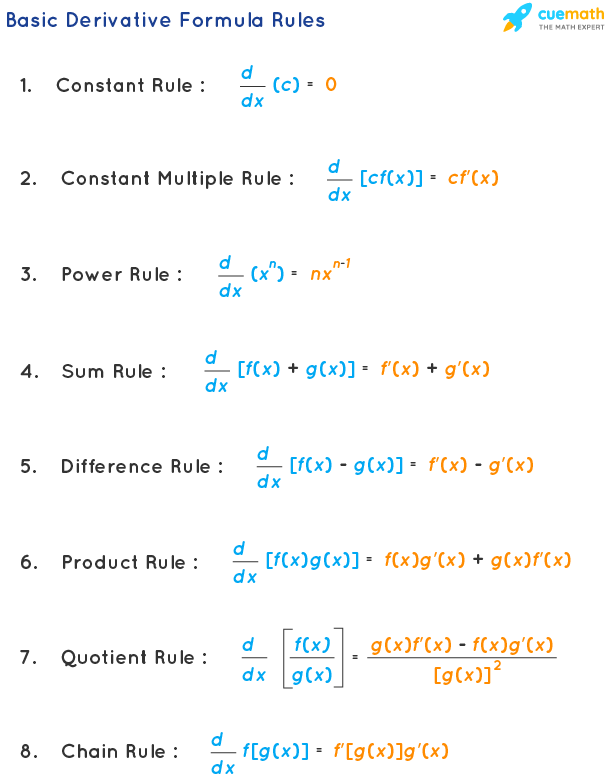
Real-world calculus problems rarely hand you a simple $\ln x$. You'll usually deal with composite functions like $\ln(3x^2 + 5)$. The chain rule states that if $f(x) = \ln(u(x))$, then the derivative is:
$$\frac{d}{dx}(\ln u) = \frac{1}{u} \cdot \frac{du}{dx}$$
Let's walk through three common scenarios using the chain rule.
Example 1: Polynomial Argument
Find the derivative of $f(x) = \ln(4x^3 - 2x)$.
- Identify the inner function $u = 4x^3 - 2x$.
- Find the derivative of the inner function: $\frac{du}{dx} = 12x^2 - 2$.
- Apply the formula $\frac{1}{u} \cdot \frac{du}{dx}$: $$\frac{d}{dx}\ln(4x^3 - 2x) = \frac{1}{4x^3 - 2x} \cdot (12x^2 - 2)$$
- Simplify the expression by factoring out a $2$: $$\frac{6x^2 - 1}{2x^3 - x}$$
Example 2: Trigonometric Argument
Find the derivative of $g(x) = \ln(\sin x)$.
- Let $u = \sin x$.
- The derivative of the inner function is $\frac{du}{dx} = \cos x$.
- Apply the rule: $$\frac{d}{dx}\ln(\sin x) = \frac{1}{\sin x} \cdot \cos x$$
- Rewrite using trigonometric identities: $$\frac{\cos x}{\sin x} = \cot x$$
Example 3: Exponential Argument
Find the derivative of $h(x) = \ln(e^{2x} + 5)$.
- Let $u = e^{2x} + 5$.
- The derivative is $\frac{du}{dx} = 2e^{2x}$.
- Combine terms: $$\frac{d}{dx}\ln(e^{2x} + 5) = \frac{2e^{2x}}{e^{2x} + 5}$$
Logarithmic Differentiation
Sometimes you face a function that looks impossible to differentiate using standard quotient or product rules, such as $y = x^x$ or massive products of polynomials. Logarithmic differentiation is a technique that uses logarithm properties to break multiplication, division, and exponents into simpler addition and subtraction problems.
Let's find the derivative of $y = x^x$ for $x > 0$.
- Take the natural logarithm of both sides: $$\ln y = \ln(x^x)$$
- Use the logarithm power rule to bring the exponent down: $$\ln y = x \ln x$$
- Take the derivative of both sides with respect to $x$. Remember to use implicit differentiation on the left side: $$\frac{1}{y} \frac{dy}{dx} = \frac{d}{dx}(x \ln x)$$
- Apply the product rule to the right side: $$\frac{1}{y} \frac{dy}{dx} = (1)(\ln x) + (x)\left(\frac{1}{x}\right)$$ $$\frac{1}{y} \frac{dy}{dx} = \ln x + 1$$
- Multiply both sides by $y$ to solve for $\frac{dy}{dx}$: $$\frac{dy}{dx} = y(\ln x + 1)$$
- Substitute the original expression for $y$ ($x^x$) back into the final equation: $$\frac{dy}{dx} = x^x(\ln x + 1)$$
This technique turns a complicated variable-exponent problem into a straightforward calculus exercise.
Common Mistakes to Avoid
Calculus students often make a few repeatable errors when differentiating logarithmic functions. Keep these pitfalls in mind during exams and homework assignments:
- Forgetting the chain rule: Writing $\frac{1}{x}$ instead of $\frac{1}{u} \cdot u'$ when the argument is anything other than a lone $x$. If your function is $\ln(5x)$, the derivative is $\frac{1}{5x} \cdot 5 = \frac{1}{x}$, not just $\frac{1}{5x}$.
- Confusing log rules with exponent rules: Trying to apply derivative rules before simplifying. Always use logarithm properties ($\ln(ab) = \ln a + \ln b$ or $\ln(a^b) = b \ln a$) to expand complex arguments before taking the derivative. It saves time and prevents algebraic errors.
- Ignoring domain constraints: Trying to evaluate a derivative at $x \le 0$ when the original function requires positive inputs. Always check your domain before plugging values into a derivative.
- Treating $\ln x$ like a power function: Mistakenly applying the power rule to bring down the exponent or alter the base. The natural log is a transcendental function with its own unique rate of change.
Frequently Asked Questions
What is the derivative of $\log_b(x)$ with a base other than $e$?
You can convert any logarithmic base to the natural logarithm using the change of base formula: $\log_b(x) = \frac{\ln x}{\ln b}$. Since $\ln b$ is a constant, its derivative is: $$\frac{d}{dx}(\log_b x) = \frac{1}{x \ln b}$$
Can you take the derivative of $\ln(-x)$?
Yes, as long as $-x > 0$, which means $x < 0$. Using the chain rule, the derivative is $\frac{1}{-x} \cdot (-1) = \frac{1}{x}$. This matches our earlier discussion about absolute value domains.
Why does the derivative of $\ln x$ not have a $+ C$?
The constant $+ C$ appears only in integration (antiderivatives) to represent the family of vertical shifts an antiderivative can have. Differentiation finds a single, exact rate of change at any given point, so no constant is needed.
How do you integrate $\frac{1}{x}$?
Integration is the reverse of differentiation. Because the derivative of $\ln|x|$ is $\frac{1}{x}$, the integral of $\frac{1}{x}$ with respect to $x$ is $\ln|x| + C$. For more practice problems on integration and differentiation pairs, check out the MIT OpenCourseWare Single Variable Calculus course materials.