Finding the derivative of arctan tells you how fast the inverse tangent function changes at any given point. If you graph arctan(x), the curve flattens out as x grows large, meaning its rate of change slows down near the horizontal asymptotes. The exact derivative formula captures this behavior cleanly using basic algebraic structures.
In this guide, you will learn how the derivative of arctan(x) is derived using implicit differentiation, how to apply the chain rule to composite functions, and why this rate of change matters in real-world calculus applications.
How to Derive the Derivative of Arctan
To find the derivative of $y = \arctan(x)$, you start by rewriting the equation to eliminate the inverse function. Taking the tangent of both sides gives:
$$\tan(y) = x$$
Because $\tan(y)$ is easier to differentiate than $\arctan(x)$, you apply implicit differentiation with respect to $x$. Differentiating both sides yields:
$$\sec^2(y) \cdot \frac{dy}{dx} = 1$$
Next, solve for $\frac{dy}{dx}$ by dividing both sides by $\sec^2(y)$:
$$\frac{dy}{dx} = \frac{1}{\sec^2(y)}$$
You want the final derivative expressed in terms of $x$, not $y$. Using the Pythagorean trigonometric identity $\sec^2(y) = 1 + \tan^2(y)$, and remembering that $\tan(y) = x$, substitute $x$ back into the denominator:
$$\frac{dy}{dx} = \frac{1}{1 + x^2}$$
This proves that the derivative of $\arctan(x)$ is simply $\frac{1}{1 + x^2}$.
Using the Chain Rule with Arctan
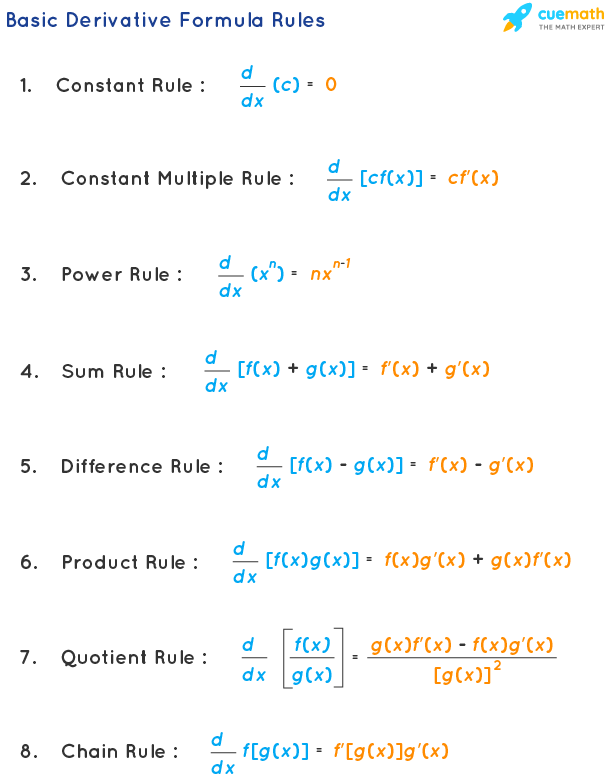
Most calculus problems involve composite functions rather than standalone variables. When you need to differentiate arctan of a function $u(x)$, you apply the chain rule.
The generalized derivative formula is:
$$\frac{d}{dx}[\arctan(u)] = \frac{1}{1 + u^2} \cdot \frac{du}{dx}$$
For example, if you want to differentiate $f(x) = \arctan(3x^2)$, you identify $u = 3x^2$ and its derivative $\frac{du}{dx} = 6x$. Plugging these into the formula gives:
$$f'(x) = \frac{1}{1 + (3x^2)^2} \cdot 6x = \frac{6x}{1 + 9x^4}$$
This scaling factor explains how stretching or compressing the input changes the steepness of the tangent curve.
Common Mistakes to Avoid
Calculus students often mix up inverse trigonometric derivatives because they look similar. Keep these pitfalls in mind during exams:
- Forgetting the denominator squared: In composite functions, students frequently forget to square the entire inner expression, writing $1 + u$ instead of $1 + u^2$.
- Confusing arcsin and arctan: The derivative of $\arcsin(x)$ has a square root in the denominator ($\frac{1}{\sqrt{1 - x^2}}$), whereas $\arctan(x)$ does not.
- Skipping the chain rule multiplier: Always multiply the final fraction by the derivative of the inner function. Leaving out $\frac{du}{dx}$ is the most common error in advanced homework problems.
You can review formal calculus definitions and proofs through resources like LibreTexts Calculus.
Frequently Asked Questions
Why is the derivative of arctan always positive?
Because the denominator $1 + x^2$ is always positive for any real number $x$, the fraction $\frac{1}{1 + x^2}$ can never be negative. This means the arctan graph is strictly increasing across its entire domain.
What happens to the rate of change as x approaches infinity?
As $x$ grows very large in either the positive or negative direction, $x^2$ becomes massive. This drives the derivative $\frac{1}{1 + x^2}$ closer and closer to zero, matching the visual flattening of the graph near its horizontal asymptotes at $y = \frac{\pi}{2}$ and $y = -\frac{\pi}{2}$.
Where is arctan used in the real world?
Engineers and programmers use arctan in coordinate conversions, specifically when transforming Cartesian coordinates $(x, y)$ into polar coordinates or calculating angles in game development and robotics.
Can you integrate $\frac{1}{1 + x^2}$ back to arctan?
Yes. Because integration is the reverse process of differentiation, integrating $\frac{1}{1 + x^2}$ with respect to $x$ yields $\arctan(x) + C$, where $C$ represents the constant of integration.