The derivative of $3x^2$ is $6x$. This result tells you the exact slope of the curve at any given point, measuring how fast the output changes relative to the input. Whether you're tracking position in physics or marginal cost in economics, finding this instantaneous rate of change relies on fundamental calculus rules.
You can determine this derivative using two primary approaches: the algebraic limit definition or the shortcut power rule. Both methods yield $6x$, but understanding each gives you a firmer grasp of how differential calculus actually works.
Using the Power Rule for Quick Results
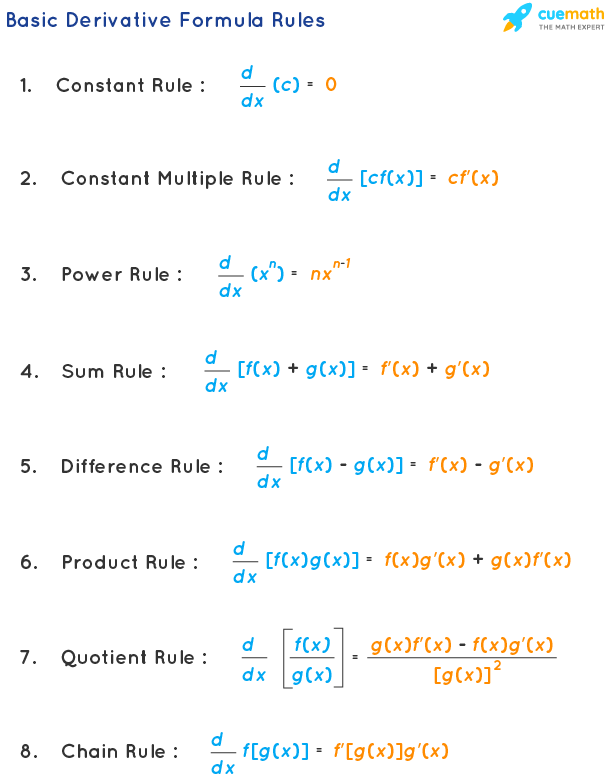
The power rule is the fastest way to differentiate single-term polynomial functions. When you have a term in the general form $ax^n$, where $a$ and $n$ are constants, the derivative is:
$$\frac{d}{dx} (ax^n) = a \cdot n x^{n-1}$$
For our specific function, $f(x) = 3x^2$:
- The coefficient $a$ is $3$.
- The exponent $n$ is $2$.
Multiply the coefficient by the exponent ($3 \cdot 2 = 6$), then subtract one from the exponent ($2 - 1 = 1$). This leaves you with $6x^1$, which simplifies directly to $6x$.
This shortcut works for any real number exponent, making it a staple tool in college-level calculus and physics courses outlined by the National Center for Education Statistics.
Proving It With the Limit Definition
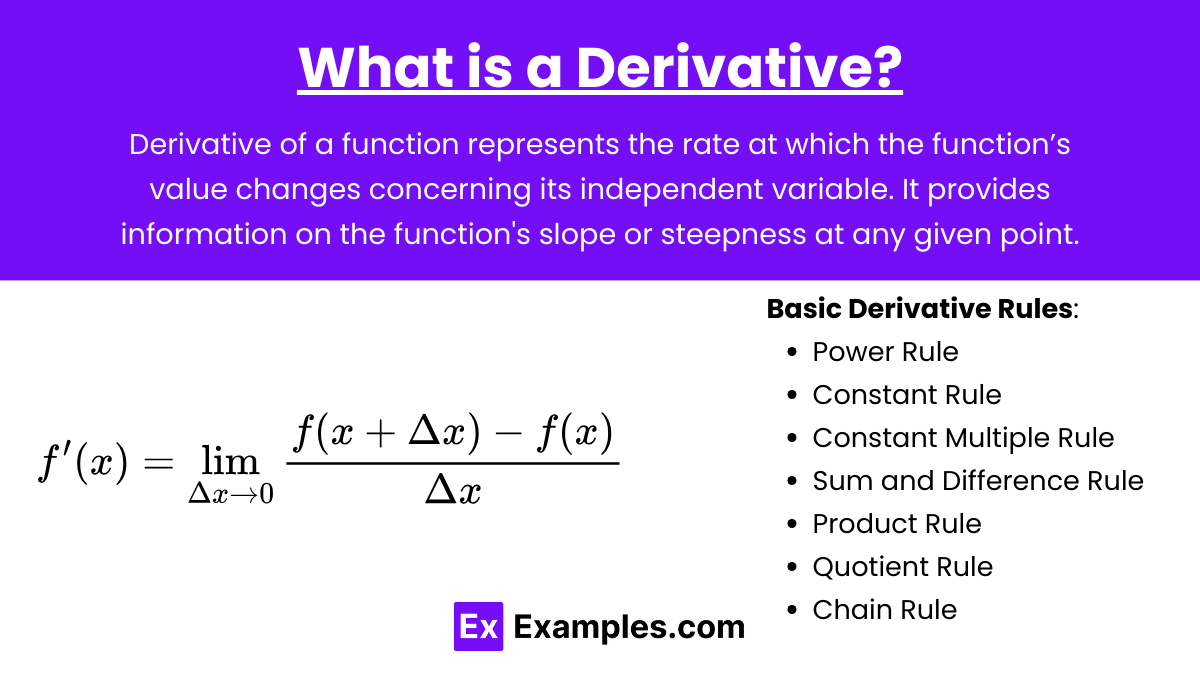
If you need to prove why $6x$ is correct without relying on shortcuts, use the formal limit definition of the derivative (also known as the difference quotient):
$$f'(x) = \lim_{h \to 0} \frac{f(x + h) - f(x)}{h}$$
Step-by-step evaluation for $f(x) = 3x^2$:
- Substitute $(x + h)$ into the function: $f(x + h) = 3(x + h)^2$.
- Expand the binomial: $(x + h)^2 = x^2 + 2xh + h^2$.
- Multiply by the coefficient: $3(x^2 + 2xh + h^2) = 3x^2 + 6xh + 3h^2$.
- Subtract the original function $3x^2$: $$(3x^2 + 6xh + 3h^2) - 3x^2 = 6xh + 3h^2$$
- Divide by $h$: $$\frac{6xh + 3h^2}{h} = 6x + 3h$$
- Evaluate the limit as $h$ approaches zero: $$\lim_{h \to 0} (6x + 3h) = 6x$$
The extra term $3h$ vanishes, leaving the exact same derivative of $6x$.
What $6x$ Means Graphically
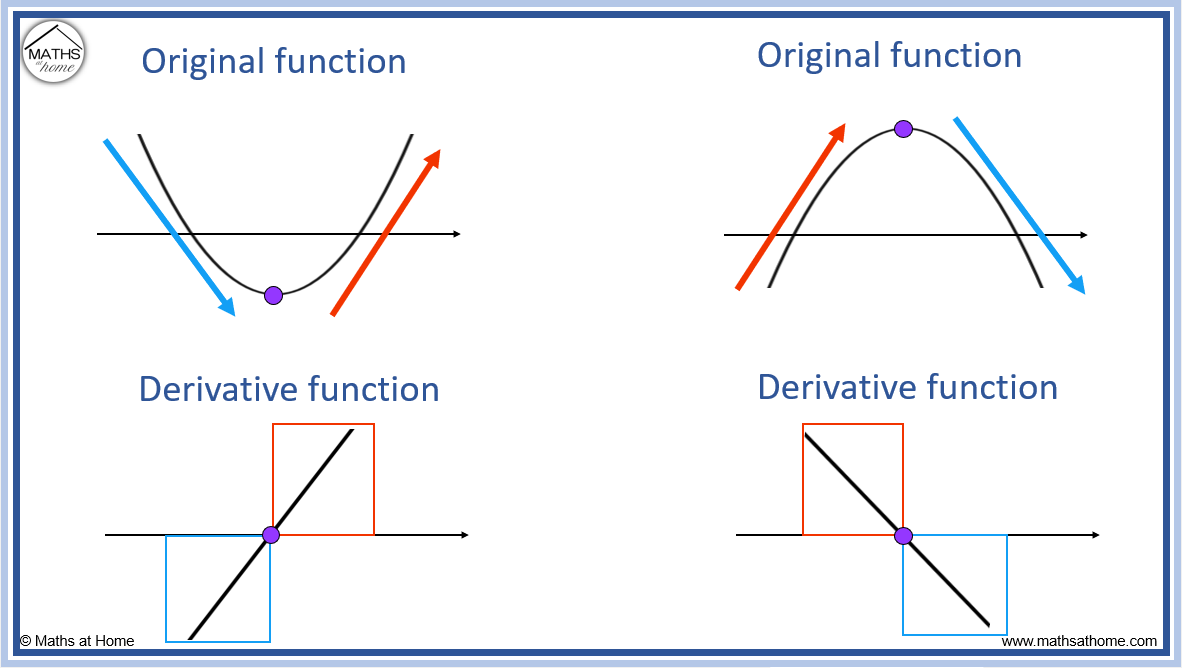
The graph of $y = 3x^2$ is a steep upward-opening parabola with its vertex at the origin $(0,0)$. Because the curve is constantly bending, its slope is never flat except at the very bottom.
- When $x = 0$: The derivative $6(0)$ equals $0$, meaning the tangent line is completely horizontal at the vertex.
- When $x = 2$: The derivative $6(2)$ equals $12$, meaning the curve rises steeply with a slope of $12$ at that specific point.
- When $x = -3$: The derivative $6(-3)$ equals $-18$, showing a downward slope on the left side of the parabola.
Real-World Applications
Instantaneous rates of change appear constantly in physical and financial sciences.
In physics, if an object's position follows the equation $s(t) = 3t^2$ meters over $t$ seconds, taking the derivative gives you its velocity function:
$$v(t) = 6t \text{ m/s}$$
If you want to know how fast the object is moving at exactly $t = 4$ seconds, substitute $4$ into the derivative to get $24$ meters per second. Further insights on motion equations can be explored via resources at the National Institute of Standards and Technology.
In business, quadratic functions frequently model cost or revenue. If total production cost is $C(x) = 3x^2$ dollars for $x$ manufactured units, the derivative $C'(x) = 6x$ represents the marginal cost. It tells management approximately how much it will cost to produce one additional unit at any given production scale.
Common Mistakes to Avoid
- Forgetting to subtract one from the exponent: A common beginner error is leaving the exponent as $x^2$ instead of reducing it to $x^1$.
- Dropping coefficients incorrectly: When applying the power rule, you must multiply the incoming exponent by the existing coefficient rather than replacing it.
- Confusing derivatives with integrals: Taking a derivative reduces the exponent by one, whereas integrating a power increases it by one.
Frequently Asked Questions
What is the second derivative of $3x^2$?
The second derivative measures the rate of change of the first derivative. Taking the derivative of $6x$ gives a constant value of $6$, which represents the constant upward acceleration of the parabolic curve.
Can I use the power rule if the exponent is negative or a fraction?
Yes. The power rule applies to any real number exponent. For instance, if you had $3x^{-2}$, the derivative would be $3(-2)x^{-3} = -6x^{-3}$.
Why does the derivative of a constant term disappear?
Constants represent flat, horizontal lines with a slope of zero. When you differentiate a constant, its rate of change is always zero, which is why isolated constants drop out of polynomial derivatives.
How does this differ from the average rate of change?
The average rate of change calculates the slope between two distinct points on a curve over an interval. The instantaneous rate of change uses limits to shrink that interval down to a single point.