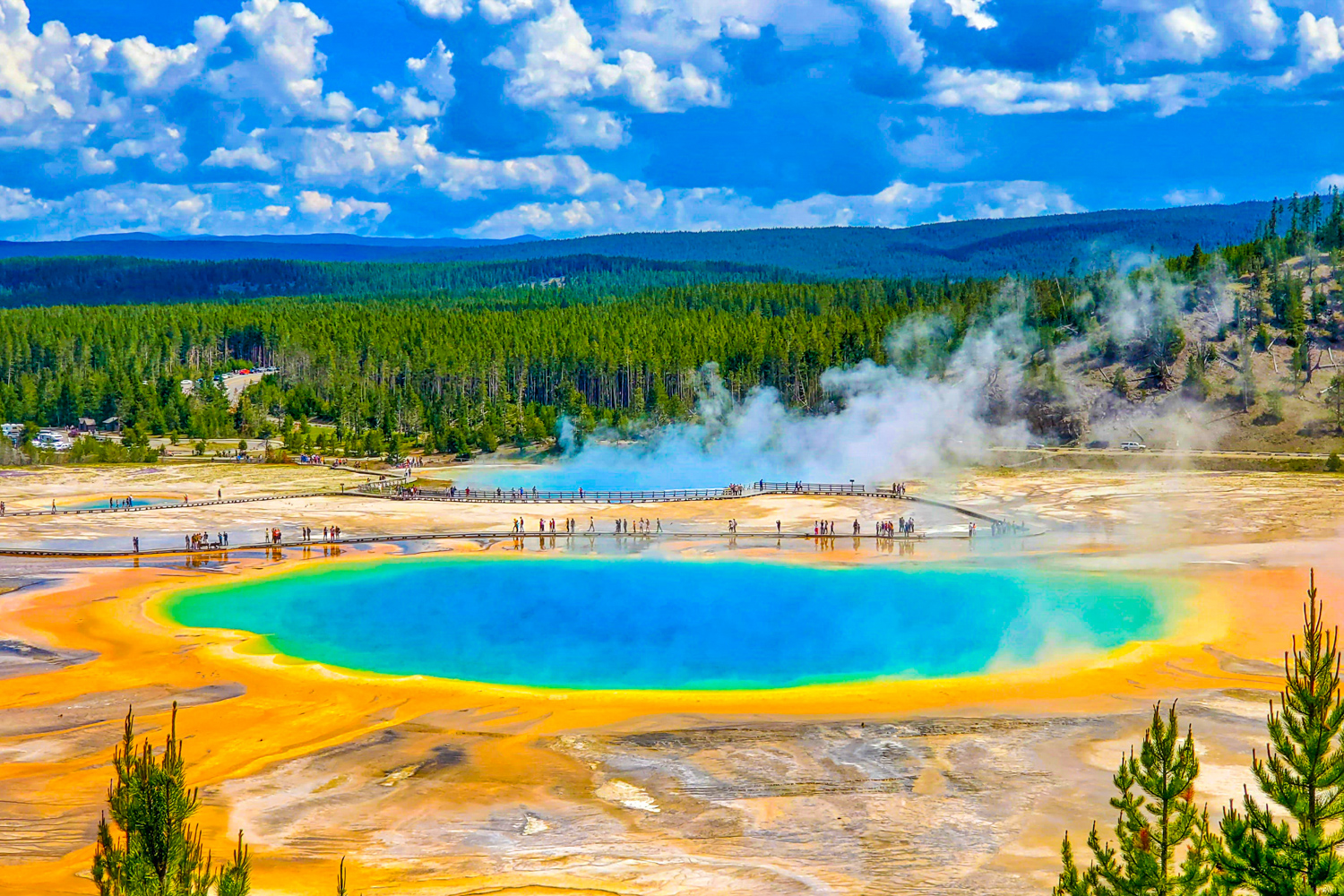
The Yellowstone supervolcano is one of the most powerful natural phenomena on Earth, capable of producing an explosive event that would reshape life as we know it. Located primarily in Wyoming, this massive volcanic system sits atop a colossal reservoir of molten rock. When people talk about a Yellowstone eruption, they aren't picturing a standard mountain peak spewing lava. They're talking about a cataclysmic caldera-forming explosion that releases thousands of cubic kilometers of volcanic material into the atmosphere.
Understanding the true scale of a Yellowstone eruption requires separating Hollywood exaggeration from actual geological science. While the system is actively monitored by the U.S. Geological Survey (USGS) Yellowstone Volcano Observatory, scientists agree that a supereruption is an extremely low-probability event in any given human lifespan. However, studying its potential blast radius, ash fallout zones, and climatic consequences helps researchers model catastrophic planetary risks and prepare emergency infrastructure.
The Geology Behind the Caldera
Yellowstone's immense power originates from a thermal hotspot deep beneath the Earth's crust. As the North American tectonic plate drifts slowly southwestward over this stationary plume of heat, it melts the overlying rock, feeding a colossal magma chamber.
The current Yellowstone caldera measures roughly 35 miles long and 45 miles wide. It was formed by three major paroxysmal eruptions over the past 2.1 million years:
- The Huckleberry Ridge Eruption: Occurred roughly 2.1 million years ago, ejecting an astonishing 2,450 cubic kilometers of volcanic debris.
- The Mesa Falls Eruption: Happened about 1.3 million years ago, releasing 280 cubic kilometers of material.
- The Lava Creek Eruption: Took place approximately 631,000 years ago, expelling 1,000 cubic kilometers of ash and lava.
These past events prove that the system operates on a multi-hundred-thousand-year cycle. Crucially, volcanologists emphasize that these past intervals do not mean an eruption is "overdue." Volcanoes do not operate on strict clockwork schedules; they erupt only when physical conditions within the magma chamber reach critical thresholds of pressure and gas saturation.
Mapping the Devastating Blast Radius
If a supereruption were to occur today, the destruction would unfold in concentric circles of varying severity, moving outward from the Yellowstone region.
Within a 50 to 100-mile radius—encompassing parts of Wyoming, Montana, and Idaho—the devastation would be total and immediate. This zone would experience the direct force of the pyroclastic flows: superheated avalanches of gas, ash, and rock racing across the landscape at hundreds of miles per hour. Buildings would be flattened, infrastructure incinerated, and survivability reduced to near zero.
As you move beyond the immediate blast zone into the regional fallout zone (stretching hundreds of miles across the American West), the primary killer shifts from pyroclastic flows to heavy volcanic ash. Accumulations of ash could reach depths of several feet across neighboring states.
Volcanic ash is not soft like campfire soot. It is pulverized, jagged rock and glass fragments. Even a few inches of wet ash can collapse residential and commercial roofs, choke internal combustion engines, short-circuit electrical grids, and render municipal water systems completely unusable. Agriculture across the breadbasket of North America would face immediate collapse due to buried crops and poisoned soil.
Global Atmospheric and Climatic Consequences
The most far-reaching impact of a Yellowstone supereruption would not be the local blast, but the atmospheric disruption that follows. Pumping thousands of cubic kilometers of sulfur dioxide and ash into the stratosphere would trigger a severe volcanic winter.
The aerosol particles would reflect incoming sunlight back into space, causing global temperatures to plummet for several years. Growing seasons would fail globally, leading to severe food shortages, disrupted supply chains, and unprecedented economic strain worldwide.
Historical analogues, such as the 1815 eruption of Mount Tambora in Indonesia, offer a glimpse of this mechanism on a smaller scale. Tambora caused the "Year Without a Summer" in 1816, resulting in widespread crop failures and famine across North America and Europe. A Yellowstone supereruption would multiply those effects on a continental or global scale, straining international civilization to its limits.
Current Monitoring and Mitigation
The USGS, alongside university researchers, monitors the Yellowstone system continuously using seismographs, GPS ground deformation sensors, satellite radar, and gas monitoring stations.
Contrary to popular myths that the volcano is "ready to blow at any moment," scientific data indicates that the vast majority of the magma chamber is currently solid or semi-solid crystals, rather than liquid melt ready to erupt. Magma chambers must reach a high melt fraction—typically 50% or more liquid—to generate enough buoyant pressure for a major eruption. Current estimates suggest the melt fraction at Yellowstone remains well below that threshold.
Emergency management agencies and the U.S. Geological Survey maintain comprehensive response protocols for various volcanic hazards. While scientists cannot prevent a supervolcanic eruption, continuous monitoring provides early warnings of increased seismic swarms, rapid ground deformation, or unusual gas venting, giving authorities time to coordinate disaster response.
Frequently Asked Questions
Is the Yellowstone supervolcano overdue for an eruption?
No. Volcanoes do not operate on a strict schedule. While past eruptions occurred roughly 600,000 to 800,000 years apart, three data points are statistically insufficient to establish a predictable cycle.
Can scientists predict when Yellowstone will erupt?
Yes and no. Scientists can detect precursor activity weeks or months in advance—such as intense earthquake swarms, rapid ground uplift, and massive changes in gas emissions—but they cannot predict the exact timing or size of an eruption years ahead of time.
Would a Yellowstone eruption wipe out all human life on Earth?
No. While it would cause catastrophic loss of life regionally, destroy global agriculture, and collapse modern economic systems, a Yellowstone supereruption is not an extinction-level event that would eradicate humanity entirely.
What is the difference between lava and volcanic ash?
Lava is molten rock that flows relatively slowly across the ground. Volcanic ash consists of microscopic, jagged particles of rock and glass blasted into the atmosphere by expanding gas, making it hazardous to breathe and destructive to machinery.