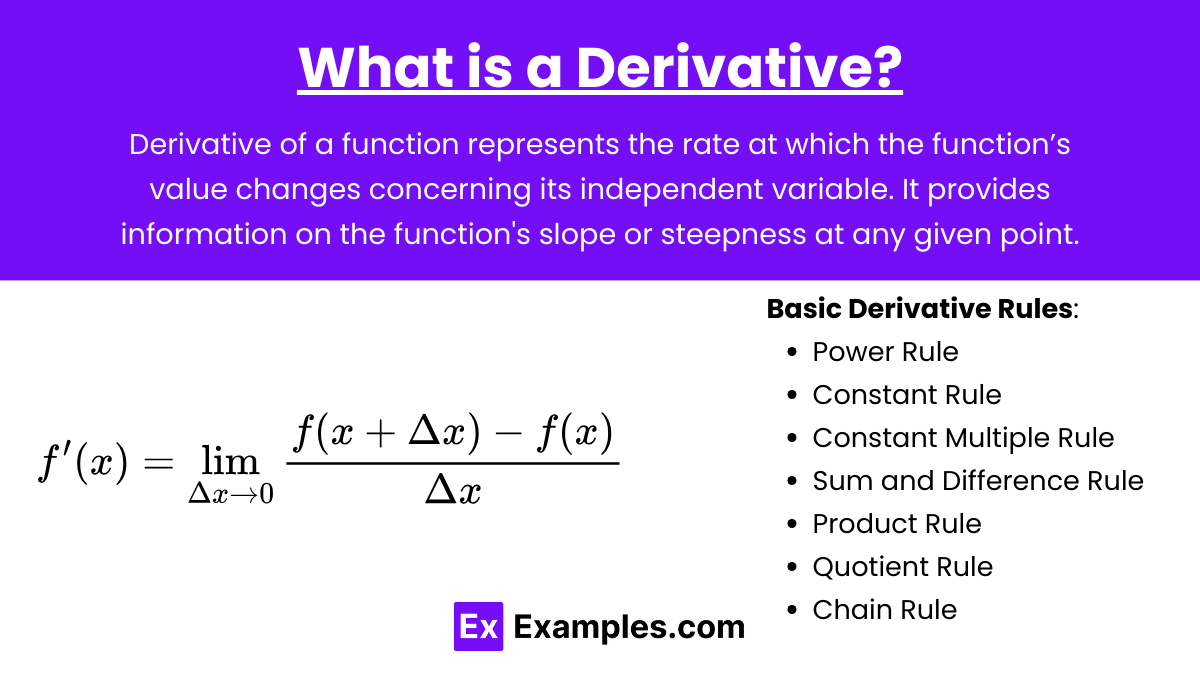
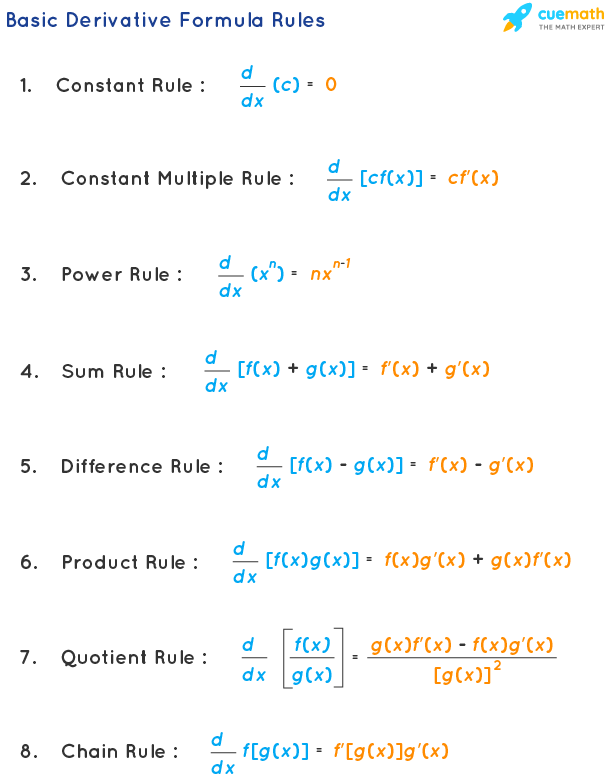
When you multiply two functions together and need to find their rate of change, you can't just take the derivative of each piece separately and multiply them. Calculus doesn't work that way. Instead, you use the multiplication rule in derivatives—often called the product rule—to find the correct slope.
If you try to differentiate $f(x) \cdot g(x)$ by multiplying individual derivatives, your answer will be wrong. The true rule requires accounting for how each function changes while the other stays fixed. Let's break down the mechanics, see it in action, and clear up the common traps that trip up students.
The Core Formula Explained
The multiplication rule states that if you have two differentiable functions, let's call them $u(x)$ and $v(x)$, the derivative of their product is:
$$\frac{d}{dx}[u(x)v(x)] = u(x)v'(x) + v(x)u'(x)$$
In plain words: keep the first function as it is, multiply it by the derivative of the second function, and add that to the second function multiplied by the derivative of the first function.
You'll often hear professors describe it this way: "First times the derivative of the second, plus the second times the derivative of the first." Order doesn't strictly matter for the addition part, but keeping a consistent rhythm prevents careless sign errors.
Step-by-Step Example
Let's find the derivative of a function made by multiplying an algebraic term and a trigonometric term:
$$f(x) = x^2 \sin(x)$$
- Identify the two parts: Let $u(x) = x^2$ and let $v(x) = \sin(x)$.
- Find their individual derivatives:
- $u'(x) = 2x$ (using the power rule)
- $v'(x) = \cos(x)$ (standard derivative of sine)
- Plug them into the product rule formula:
- $u(x)v'(x) = x^2 \cos(x)$
- $v(x)u'(x) = \sin(x) \cdot 2x = 2x \sin(x)$
- Combine the results:
$$\frac{d}{dx}[x^2 \sin(x)] = x^2 \cos(x) + 2x \sin(x)$$
That's it. You've successfully differentiated a product without expanding or guessing.
Why You Can't Just Multiply Derivatives
A common beginner mistake is assuming that the derivative of a product is simply the product of the derivatives. That is, people assume $(u \cdot v)'$ equals $u' \cdot v'$.
Let's test why that fails with a simple polynomial like $f(x) = x \cdot x = x^2$.
- We know from the power rule that the derivative of $x^2$ is $2x$.
- If the wrong assumption were true, we'd take the derivative of $x$ (which is $1$) and multiply it by the derivative of $x$ ($1$), giving us $1 \cdot 1 = 1$.
That output is completely wrong for $x^2$. The multiplication rule ensures we capture the actual geometric growth of multiplying two changing quantities together. For a deeper mathematical foundation on limits and rates of change, check out the Khan Academy Calculus Curriculum.
Extending to Three or More Functions
What happens if you have three functions multiplied together, like $f(x) = x \cdot e^x \cdot \ln(x)$? You don't have to panic. You can extend the multiplication rule by treating two of the functions as a single combined unit, or by using the expanded three-part formula:
$$\frac{d}{dx}[u \cdot v \cdot w] = u'vw + uv'w + uvw'$$
You take turns differentiating one function at a time while leaving the other two untouched, then sum the three products together.
Common Mistakes to Avoid
Even experienced calculus students stumble on specific edge cases when applying this rule. Watch out for these traps:
- Forgetting the plus sign: Mixing up addition with multiplication inside the rule formula will throw off your entire result.
- Dropping constants: If one of your functions is multiplied by a constant coefficient, make sure you distribute or carry it correctly through the derivative steps.
- Confusing it with the quotient rule: The multiplication rule uses addition in the middle, whereas the quotient rule uses subtraction and divides by the denominator squared.
For additional reference material on formal mathematical definitions, you can review the LibreTexts Calculus Textbooks.
Frequently Asked Questions
Can I use the product rule if I can just expand the expression first?
Yes, but it's often slower. For example, if you have $(x^2 + 1)(x^3 - 2)$, you could multiply it out into a standard polynomial and use the power rule term by term. However, when dealing with transcendental functions like exponentials, logarithms, or trig functions, expansion isn't an option, and the multiplication rule becomes mandatory.
Does the order of terms matter in the final answer?
No. Because addition is commutative, writing $u(x)v'(x) + v(x)u'(x)$ gives the exact same result as $v(x)u'(x) + u(x)v'(x)$. Pick whichever format looks cleanest.
How does the multiplication rule relate to the product rule in vector calculus?
In higher-level vector math, similar product rules govern dot products and cross products of vector-valued functions. The underlying principle remains identical: you differentiate components sequentially while keeping the remaining structural elements intact.