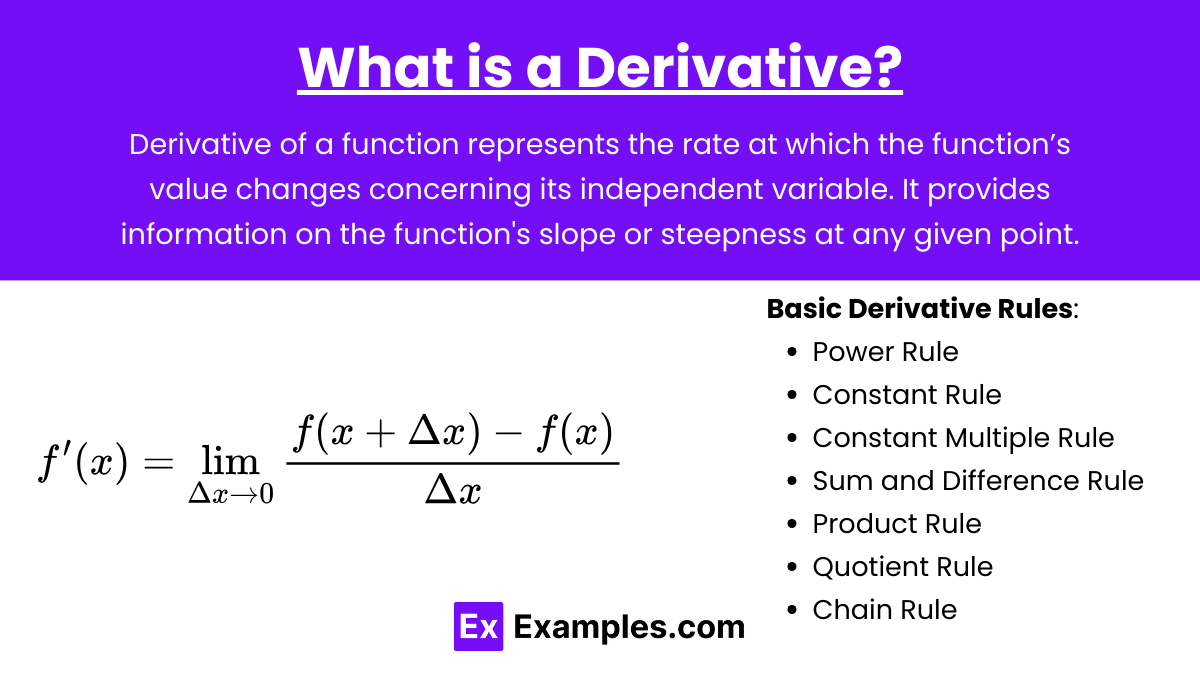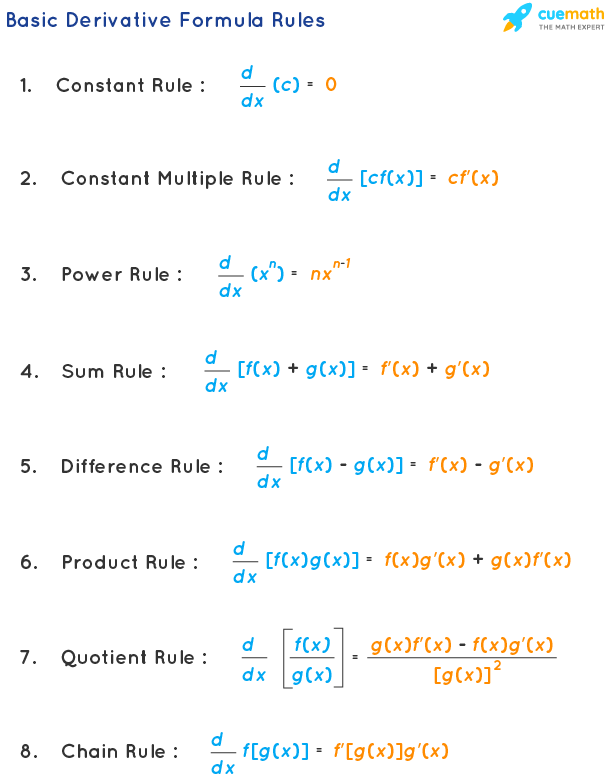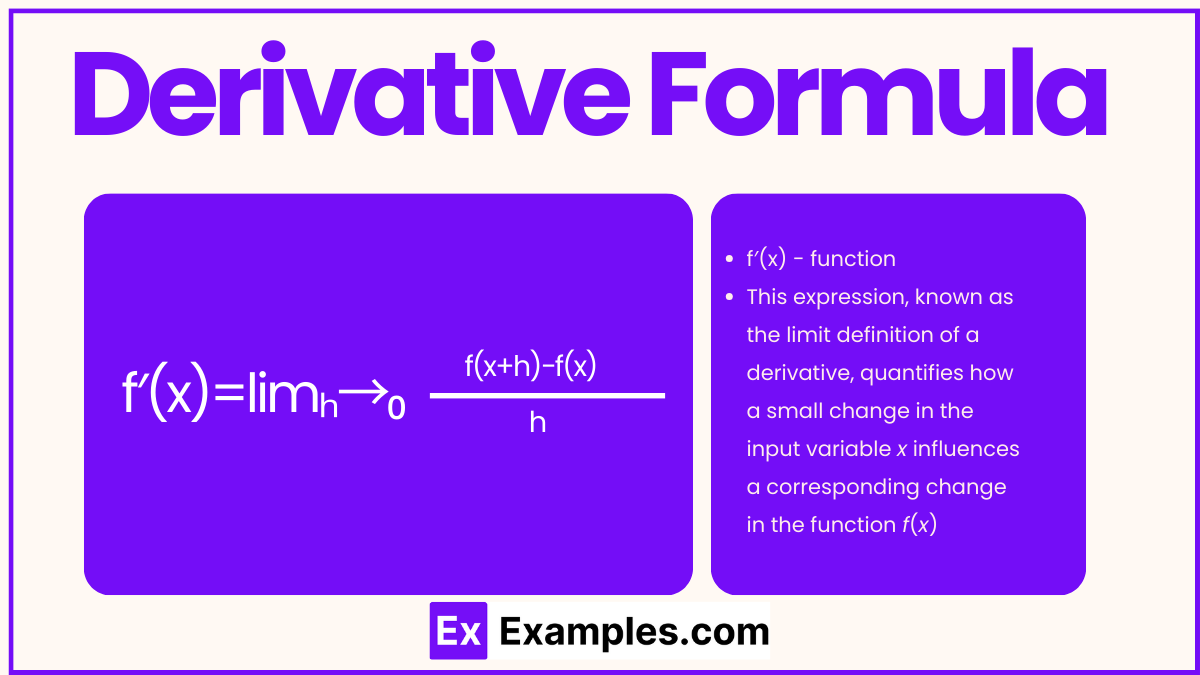
The derivative of the natural logarithm function, denoted as $\ln(x)$, is simply $\frac{1}{x}$ for any $x > 0$. This clean, deceptively simple result forms a bridge between exponential growth and linear rates of change, showing up everywhere from compound interest calculations to complex physics models. If you need to find the instantaneous rate of change for a logarithmic curve, this formula gives you the exact slope at any given point.
Understanding how to arrive at this derivative—and how to apply it when functions get more complicated—is a foundational skill in calculus. Let's break down why $\frac{d}{dx}[\ln(x)] = \frac{1}{x}$, explore how to use it with the chain rule, and look at practical applications where this mathematical tool solves real problems.
Why the Derivative of ln(x) Equals 1/x
To understand where $\frac{1}{x}$ comes from, we have to look at the inverse relationship between the natural logarithm and the natural exponential function, $e^x$. By definition, if $y = \ln(x)$, then applying exponentials to both sides gives us:
$$e^y = x$$
We can find the derivative of $\ln(x)$ by using implicit differentiation on this exponential form. Take the derivative of both sides with respect to $x$:
$$\frac{d}{dx}[e^y] = \frac{d}{dx}[x]$$
Using the chain rule on the left side, since $y$ is a function of $x$:
$$e^y \cdot \frac{dy}{dx} = 1$$
Now, solve for $\frac{dy}{dx}$:
$$\frac{dy}{dx} = \frac{1}{e^y}$$
Since we already defined $x$ as $e^y$, we substitute $x$ back into the denominator:
$$\frac{dy}{dx} = \frac{1}{x}$$
This elegant proof demonstrates why the derivative of a logarithm turns into a reciprocal fraction. As $x$ grows larger, the rate of change of $\ln(x)$ shrinks toward zero, matching the characteristic flattening shape of the logarithmic curve.
Domain Restrictions and Negative Values
Before taking the derivative of any logarithmic expression, you must pay close attention to the domain. The standard natural logarithm function $\ln(x)$ is only defined for strictly positive real numbers where $x > 0$. You cannot plug zero or negative numbers into a standard natural log because there is no real power to which $e$ can be raised to yield a negative result.
However, you will frequently encounter functions like $\ln(|x|)$ in integration and advanced calculus. The derivative of $\ln(|x|)$ is also $\frac{1}{x}$, but it expands the valid domain to include all non-zero real numbers ($x \neq 0$). When working through calculus problems, always check your initial constraints to make sure you aren't dividing by zero or evaluating logs of negative values.
Applying the Chain Rule with Logarithmic Functions
Rarely do you encounter a pure $\ln(x)$ in real-world calculus problems. Instead, you'll see composite functions where the argument inside the logarithm is an entire expression, such as $\ln(3x^2 + 5)$ or $\ln(\sin(x))$.
To handle these, you rely on the chain rule for logarithms. The general formula states that if $u$ is a differentiable function of $x$, then:
$$\frac{d}{dx}[\ln(u)] = \frac{1}{u} \cdot \frac{du}{dx} = \frac{u'}{u}$$
In plain terms: you take the derivative of the inside function and divide it by the inside function itself.
Step-by-Step Example 1: Polynomial Argument
Let's find the derivative of $f(x) = \ln(4x^3 - 2x + 1)$.
- Identify the inside function $u$: $u = 4x^3 - 2x + 1$.
- Find the derivative of the inside function $u'$: $u' = 12x^2 - 2$.
- Apply the logarithmic derivative rule $\frac{u'}{u}$:
$$f'(x) = \frac{12x^2 - 2}{4x^3 - 2x + 1}$$
You can factor a 2 out of the numerator and denominator to simplify the expression slightly, but the core application of the rule is complete.
Step-by-Step Example 2: Trigonometric Argument
Find the derivative of $g(x) = \ln(\tan(x))$.
- Let $u = \tan(x)$.
- The derivative of $\tan(x)$ is $u' = \sec^2(x)$.
- Apply the rule:
$$g'(x) = \frac{\sec^2(x)}{\tan(x)}$$
Using trigonometric identities, you can rewrite this as $\frac{1}{\cos^2(x)} \cdot \frac{\cos(x)}{\sin(x)}$, which simplifies to $\frac{1}{\sin(x)\cos(x)}$, or $2\csc(2x)$.
Logarithmic Differentiation for Complex Products
One of the most powerful uses of the natural logarithm's derivative is a technique called logarithmic differentiation. This method lets you find the derivatives of monstrous products, quotients, or functions raised to the power of other functions by taking the natural log of both sides first.
Consider a function like $y = \frac{x^3 \sqrt{x^2 + 1}}{(5x - 2)^4}$. Attempting to use the quotient rule and product rule directly would lead to an algebraic nightmare.
Instead, take $\ln$ of both sides:
$$\ln(y) = \ln\left(\frac{x^3 \sqrt{x^2 + 1}}{(5x - 2)^4}\right)$$
Using logarithm properties to expand the right side:
$$\ln(y) = 3\ln(x) + \frac{1}{2}\ln(x^2 + 1) - 4\ln(5x - 2)$$
Now, take the derivative of both sides with respect to $x$:
$$\frac{1}{y} \frac{dy}{dx} = \frac{3}{x} + \frac{1}{2}\left(\frac{2x}{x^2 + 1}\right) - 4\left(\frac{5}{5x - 2}\right)$$
Finally, multiply both sides by $y$ to isolate $\frac{dy}{dx}$, substituting back the original expression for $y$. This turns a multi-rule calculus problem into simple term-by-term differentiation. For more details on underlying principles, you can read about derivatives on Khan Academy.
Common Mistakes to Avoid
Calculus students frequently trip up on a few specific log differentiation traps. Keep these pitfalls in mind during exams and homework:
- Confusing logs with powers: The power rule ($\frac{d}{dx}[x^n] = n x^{n-1}$) applies when the variable is the base and the exponent is a constant. The derivative $\frac{1}{x}$ applies when $x$ is the argument of a natural logarithm. Don't mix them up.
- Forgetting the chain rule: If you differentiate $\ln(5x)$, the answer is NOT just $\frac{1}{5x}$. You must multiply by the derivative of the inside function ($5$), giving $\frac{5}{5x}$, which simplifies to $\frac{1}{x}$. Always multiply by $u'$.
- Ignoring absolute values in integrals: While the derivative of $\ln(x)$ is $\frac{1}{x}$, remember that integrating $\frac{1}{x}$ gives $\ln(|x|)$ because the domain of the antiderivative must match the broader domain of the reciprocal function.
Practical Applications in the Real World
Logarithmic rates of change appear whenever growth or decay scales proportionally to the current value.
In finance, continuous compound interest models rely heavily on exponential and logarithmic functions. If you need to find how fast an investment's growth rate is changing relative to time or principal amounts, logarithmic derivatives provide the exact analytical tools required.
In computer science, algorithms with logarithmic time complexity, such as binary search trees, use logarithmic functions to describe efficiency. Understanding how the slope changes helps engineers predict performance bottlenecks as data sets scale into millions of records. For official mathematical documentation and historical context on notation, consult resources like Wolfram MathWorld.
Frequently Asked Questions
What is the derivative of log base 10 of x?
For logarithms with bases other than $e$, you must convert them to the natural logarithm using the change of base formula: $\log_b(x) = \frac{\ln(x)}{\ln(b)}$. Therefore, the derivative of $\log_b(x)$ is $\frac{1}{x \ln(b)}$. For common logarithms base 10, the derivative is $\frac{1}{x \ln(10)}$.
Can you take the derivative of ln(-x)?
Yes, as long as the argument of the logarithm remains positive. If $x$ is negative, say $x = -3$, then $-x$ becomes positive ($3$), making $\ln(-x)$ valid. By the chain rule, $\frac{d}{dx}[\ln(-x)] = \frac{1}{-x} \cdot (-1) = \frac{1}{x}$. This matches the general rule for $\ln(|x|)$.
Why doesn't the derivative of ln(x) depend on the base e's value directly in the final expression?
The constant factor disappears because of how exponential and logarithmic functions scale. The base $e$ is defined such that the slope of $e^x$ at $x = 0$ is exactly 1. This unique property makes the derivative of its inverse ($\ln(x)$) equal to the clean fraction $\frac{1}{x}$ without needing messy adjustment coefficients.
What happens to the derivative as x approaches infinity?
As $x$ grows larger toward infinity, $\frac{1}{x}$ approaches zero. This tells us that while the natural log function keeps climbing higher forever, its rate of change gets progressively slower and flatter over time.