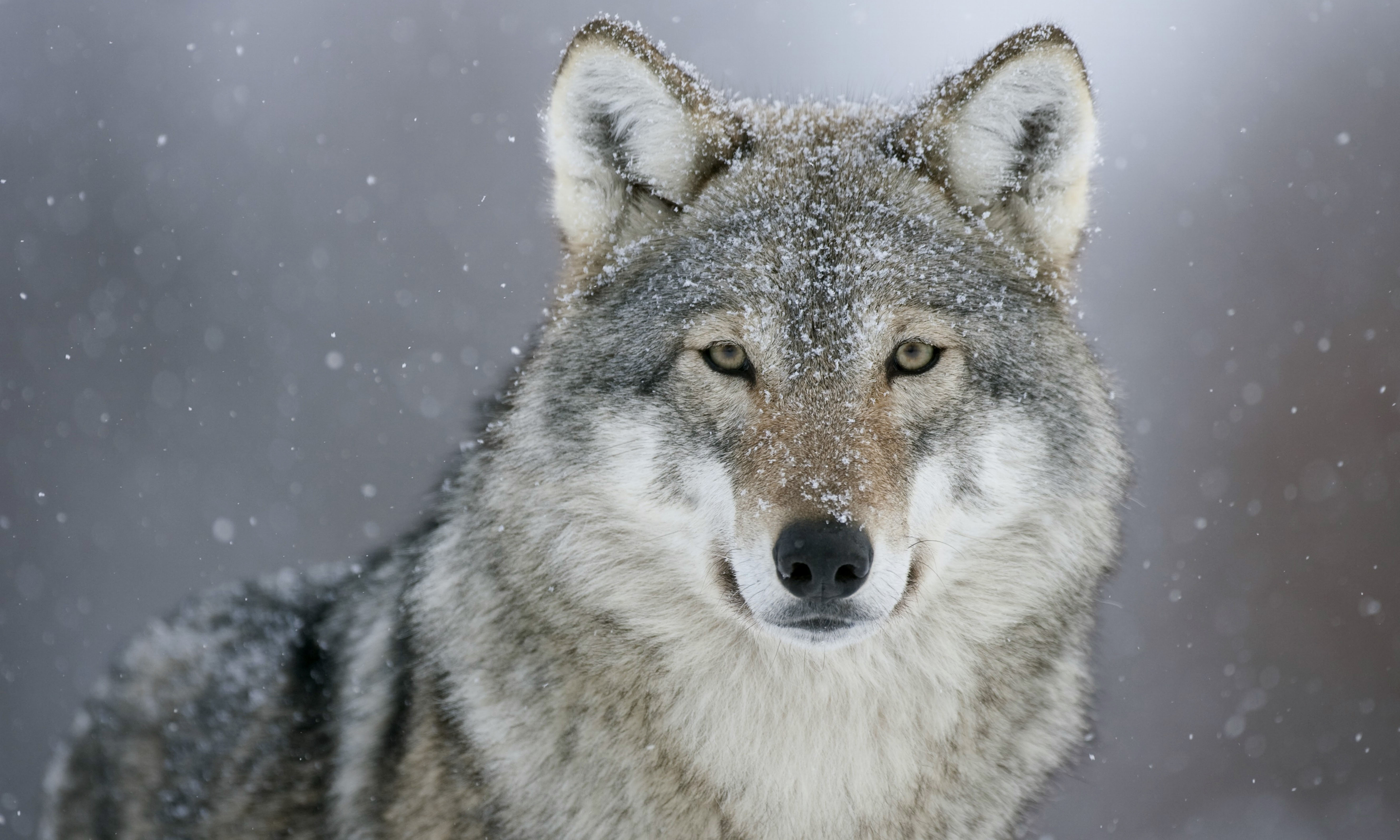
When people picture a gray wolf, they often imagine a monstrous creature standing head-to-head with an adult. Popular culture and wildlife photography frequently distort reality, making wild canines look massive through camera lens compression and thick winter coats. In truth, a direct wolf vs human size comparison reveals a different picture: while wolves are powerful apex predators, most humans actually outweigh them by a significant margin.
An average adult gray wolf stands between 26 and 32 inches tall at the shoulder and weighs from 60 to 145 pounds. Meanwhile, an adult human male averages roughly 5 feet 9 inches tall and weighs close to 197 pounds according to the Centers for Disease Control and Prevention. When a wolf stands on all fours, its back reaches roughly hip or waist height on an average person. Understanding the exact dimensions, weight classes, and physical builds of these animals helps clear up common myths.
Core Dimensions: Wolves on All Fours vs Humans Standing
To understand how a wolf measures up next to a person, it helps to look at the hard numbers. Gray wolves (Canis lupus) vary by subspecies and geography, but standard biological metrics provide a clear baseline.
- Shoulder Height: 26 to 32 inches (66 to 81 cm) for most adult gray wolves. Larger northern subspecies, such as the Northwestern wolf, can reach up to 36 inches.
- Body Length: 4.5 to 6 feet (1.4 to 1.8 m) from the tip of the nose to the base of the tail, with tails adding an extra 13 to 20 inches.
- Body Weight: 60 to 145 pounds (27 to 66 kg), with exceptional males in extreme northern climates occasionally pushing past 175 pounds.
When standing normally on all fours, a wolf's head and back align with the hip or lower waist of a standing adult human. They don't look you in the eye from above; instead, they sit below your chest level.
The Bipedal Stance Illusion
A common point of confusion arises when wolves rear up on their hind legs. Like many mammals, wolves can stretch upward to check their surroundings, reach for food, or engage in social dominance displays within the pack.
When a large male wolf stands fully vertical on its hind legs, its total reach can extend from 5 to 7 feet. This vertical stretch puts a large wolf face-to-face with an adult human. However, this stance is fleeting. Wolves rarely maintain a bipedal posture for more than a few seconds, as their skeletal structure is built for efficient quadrupedal endurance running rather than upright balancing.
Weight Discrepancies and Mass
Weight is where the biggest surprises happen in a wolf vs human size analysis. Popular media portrays wolves as heavy-set beasts that could easily crush a person. In reality, their physical appearance is deceiving.
- The Fur Factor: A wolf's dense double coat—composed of a fine insulating undercoat and coarse guard hairs—accounts for a massive portion of its visual volume. If you were to wet a wolf, its apparent body size would shrink by nearly half.
- Lean Muscle Composition: Wolves are engineered for long-distance trotting and sustained chases. Their bones are relatively light, and their muscle structure is lean and narrow-chested, reducing dead weight.
- The Scale Test: Because an average adult human male weighs nearly 200 pounds and an average female weighs around 170 pounds, a typical 90-pound gray wolf is actually lighter than most humans. Only the largest alpha males in deep winter populations approach or exceed human weight classes.
Regional Variations: Subspecies Size Differences
Not all wolves are built the same. Climate plays a major role in animal sizing, a principle known as Bergmann's Rule, which states that animals in colder regions evolve larger body masses to retain heat.
Northern and Arctic Wolves
Wolves living in the sub-Arctic, Alaska, and northern Canada are the heavyweights of the canine world. A mature male Northwestern wolf can easily weigh between 130 and 175 pounds and possess a massive skull and wide chest. Next to a human, these northern specimens look and feel much more imposing.
Southern and Arabian Wolves
At the opposite end of the spectrum, smaller subspecies like the Arabian wolf (Canis lupus arabs) inhabit arid deserts. These diminutive canines weigh as little as 35 to 45 pounds and stand barely 20 inches at the shoulder. They are dwarfed by humans, resembling medium-sized domestic dogs more than storybook predators.
Wolves Compared to Domestic Dogs and Large Predators
People often confuse wolves with large domestic breeds like German Shepherds or Great Danes. While a large German Shepherd might weigh 85 pounds, a gray wolf features longer legs, a wider skull, and much stronger jaws capable of crushing heavy bones.
At the same time, wolves are thoroughly outmatched by other large carnivores. According to data from the National Park Service, grizzly bears and brown bears frequently outweigh wolves by 400 to 600 pounds, routinely displacing wolf packs from their kills through sheer size dominance. Wolves survive competing with larger predators through high intelligence, endurance, and complex pack coordination rather than individual physical mass.
Frequently Asked Questions
Do wolves look bigger in person or in photos?
Wolves almost always look larger in photographs than they do in real life. Photographers often use telephoto lenses that compress backgrounds and emphasize the animal's thick fur and wide facial structure, creating an optical illusion of massive scale.
Can an average human overpower a wolf?
While a wolf is lighter than an average adult human, wild canines possess specialized predatory adaptations, including razor-sharp canine teeth, extreme bite force, and intense survival instincts. Physical confrontations in the wild are exceptionally dangerous, and wildlife agencies advise maintaining a respectful distance.
How do female wolves compare in size to males?
Sexual dimorphism is pronounced in wolf populations. Female gray wolves are typically 20% smaller and lighter than males within the same pack, usually averaging 60 to 100 pounds.
Are red wolves larger than gray wolves?
No. The red wolf (Canis rufus) is a distinct, highly endangered species native to the southeastern United States that typically weighs between 45 and 80 pounds, placing it closer in size to a large coyote than a standard gray wolf.