The ulna sits quietly on the medial side of the forearm, sharing space with the more frequently discussed radius. While people often focus on the humerus or radius during arm injuries, the ulna acts as the main stabilizing pillar for both the elbow and the wrist. If you rotate your forearm or grip a heavy object, you're relying heavily on this long bone. Without its structural integrity, everyday tasks like turning a doorknob or opening a jar become painful or impossible.
Understanding this bone requires looking past basic textbook definitions and examining its specific structural landmarks, biomechanical roles, and common clinical vulnerabilities. Orthopedic specialists and physical therapists know that overlooking minor ulnar issues can lead to chronic wrist pain or permanent grip weakness. Let's break down how the ulna is built, how it functions in daily movement, and what happens when things go wrong.
Gross Anatomy and Structural Landmarks
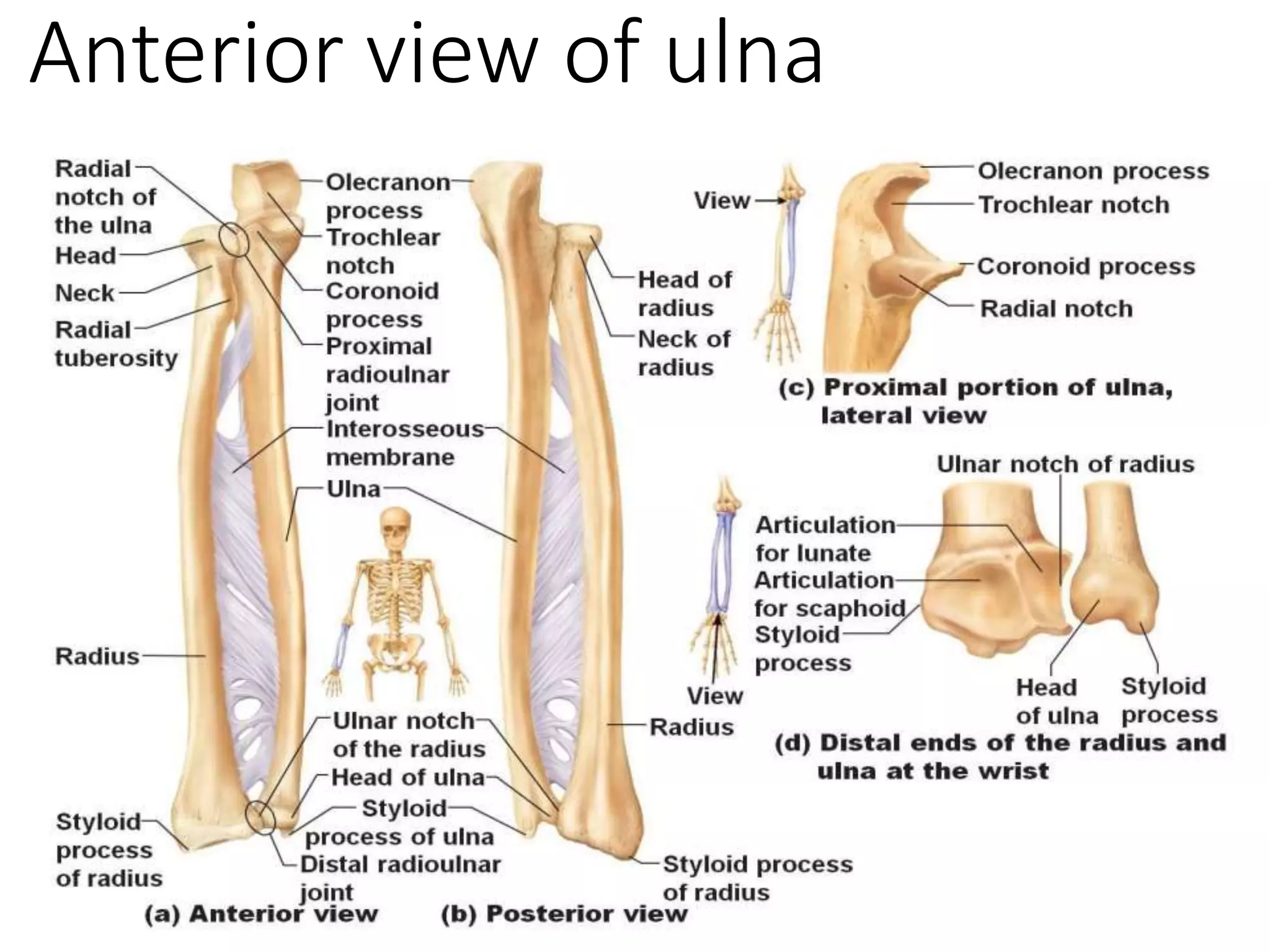
The ulna is a paired long bone running parallel to the radius, positioned on the side of the little finger. Like other long bones, it features a shaft and two distinct extremities: the proximal end near the elbow and the distal end near the wrist.
At the proximal end, the ulna forms a major part of the hinge joint at the elbow. It features two prominent projections: the olecranon process and the coronoid process.
- Olecranon Process: This serves as the bony tip of the elbow. It fits directly into the olecranon fossa of the humerus when you straighten your arm, preventing hyperextension.
- Coronoid Process: This forward-projecting lip forms the lower boundary of the semi-circular trochlear notch, locking securely with the humerus.
- Trochlear Notch: A deep, wrench-shaped articular surface that grips the humeral trochlea, allowing smooth flexion and extension.
- Radial Notch: A small depression on the lateral side of the coronoid process where the head of the radius articulates, forming the proximal radioulnar joint.
Moving down the shaft, the bone tapers gradually from top to bottom. The sharp lateral border gives attachment to the interosseous membrane, a thick fibrous sheet that binds the ulna and radius together. This membrane distributes forces evenly across the forearm when you push or lift objects.
At the distal end, you find a much smaller structure compared to the proximal region. The distal ulna consists of the rounded ulnar head and a small downward projection called the ulnar styloid process. This region articulates with the radius via the ulnar notch and sits just proximal to the triangular fibrocartilage complex (TFCC), which cushions the wrist joint. You can read more about wrist stabilization structures at the American Academy of Orthopaedic Surgeons.
Biomechanical Function and Movement
The ulna doesn't just sit there; it directs how the forearm moves and handles loads. While the radius rotates around the ulna during pronation and supination, the ulna remains relatively fixed, acting as the stable axis of the forearm.
When you turn your palm downward, the radial head spins against the proximal ulna while the distal radius swings over the distal ulnar head. The entire complex relies on the ulna to keep the forearm from buckling under rotational torque.
Furthermore, the ulna handles significant load-sharing during weight-bearing activities. When you fall on an outstretched hand, roughly eighty percent of the impact force travels through the radius to the wrist, while the remaining twenty percent travels through the ulnar side. If the ulna is too long or too short relative to the radius—a condition known as ulnar variance—that force distribution shifts abnormally, leading to cartilage wear and chronic pain. For detailed physiological breakdowns of joint mechanics, check resources at National Institutes of Health.
Common Clinical Pathologies and Injuries
Because of its superficial position and structural demands, the ulna is vulnerable to specific fractures, nerve compression syndromes, and chronic wear. Recognizing these conditions early prevents long-term disability.
Ulnar Shaft and Elbow Fractures
Fractures of the ulna often happen during direct trauma, such as blocking a blow with your arm, which results in a classic nightstick fracture. When a fracture occurs alongside a dislocation of the radial head, doctors diagnose a Monteggia fracture-dislocation. These injuries require precise anatomical reduction, sometimes using plates and screws, to restore normal forearm rotation.
At the elbow, fractures of the olecranon are common after a direct fall onto the elbow. Because the triceps tendon attaches directly to the olecranon, a broken fragment often pulls upward, disrupting the patient's ability to straighten the arm against resistance.
Ulnar Impaction Syndrome
Ulnar impaction happens when the distal ulna is longer than the radius (positive ulnar variance), causing it to grind against the carpal bones of the wrist, specifically the lunate and triangular fibrocartilage. Over time, this repetitive abutment causes chronic pain on the pinky side of the wrist, swelling, and clicking during movement. Treatment ranges from physical therapy and anti-inflammatory medications to surgical shortening of the bone.
Ulnar Nerve Entrapment
While the ulnar nerve isn't part of the bone itself, it runs directly through a tight tunnel right against the medial epicondyle of the humerus and passes near the elbow's ulnar groove. Commonly known as the funny bone area, chronic pressure or repetitive bending of the elbow stretches this nerve, leading to cubital tunnel syndrome. Patients experience numbness in the ring and pinky fingers, hand weakness, and clumsiness.
Frequently Asked Questions
Why is the ulna called the forgotten bone?
People often focus on the radius because it connects directly to the hand and moves during rotation, or they focus on the humerus because of its size. However, the ulna is essential for elbow stability and forearm structure.
Can you move your arm if your ulna is broken?
Movement is usually severely limited and painful. Because muscles like the triceps and forearm flexors attach to the ulna, attempting to move the arm pulls on the fractured fragments, causing sharp pain and instability.
What causes ulnar variance to change?
Ulnar variance can be congenital, meaning you were born with a longer or shorter ulna, or it can develop after a fracture heals improperly or if the growth plate closes prematurely in younger athletes.
How is ulnar nerve entrapment treated at home?
Mild cases improve by avoiding prolonged elbow flexion, using a soft elbow splint at night, and modifying repetitive workplace activities. Persistent numbness requires evaluation by a hand specialist.