Introduction
Plant cells rely on specialized internal structures to capture sunlight, produce energy, and manufacture the pigments that give leaves, flowers, and fruits their distinct colors. These versatile organelles are known as plastids. While chloroplasts get the most attention for driving photosynthesis, the broader family of plastids handles everything from nutrient storage to stress response.
Understanding how these cellular components operate provides a clear picture of how plants convert light into chemical energy and sustain nearly all life on Earth. Let's examine how plastids are structured, how they execute photosynthesis, and why their adaptability matters for modern agriculture.
Origins and Types of Plastids
Plastids are ancient organelles that share an evolutionary history with free-living cyanobacteria. Through a process called endosymbiosis, an ancestral eukaryotic host cell engulfed a photosynthetic bacterium over a billion years ago. Instead of digesting the microbe, the host established a symbiotic relationship with it. Over evolutionary time, most of the bacterial genes transferred to the host cell nucleus, transforming the symbiont into an integrated cellular organelle.
All plastids develop from precursor cells called proplastids, which are found in the meristematic tissues of growing plants. Depending on environmental signals and developmental cues, proplastids differentiate into several specialized forms:
- Chloroplasts: The green, chlorophyll-containing plastids responsible for photosynthesis.
- Chromoplasts: Pigmented plastids containing carotenoids that give bright yellow, orange, and red hues to flowers and ripe fruits, attracting pollinators and seed dispersers.
- Leucoplasts: Non-pigmented plastids specialized in bulk storage. These include amyloplasts (storing starch), elaioplasts (storing lipids), and proteinoplasts (storing proteins).
- Amyloplasts: A specific type of leucoplast found heavily in roots and tubers like potatoes, dense with starch grains used for energy storage and gravity sensing.
Anatomy of a Chloroplast
To understand photosynthesis at the cellular level, you need to look closely at chloroplast architecture. A typical plant chloroplast is lens-shaped, measuring roughly five micrometers in length, and is enclosed by a double-membrane envelope consisting of an outer membrane and an inner membrane. These membranes create a selective barrier separating the chloroplast's internal chemistry from the surrounding cytoplasm.
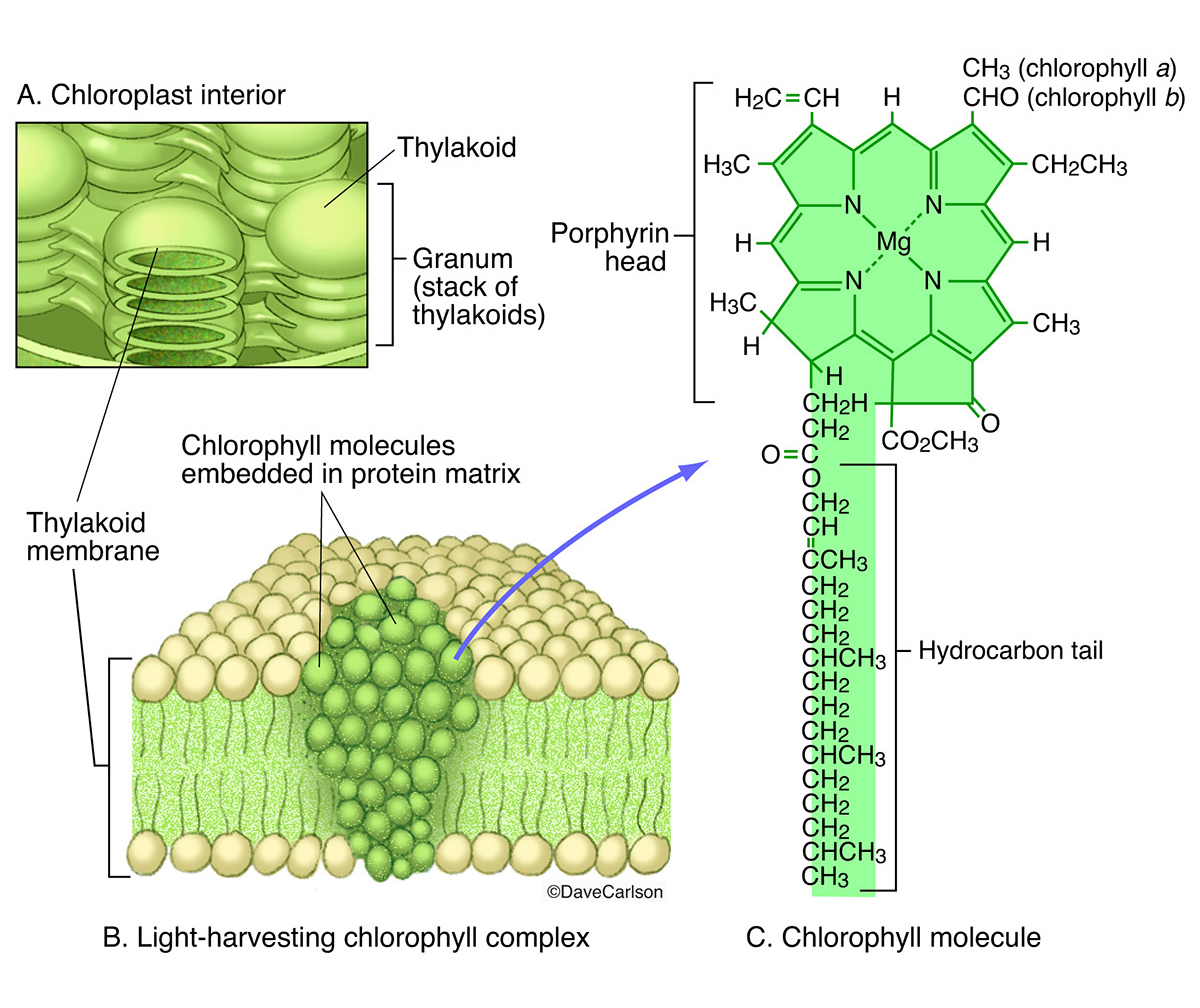
Inside the inner membrane lies a fluid-filled space called the stroma. The stroma contains circular DNA, ribosomes, and the enzymes necessary for synthesizing organic molecules. Suspended within the stroma is a complex network of interconnected membrane sacs known as thylakoids.
Thylakoids stack together in coin-like columns called grana. The thylakoid membrane holds the light-absorbing pigments, such as chlorophyll a and chlorophyll b, along with the electron transport proteins that drive the first phase of photosynthesis. This intricate folding maximizes surface area, allowing a single microscopic cell to harvest light efficiently.
The Mechanics of Photosynthesis
Photosynthesis occurs in two sequential stages: the light-dependent reactions and the light-independent reactions (commonly known as the Calvin cycle). Both take place within the chloroplast, coordinated between the thylakoid membranes and the surrounding stroma.
Light-Dependent Reactions
The light-dependent reactions take place across the thylakoid membranes. When photons strike chlorophyll molecules, they excite electrons to a higher energy state. These energized electrons move through a series of protein complexes embedded in the membrane, known as the electron transport chain.
Water molecules are split to replace the lost electrons, releasing oxygen gas as a byproduct. This splitting of water also generates protons, creating a concentration gradient across the thylakoid membrane. As protons flow back into the stroma through ATP synthase, they drive the formation of adenosine triphosphate (ATP) and nicotinamide adenine dinucleotide phosphate (NADPH). These two molecules act as short-term energy carriers for the next stage.
The Calvin Cycle
The ATP and NADPH produced in the thylakoid membranes move into the stroma to fuel the Calvin cycle. This phase does not require direct light, though it relies on the products of the light reactions.
During the Calvin cycle, enzymes such as RuBisCO fix carbon dioxide from the atmosphere into organic carbon molecules. Through a series of carbon-fixation, reduction, and regeneration steps, the plant converts these carbon molecules into glyceraldehyde-3-phosphate (G3P), which is subsequently used to build glucose, cellulose, and starch.
Environmental Factors Affecting Plastid Efficiency
Plant cells adjust their plastid composition in response to changing environmental conditions. When light levels shift, plants can alter the number of grana stacks and regulate pigment concentrations to prevent photoinhibition, which occurs when excessive light damages the photosynthetic machinery.
Temperature also plays a major role. Extreme heat can denature the enzymes involved in the Calvin cycle and damage thylakoid membranes, triggering stress responses that temporarily shut down photosynthesis to protect the cell. Similarly, nutrient availability—particularly nitrogen, iron, and magnesium—directly limits chlorophyll synthesis and protein production within the chloroplast.
You can explore more about plant physiology and cell adaptation through resources provided by the National Science Foundation and academic overviews from the Smithsonian Institution.
Applications in Agriculture and Biotechnology
Crop science leverages our understanding of plant plastids to address global challenges. By modifying nuclear and plastid genomes through plant biotechnology, researchers work to improve photosynthetic efficiency in staple crops like rice and wheat. Enhanced carbon fixation pathways can increase biomass accumulation and crop yields under drought stress.
Furthermore, plant pigments derived from chromoplasts serve vital commercial roles. Natural colorants extracted from flowers and fruits replace synthetic dyes in food and cosmetics. Understanding how plastids differentiate also helps food scientists manage ripening processes, extending shelf life and improving nutritional profiles in commercial crops.
Frequently Asked Questions
What is the main difference between a chloroplast and a chromoplast?
Chloroplasts contain high concentrations of chlorophyll and specialize in photosynthesis. Chromoplasts lack chlorophyll but accumulate carotenoid pigments, providing red, orange, and yellow colors to petals and ripe fruits to attract animals.
Can non-green plant parts perform photosynthesis?
Stems, unripe fruits, and developing seeds often contain chloroplasts or precursors called chloroplast-like plastids that contribute partially to their own energy needs through photosynthesis, though leaves remain the primary site.
How do plastids reproduce inside a plant cell?
Plastids contain their own circular DNA and ribosomes, independent of the plant cell nucleus. They multiply by binary fission, dividing within the cytoplasm as the host plant cell grows and divides.
Why are leucoplasts important if they do not contain pigments?
Leucoplasts specialize in storing essential nutrients. Amyloplasts store large amounts of starch to supply energy during germination or winter dormancy, while elaioplasts store lipids needed for cellular repair and hormone synthesis.