When you look at a lush green forest or a single houseplant on your windowsill, you're looking at millions of microscopic energy factories. At the center of this green world is chlorophyll, the pigment that captures sunlight and drives photosynthesis. But if you zoom in past the plant cell wall and into the cell itself, where does this pigment actually live?
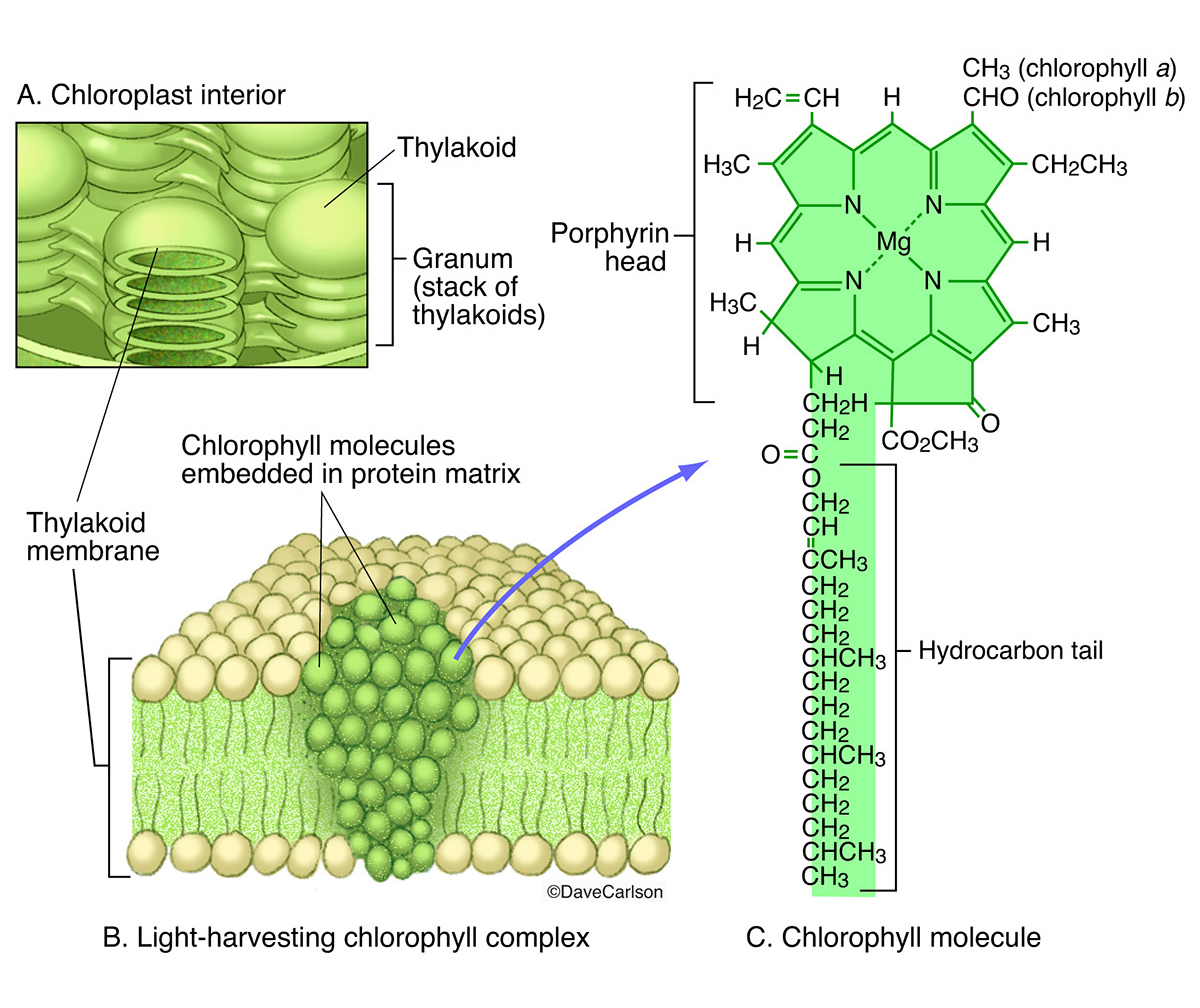
Chlorophyll is found embedded specifically within the thylakoid membranes inside the chloroplast. While chloroplasts serve as the overall organelle for photosynthesis, chlorophyll molecules aren't just floating freely in the fluid interior. They are anchored tightly within protein-pigment complexes across these folded, disk-like membrane structures, perfectly positioned to intercept light photons.
Understanding this precise microscopic architecture reveals how plants convert sunlight into chemical energy without burning up or wasting solar radiation. Let's look inside the plant cell to see how chloroplast structure makes photosynthesis possible.
The Architecture of a Chloroplast
To understand where chlorophyll resides, you need to map out its home: the chloroplast. Chloroplasts are specialized organelles found in plant cells and green algae. They evolved from ancient cyanobacteria through endosymbiosis, which explains why they retain their own circular DNA and double-membrane envelope.
An outer membrane and an inner membrane enclose the entire organelle, leaving an intermembrane space between them. Inside this boundary lies the internal aqueous fluid called the stroma, which contains enzymes, ribosomes, and chloroplast DNA. Suspended within this stroma is a complex network of internal membranes known as the thylakoid system.
The stroma isn't just empty fluid. It's where the light-independent reactions (the Calvin cycle) take place, turning carbon dioxide into glucose using the energy packets generated by the light-dependent stage.
Inside the Thylakoid Membrane
The thylakoid system is where the physical magic of light absorption happens. Thylakoids are flattened, sac-like membranes. In most plant chloroplasts, they stack neatly on top of one another like rolls of coins. These stacks are called grana (singular: granum), while the unstacked membrane channels connecting different grana are called stromal lamellae.
This stacking isn't random. It maximizes surface area within a tiny volume, allowing millions of chlorophyll molecules to pack into a single chloroplast.
Within these thylakoid membranes, chlorophyll molecules don't float by themselves. They bind to specific proteins to form photosystems—specifically Photosystem I (PSI) and Photosystem II (PSII). These photosystems act like solar panels. When a photon hits a chlorophyll molecule in the antenna complex, an electron gets excited and jumps to a primary electron acceptor, kicking off the electron transport chain that generates ATP and NADPH.
Why Chlorophyll Location Matters for Photosynthesis
Location dictates function in cellular biology. If chlorophyll were dissolved randomly in the cell cytoplasm or sloshing around in the chloroplast stroma, it wouldn't be able to maintain the directional electron flow required to split water molecules and create a proton gradient.
By embedding chlorophyll inside the hydrophobic core of the thylakoid lipid bilayer, the plant achieves three critical goals:
- Stable orientation: The porphyrin ring (the light-absorbing "head" of the chlorophyll molecule) faces outward toward the stroma/lumen interface where it can interact with proteins, while the phytol tail anchors it securely inside the lipid membrane.
- Proton concentration: As electrons move through the transport chain, protons are pumped from the stroma into the interior of the thylakoid (the lumen). This creates a steep electrochemical gradient used by ATP synthase to make cellular energy.
- Efficient energy transfer: Packing chlorophyll molecules closely together in photosystems allows for resonance energy transfer, where absorbed light energy hops rapidly from one pigment molecule to the next until it reaches the reaction center.
If you want to read more about the broader biochemical pathways of plant cellular respiration and light capture, check out the National Science Teaching Association resources or explore research summaries from the National Institutes of Health.
Other Pigments in the Chloroplast
While chlorophyll a and chlorophyll b get most of the attention, they aren't the only pigments housed inside the thylakoid membranes. Chloroplasts also contain accessory pigments like carotenoids (which provide yellow, orange, and red hues) and xanthophylls.
These accessory pigments serve two main purposes: they absorb wavelengths of light that chlorophyll misses, broadening the usable solar spectrum, and they act as safety shields. When light intensity gets too high, carotenoids absorb excess energy and dissipate it as heat through a process called non-photochemical quenching, preventing the delicate photosynthetic machinery from burning out.
Common Misconceptions About Chlorophyll
Cell biology often invites confusion because diagrams simplify complex 3D spaces into flat illustrations. Clearing up these common myths helps solidify how plant cells actually function:
- Myth: Chlorophyll fills the entire chloroplast. Reality: Chlorophyll is strictly confined to the thylakoid membranes. The stroma is completely separate and contains no chlorophyll.
- Myth: Plants only have green pigments. Reality: Leaves contain multiple pigments year-round. In autumn, chlorophyll breaks down first, revealing the underlying carotenoids that create yellow and orange fall foliage.
- Myth: Chlorophyll is unique to plants. Reality: While land plants and green algae use chlorophyll a and b, other photosynthetic organisms like cyanobacteria and red/brown algae use modified variants like chlorophyll c or d.
For deeper technical details on plant pigment chemistry, you can review publications hosted by the Smithsonian Institution.
Frequently Asked Questions
Is chlorophyll found in animal cells?
No. Animals are heterotrophs, meaning they must consume other organisms for energy. Animal cells lack chloroplasts entirely and cannot perform photosynthesis.
What is the chemical difference between chlorophyll a and chlorophyll b?
Chlorophyll a has a methyl group ($\text{-CH}_3$) at a specific position on its porphyrin ring, whereas chlorophyll b has a formyl group ($\text{-CHO}$). This slight chemical tweak shifts the wavelengths of light they absorb best, allowing plants to capture a wider range of solar energy.
Why do leaves look green?
Chlorophyll absorbs red and blue light from the visible light spectrum very efficiently but reflects green light. Because green light is reflected off the leaf surface and enters our eyes, leaves appear green to human observers.
Can chloroplasts move inside the cell?
Yes. Chloroplasts can reposition themselves along the cytoskeleton through cytoplasmic streaming. If light is too weak, they spread out to maximize exposure; if sunlight becomes dangerously intense, they cluster together along cell walls to minimize photodamage.