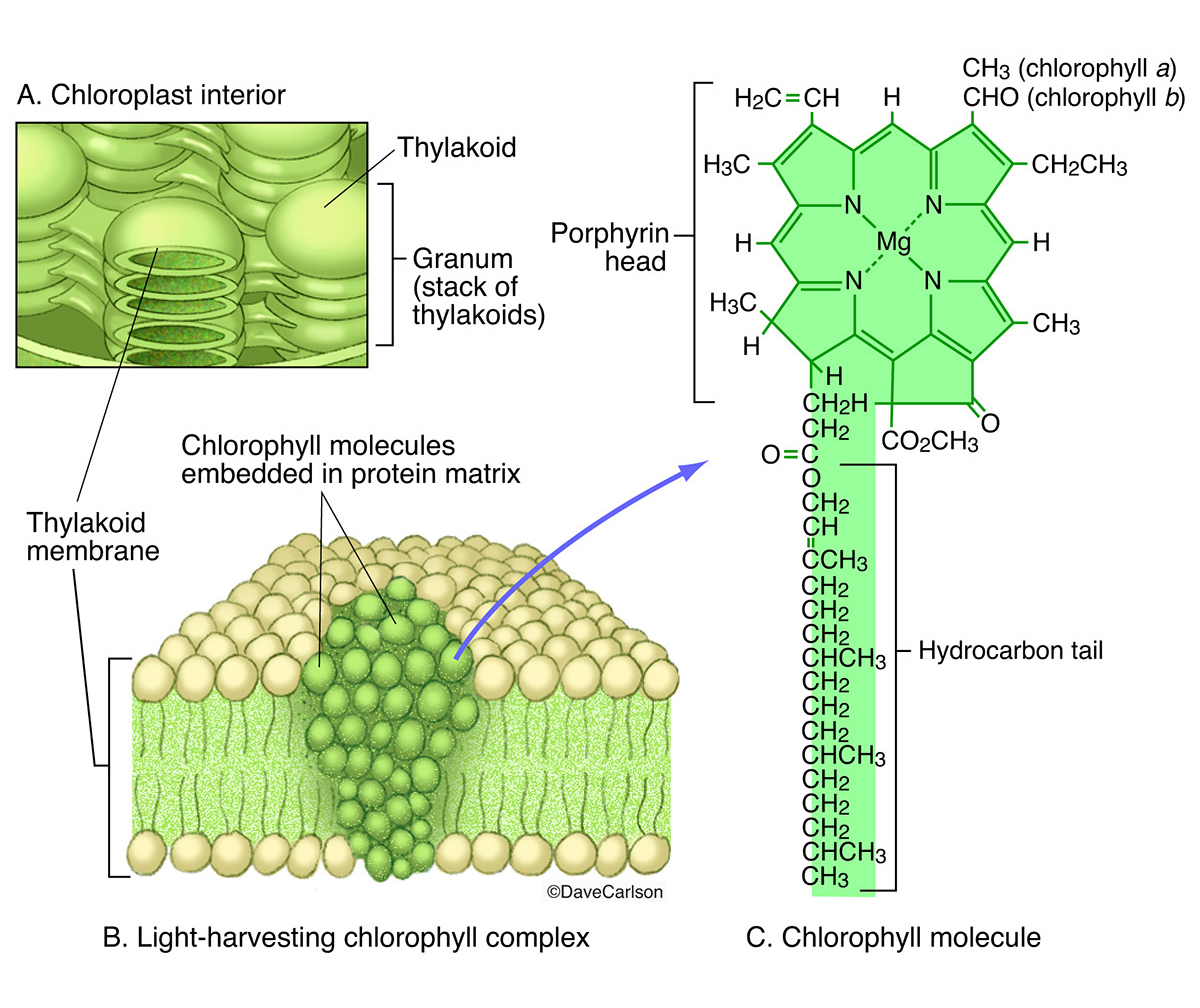
Chlorophyll is embedded directly within the thylakoid membranes inside plant chloroplasts. Specifically, chlorophyll molecules are anchored within protein-pigment complexes called photosystem I and photosystem II, as well as light-harvesting complexes, positioned precisely within the lipid bilayer of these internal sac-like structures.
Understanding this precise microscopic location explains how plants capture solar energy. While chloroplasts float freely in the cytoplasm of plant cells as double-membrane organelles, chlorophyll isn't floating loosely inside them. It's locked into specific structural proteins within the thylakoids, which stack together to form structures called grana. This architecture maximizes surface area for light absorption during photosynthesis.
The Architecture of the Chloroplast
To understand where chlorophyll lives, you need to map out the internal compartments of a chloroplast. A single plant cell can contain anywhere from 20 to 100 chloroplasts, each functioning as a microscopic solar power plant.
The organelle features a protective double-membrane envelope consisting of an outer membrane and an inner membrane, separated by an intermembrane space. Inside this envelope lies a fluid-filled matrix called the stroma. The stroma contains dissolved enzymes, DNA, ribosomes, and a maze of internal membranes known as the thylakoid system.
- Outer and Inner Membranes: These regulate what enters and leaves the chloroplast, maintaining a stable internal environment.
- Stroma: The site of the light-independent reactions (the Calvin cycle), where sugars are synthesized from carbon dioxide using chemical energy generated by the light-dependent reactions.
- Thylakoids: Disks formed from continuous inner membrane folding. These stacked disks are called grana, and they represent the physical home of chlorophyll.
Where Chlorophyll Lives Inside the Thylakoid Membrane
Within the thylakoid network, chlorophyll molecules don't float around randomly. They are bound tightly to specific transmembrane proteins. These arrangements are divided into functional units known as photosystems.
Each photosystem consists of a reaction center surrounded by hundreds of antenna pigment molecules. When you look at the molecular structure of chlorophyll, you notice it has a hydrophilic (water-loving) porphyrin ring and a hydrophobic (water-fearing) phytol tail. The porphyrin ring absorbs light energy, featuring a magnesium ion at its center. The hydrophobic phytol tail acts like an anchor, embedding the entire chlorophyll molecule straight into the hydrophobic core of the thylakoid phospholipid bilayer.
This precise orientation ensures that when sunlight strikes the porphyrin ring, the excited electrons can be transferred rapidly along the electron transport chain without wasting energy.
How Chlorophyll Captures Light Energy
The location of chlorophyll inside the thylakoid membrane directly dictates its function. Photosynthesis relies on two primary stages: light-dependent reactions and light-independent reactions. Chlorophyll drives the first phase.
When photons hit the chlorophyll molecules embedded in photosystem II, the energy excites an electron in the porphyrin ring to a higher energy state. This high-energy electron hops from one molecule to the next until it reaches the reaction center.
To replace the lost electron, an enzyme complex splits water molecules into oxygen, hydrogen ions, and electrons—a process called photolysis. The oxygen you breathe is a direct byproduct of this water-splitting reaction occurring right next to chlorophyll inside the thylakoid lumen.
Chlorophyll Types and Variations
Not all chlorophyll is identical. Plants, algae, and cyanobacteria contain different variants tailored to absorb specific wavelengths of light.
- Chlorophyll a: Found in all oxygenic photosynthetic organisms. It absorbs violet-blue and orange-red light best and acts as the primary electron donor in the electron transport chain.
- Chlorophyll b: An accessory pigment that collects light energy and passes it to chlorophyll a. It shifts the absorption spectrum slightly, allowing plants to capture green light wavelengths they would otherwise miss. It sits right alongside chlorophyll a in the light-harvesting complexes.
- Chlorophyll c and d: Found primarily in various marine algae and cyanobacteria rather than standard land plants.
Common Misconceptions About Chloroplasts and Chlorophyll
People often confuse where various parts of photosynthesis take place. Clarifying these boundaries helps prevent confusion when studying plant physiology.
One common error is assuming chlorophyll floats dissolved in the liquid stroma. In reality, the stroma is where sugar production happens, while the thylakoid membrane is where light capture occurs. If you isolate the stroma, you won't find chlorophyll; you'll find the enzymes responsible for fixing carbon dioxide into glucose.
Another mix-up involves plant color changes in autumn. When deciduous trees prepare for winter, they break down chlorophyll inside their thylakoid membranes to salvage nitrogen and magnesium. As chlorophyll disappears, underlying accessory pigments like carotenoids and xanthophylls—which were masked all summer by the overwhelming green pigment—finally become visible, creating yellow and orange autumn foliage. You can read more about plant pigments and cellular biology through resources provided by the National Science Teaching Association or general plant science overviews at Botanical Society of America.
Frequently Asked Questions
What happens to chlorophyll if a plant doesn't get enough light?
Without adequate light, plants reduce chlorophyll synthesis because maintaining the pigment requires energy and resources the plant cannot recoup. This leads to chlorosis, where leaves turn pale yellow or white.
Is chlorophyll found in all plant cells?
No. Chlorophyll is restricted to cells exposed to light and specialized for photosynthesis, primarily in the mesophyll layer of leaves. Root cells, inner stem cells, and specialized storage tissues lack chloroplasts and chlorophyll entirely.
Why do chloroplasts have multiple membranes?
The double outer membrane protects the internal chemistry of the organelle, while the internal thylakoid membrane system creates a massive surface area packed with chlorophyll to maximize light absorption efficiency.
Can chlorophyll function outside of a chloroplast?
Extracted chlorophyll dissolved in a solvent can still absorb light and fluoresce red when exposed to ultraviolet light, but it cannot perform photosynthesis because it lacks the organized electron transport chain and enzyme proteins found inside intact thylakoid membranes.