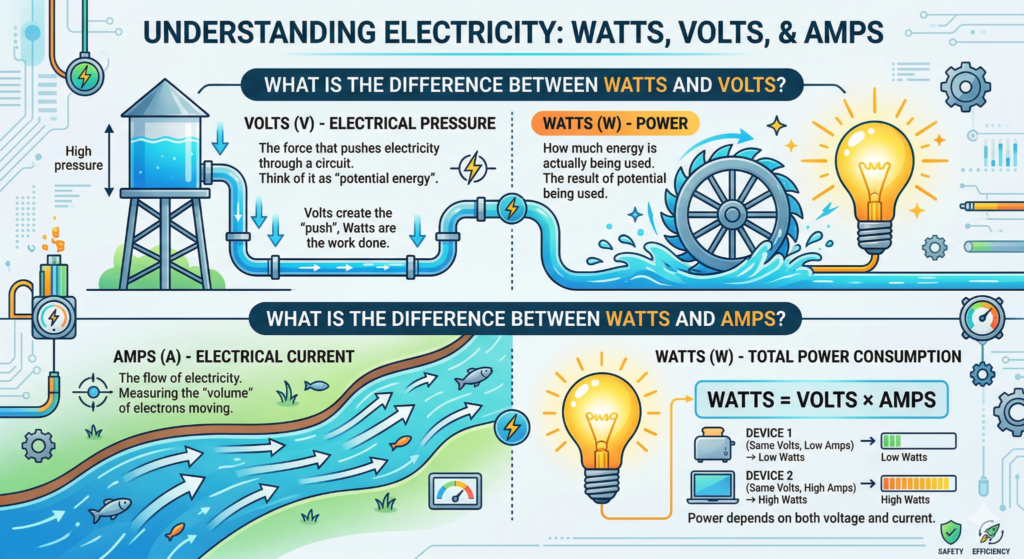
Understanding the difference between watts and joules is tricky because we use both terms when talking about electricity, gas bills, and batteries. Here is the short version: a joule is a measure of total energy, while a watt is a measure of power, which is how fast that energy is used or produced. One watt equals one joule per second. If energy is water in a tank, joules are the total gallons stored, and watts are the flow rate coming out of the pipe.
Mixing up these two units leads to common misconceptions about electricity bills, appliance ratings, and battery storage. Let's break down how power and energy interact, the math that connects them, and why the distinction matters for everyday tech.
Defining the Core Terms: Energy vs Power
To untangle the confusion, we need to separate energy from power at a fundamental level.
- Energy is the capacity to do work or cause a change. It's measured in joules (J) in the International System of Units. One joule is roughly the energy required to lift a small apple about one meter against Earth's gravity, or the kinetic energy of a two-kilogram object moving at one meter per second.
- Power is the rate at which energy is transferred, consumed, or generated over time. It's measured in watts (W), where one watt equals one joule per second ($1\text{ W} = 1\text{ J/s}$).
Think of running a marathon. The total calories you burn by the end of the race represent your total energy expenditure (measured in joules or calories). Your running speed at any given sprint represents your power output (measured in watts). A runner who finishes in two hours and a runner who finishes in four hours might burn a similar total amount of energy, but the faster runner generates a much higher power output to finish quicker.
The Mathematical Bridge: Watts, Joules, and Time
Because power is the rate of energy flow per second, we can calculate total energy if we know the power and how long it ran. The core formula is:
$$\text{Power (Watts)} = \frac{\text{Energy (Joules)}}{\text{Time (Seconds)}}$$
By rearranging this equation, we get the formula for finding total energy:
$$\text{Energy (Joules)} = \text{Power (Watts)} \times \text{Time (Seconds)}$$
This direct relationship is what people mean when asking about the watts in a joule. A joule isn't a fixed amount of power; rather, a joule is the total accumulation of one watt of power flowing for one second.
For example, if you turn on a small 10-watt LED desk lamp, it draws 10 joules of electrical energy every single second. If you leave that lamp on for one full minute (60 seconds), it consumes:
$$10\text{ watts} \times 60\text{ seconds} = 600\text{ joules of energy}$$
If you leave it on for an entire hour (3,600 seconds), it consumes 36,000 joules.
Why Utilities Use Kilowatt-Hours Instead of Joules
If joules and watts give us a precise scientific picture, why do electricity bills charge us in kilowatt-hours (kWh) instead of joules or kilojoules?
The answer comes down to scale and convenience. One joule is an extremely small amount of energy on a macroscopic scale. Power plants and home appliances deal with massive amounts of energy over hours, days, and months. If your home used 300 megajoules of electricity in a month, the numbers would get clunky and difficult to track on a standard billing statement.
A kilowatt is 1,000 watts. An hour is 3,600 seconds. When you combine them into a kilowatt-hour, you are measuring a bundle of energy:
$$1\text{ kWh} = 1,000\text{ watts} \times 3,600\text{ seconds} = 3,600,000\text{ joules (or } 3.6\text{ megajoules)}$$
When your monthly utility bill states you consumed 500 kWh, you've used 500 hours worth of energy flowing at a rate of one kilowatt. According to the U.S. Energy Information Administration, tracking energy in these units makes it straightforward to compare appliance efficiency across refrigerators, air conditioners, and heaters.
Real-World Comparisons: Appliances, Batteries, and Physics
To see how this plays out in real devices, let's look at three everyday contexts where power and energy collide.
1. Microwave Ovens
A standard kitchen microwave might have a power rating of 1,200 watts. That tells you how fast it transfers energy to your food. When you heat a bowl of soup for 90 seconds, you can calculate the total thermal energy delivered:
$$1,200\text{ W} \times 90\text{ s} = 108,000\text{ joules} (108\text{ kJ})$$
Notice that a 600-watt microwave would need 180 seconds to deliver that same 108,000 joules of energy to your soup. The power rate changes, but the final energy transferred to the food remains identical.
2. Smartphone Batteries
Lithium-ion batteries in modern phones are usually rated in milliamp-hours (mAh) and voltage, which translates to watt-hours. If a phone battery holds 15 watt-hours of energy, that equals about 54,000 joules of chemical energy stored inside the cell. When you play a high-end mobile game that draws 5 watts of power from the system, the battery drains quickly because it's spending 5 joules of stored energy every second.
3. Human Metabolism
The human body operates like a biological engine. At rest, an average adult burns energy at a basal rate of roughly 100 watts (100 joules of heat and metabolic work per second). During a heavy sprint, that power output can spike to 1,000 watts or more. Over an hour of heavy exercise, your total energy expenditure climbs into the hundreds of kilojoules, which is why your body needs caloric fuel to replenish those spent reserves.
Common Mistakes When Comparing Power and Energy
People frequently stumble over these physics concepts in everyday conversations. Watch out for these three common errors:
- Treating watts and joules as interchangeable: Saying a device "uses 500 joules per hour" is wrong because joules already factor in time. You should say a device uses "500 watts of power."
- Confusing battery capacity with charging speed: A portable power bank might have a large energy capacity (measured in watt-hours or joules), but if its USB port only outputs 10 watts, it will charge your tablet very slowly. Capacity is energy; output is power.
- Forgetting that time dictates consumption: Leaving a 100-watt incandescent bulb on for 10 hours uses far more energy than running a 1,500-watt hair dryer for two minutes, even though the hair dryer has a much higher power rating.
Frequently Asked Questions
How many joules are in one watt?
Strictly speaking, you can't convert watts directly into joules because they measure different things. A watt is a rate (joules per second), while a joule is a total amount. However, one watt is equal to a flow rate of one joule per second.
Why do some devices use calories instead of joules?
Calories and joules are both units of energy. A calorie is traditionally defined as the energy needed to raise the temperature of one gram of water by one degree Celsius. One calorie equals approximately 4.184 joules. Nutrition labels use food calories (kilocalories), while physics texts use joules, but both measure the exact same physical property.
Can a low-wattage device consume more energy than a high-wattage device?
Yes. If a 15-watt internet router stays powered on 24 hours a day, it consumes more total energy (joules or kilowatt-hours) over a month than a 1,500-watt electric kettle that runs for just five minutes a day. Total energy depends equally on power and duration.
How do I convert watts to kilowatt-hours?
You cannot convert watts directly to kilowatt-hours because kilowatt-hours measure energy over time, while watts measure instantaneous power. To get kilowatt-hours, multiply your power in kilowatts by the number of hours the device runs: $\text{kWh} = \text{kW} \times \text{Hours}$.



