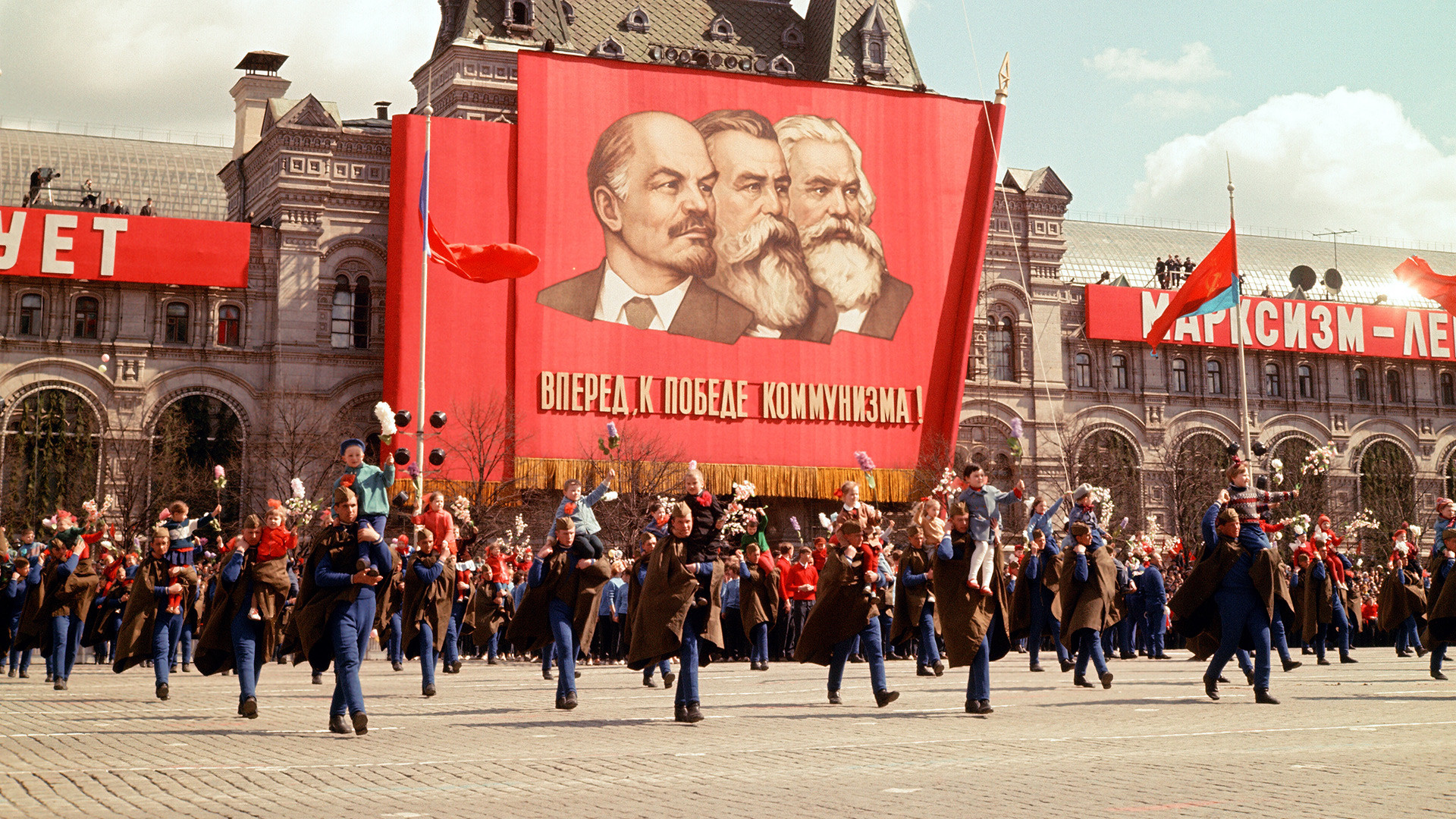
The collapse of the Soviet Union in 1991 didn't erase its operating system; it decentralized it. What we call the Soviet model paradox is the persistent reality that while the command economy and the single-party state largely dissolved, the institutional mechanics of information control, centralized resource allocation, and ideological legitimation survived. These mechanisms didn't vanish; they migrated into modern corporate governance, digital media ecosystems, and contemporary authoritarian states that bear little surface resemblance to Moscow. Understanding this survival explains why modern political discourse often sounds eerily familiar, even in nations that spent the twentieth century standing in fierce opposition to the Kremlin.
The Anatomy of the Soviet Model
The enduring influence of the Soviet system stems from its three-tiered architecture. Most historical analyses treat these tiers as separate phenomena, but their power relied entirely on how tightly they locked together.
- The Economic Command Layer: Production targets, pricing, and distribution were determined through centralized planning rather than open market signals. This established a permanent precedent for state intervention in industrial output.
- The Political Legitimacy Layer: Authority derived from adherence to a unifying ideology rather than competitive electoral mandates. Loyalty to the system superseded public consensus.
- The Informational Control Layer: The state maintained a total monopoly over public discourse, education, and media narratives to enforce a singular interpretation of reality.
When the union fell apart, Western observers assumed all three layers collapsed simultaneously. In practice, only the economic command structure suffered total failure. The political and informational layers proved remarkably adaptable, re-emerging in varied political landscapes across the globe.
How Information Architecture Survived
The informational layer is where the paradox becomes most visible in global discourse. The Soviet Union perfected a particular kind of strategic narrative where truth is subordinated to state utility. Controlling how a population perceives its own history is vastly more durable than controlling physical factories.
When state media structures transitioned in post-Soviet spaces, the editorial staff, the underlying bureaucratic habits, and the compulsion to shape rather than reflect public opinion frequently remained intact. Journalists trained to frame news through the lens of civilizational struggle simply swapped out their vocabulary when the flag changed. The mechanics of narrative management—such as manufactured consensus, the delegitimization of opposition through framing, and the blurring of fact and state interest—became exportable techniques. Modern political actors worldwide utilize these exact operational blueprints today without needing a Marxist-Leninist ideological framework.
Path Dependency and State-Led Modernization
The Soviet model was never just about communism; it was a radical vehicle for state-led modernization from above. By combining traditional imperial patterns of autocratic rule with industrial acceleration, it created a template for rapid nation-building that bypassed traditional democratic friction.
This legacy of path dependency influences how nations handle crises today. When contemporary governments face economic stress or social fragmentation, the instinct to centralize power, override local governance, and treat dissent as an existential threat often mirrors nineteenth and twentieth-century imperial-Soviet habits. It represents an institutional muscle memory where centralization is automatically equated with stability, and pluralism is viewed as systemic vulnerability.
The Paradox in Contemporary Global Narratives
The true paradox of our current era is that Western liberal democracies and modern competitive authoritarian states both borrow from the administrative ghost of the Soviet model, albeit in different ways.
Corporate Bureaucracy and Centralized Planning
Modern mega-corporations frequently mirror the hyper-centralized planning structures of Gosplan. Algorithmic management, top-down efficiency metrics, and comprehensive attempts to predict and control consumer behavior reflect a corporate command economy. The methods differ, but the ambition to eliminate market uncertainty through total data collection echoes the old central planning dreams.
Narrative Warfare in Digital Ecosystems
In the realm of global information warfare, the techniques pioneered by Soviet agitprop have been supercharged by digital platforms. The objective is no longer necessarily to convince target audiences of a specific ideological truth, but to flood the zone with contradictory narratives until the very concept of objective truth collapses. This cynical management of reality is the most potent surviving artifact of the Soviet model.
Frequently Asked Questions
What is the core contradiction of the Soviet model paradox?
The contradiction lies in the fact that while the physical state and economic ideology of the USSR collapsed, the administrative habits, narrative controls, and authoritarian governance techniques it perfected continue to thrive globally.
Why did the informational layer survive the economic collapse?
Controlling information and shaping public consensus requires human networks and psychological habits rather than heavy industrial capital. Bureaucrats and media professionals retained these skills and applied them to new political contexts.
How do modern entities use Soviet-style narrative control?
Contemporary actors use legacy techniques—such as discrediting independent verification, manufacturing false consensus, and framing geopolitical conflicts in existential terms—to manage domestic and international populations through digital channels.
Is the Soviet model relevant to economic systems today?
While formal command economies have largely disappeared, elements of state-directed capitalism and heavy industrial targeting draw heavily on the precedent of centralized resource allocation pioneered during the twentieth century.



