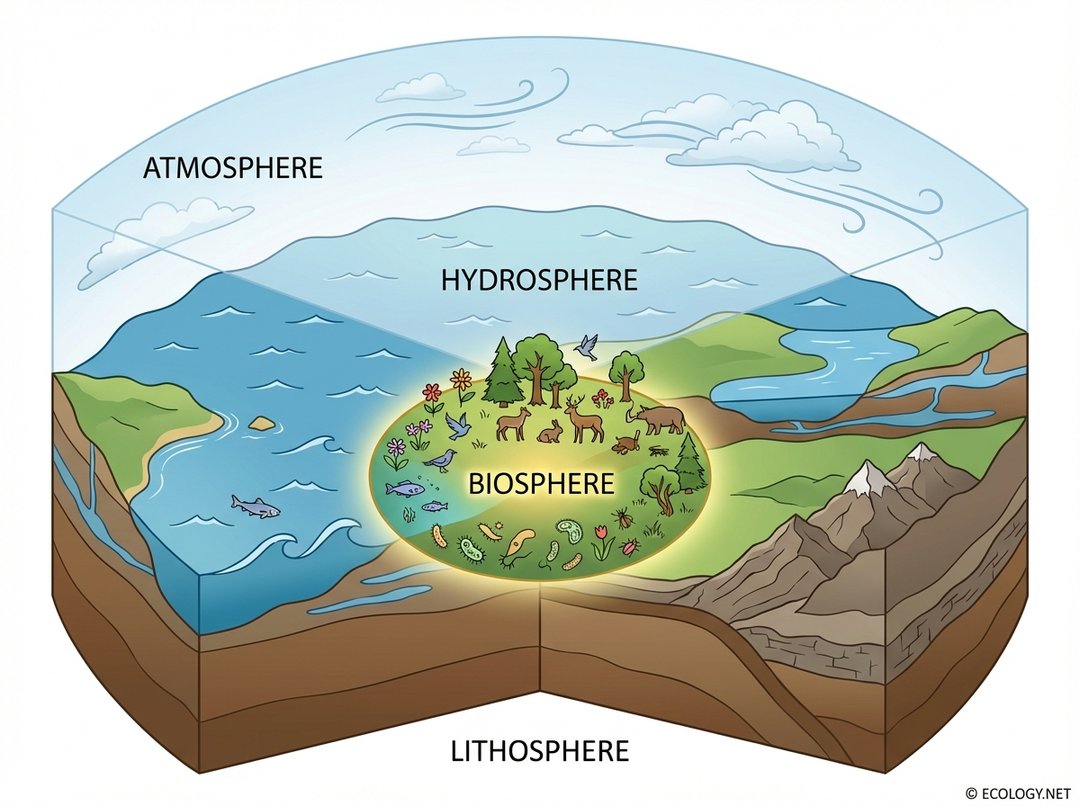
The biosphere is the global ecological zone where all life exists, stretching from deep ocean hydrothermal vents to the lower atmosphere. It isn't a single physical layer like the crust or the oceans, but an integrated, planetary-scale network born from the interaction between living organisms and their physical environments. Without it, Earth would be a lifeless rock subject to extreme temperature swings and unmitigated solar radiation.
Understanding this system requires looking past isolated forests or individual species. The biosphere operates as a self-regulating thermodynamic engine driven by solar energy and regulated by biogeochemical feedback loops. When human activities disrupt these feedback loops, the effects ripple through every corner of the planet, making comprehension of this complex network critical for modern environmental management.
Structure and Spheres of Interaction
The biosphere doesn't exist in a vacuum; it occupies the intersection of Earth's other primary physical layers. Life depends on constant exchanges across these boundaries.
- Atmosphere: This gaseous envelope supplies carbon dioxide for photosynthesis and oxygen for aerobic respiration, while filtering out lethal ultraviolet radiation.
- Hydrosphere: Encompassing all liquid water, ice, and vapor, the hydrosphere provides the fluid medium necessary for cellular metabolism and global heat redistribution.
- Lithosphere: The solid outer mineral layer offers physical anchorage, mineral nutrients, and a substrate for terrestrial biomes.
Microorganisms, plants, and animals bridge these realms. For example, tree roots weather solid rock in the lithosphere to extract minerals while releasing moisture into the atmosphere via transpiration. According to the National Geographic Society, these constant cross-system exchanges maintain the chemical stability required to sustain complex multicellular life. More reporting by Bloomberg highlights related perspectives on the subject.
Energy Flow and Nutrient Cycling
Life inside the biosphere relies on two fundamental physical processes: the one-way flow of energy and the cyclical exchange of matter.
Solar radiation enters the system, where primary producers like plants and cyanobacteria convert photons into chemical energy through photosynthesis. This energy moves upward through trophic webs, feeding herbivores, carnivores, and omnivores. At every transfer step, a large portion of energy is lost as metabolic heat, meaning ecosystems require a continuous, daily input of sunlight to survive.
Sunlight -> Primary Producers -> Herbivores -> Carnivores -> Decomposers
Nutrients don't arrive from space daily. Instead, elements like carbon, nitrogen, and phosphorus are recycled indefinitely. Decomposers such as fungi and soil bacteria break down dead organic matter, freeing trapped minerals and returning them to the soil and water. Without this recycling loop, global nutrient reserves would deplete within decades. You can explore detailed geochemical breakdowns via NASA Earth Observatory.
Why the Biosphere Is Underappreciated
Many people view nature as a collection of pretty backdrops rather than an active engine supporting human civilization. This disconnect leads to severe ecological blind spots.
- The Illusion of Infinite Buffers: Society often treats oceans and forests as limitless sinks for pollution and carbon emissions, ignoring the strict thermodynamic thresholds of biological systems.
- Focus on Individual Species: Conservation efforts frequently target charismatic megafauna while neglecting soil microbiomes and insect populations that drive foundational nutrient cycles.
- Economic Disconnection: Standard economic models rarely account for natural capital, pricing ecological services like water purification and pollination at zero until they fail.
Recognizing the biosphere as a vital life-support network shifts the focus from passive conservation to active planetary stewardship.
Frequently Asked Questions
What are the main boundaries of the biosphere?
The biosphere extends from about 10 kilometers into the atmosphere down to roughly 10 kilometers beneath the ocean surface. However, active, thriving life is concentrated in a much thinner envelope near the planet's surface where temperatures and pressures remain moderate.
How does the biosphere regulate global climate?
Forests, oceans, and wetlands act as major carbon sinks that absorb massive volumes of carbon dioxide from the atmosphere. By locking carbon into biomass and marine sediments, the biosphere helps buffer the greenhouse effect and stabilize global temperatures.
What is the difference between an ecosystem and the biosphere?
An ecosystem is a specific, localized community of living organisms interacting with their non-living physical surroundings, such as a coral reef or a tundra valley. The biosphere is the global sum of all these individual ecosystems combined.
How do human activities alter the biosphere?
Industrial emissions, deforestation, and intensive agriculture disrupt natural biogeochemical cycles, particularly the carbon and nitrogen cycles. These disruptions cause rapid climate shifts, habitat fragmentation, and a global loss of biodiversity that weakens the system's resilience.


