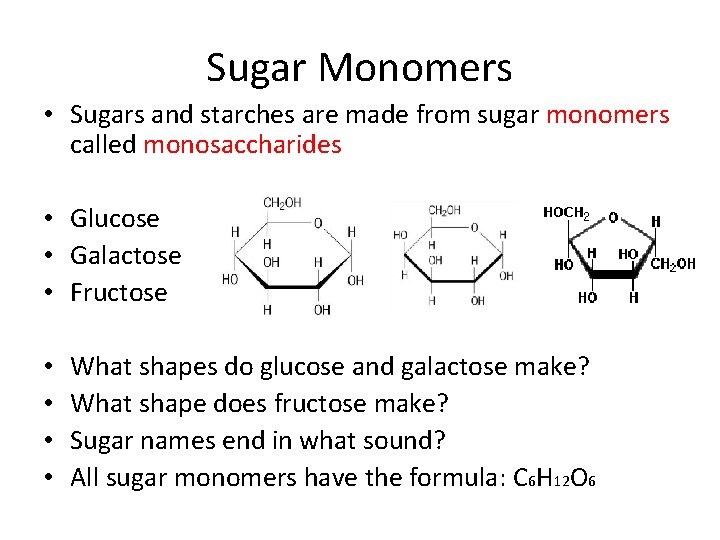
Carbohydrates drive biological life by fueling cellular respiration and building rigid structural frameworks. At the core of these macromolecules lie monomers of carbohydrates, small single-unit sugar molecules known as monosaccharides. You can't understand complex biological energy storage or cellular architecture without examining these primary building blocks.
Monosaccharides link together through glycosidic bonds to form larger disaccharides and polysaccharides. When your cells break down these bonds during metabolism, they release chemical energy stored as ATP. Beyond immediate cellular fuel, specific carbohydrate monomers construct resilient structural matrices like plant cell walls and crustacean exoskeletons.
Defining Monosaccharides: Structure and Classification
A monosaccharide represents the simplest form of carbohydrate, meaning it cannot be hydrolyzed into smaller sugar units. Most monosaccharides share the chemical formula $(CH_2O)_n$, where $n$ typically ranges from 3 to 7.
Biochemists classify these monomers by the number of carbon atoms in their backbones:
- Trioses ($n=3$): Glyceraldehyde, key intermediates in cellular respiration.
- Pentoses ($n=5$): Ribose and deoxyribose, forming the structural backbones of RNA and DNA.
- Hexoses ($n=6$): Glucose, fructose, and galactose, serving as primary metabolic fuel sources.
In aqueous cellular environments, pentoses and hexoses spontaneously form stable cyclic ring structures. For example, glucose closes into a six-membered pyranose ring through an intramolecular reaction between the C-1 aldehyde carbon and the C-5 hydroxyl group.
The Big Three Hexose Monomers
Three hexose sugars dominate biological systems: glucose, fructose, and galactose. While they share the exact molecular formula ($C_6H_{12}O_6$), their distinct atomic arrangements create vastly different biochemical properties.
Glucose: The Universal Cellular Fuel
Glucose is the predominant energy currency for living organisms. Photosynthetic plants synthesize glucose from carbon dioxide and water using solar energy. Animals ingest these plant-based carbohydrates, then catabolize glucose via glycolysis, the Krebs cycle, and oxidative phosphorylation. Blood glucose levels remain tightly regulated in humans through hormonal feedback loops involving insulin and glucagon.
Fructose: The Fruit Sugar
Fructose features a five-membered furanose ring structure, distinguishing it from glucose. Found naturally in fruits, honey, and root vegetables, fructose enters metabolic pathways in the liver through specialized phosphorylation steps. Because it bypasses early regulatory checkpoints in glycolysis, hepatic processing of excess fructose differs significantly from glucose metabolism.
Galactose: The Milk Component
Galactose rarely occurs as a free monomer in nature. Instead, it binds with glucose to form lactose, the primary disaccharide in mammalian milk. Enzymatic conversion in the liver transforms galactose into glucose-1-phosphate, allowing it to enter standard cellular energy pathways.
From Monomers to Polymers: Glycosidic Linkages
Individual monosaccharides join via dehydration synthesis reactions, releasing a water molecule as a covalent glycosidic bond forms between hydroxyl groups.
- Alpha ($\alpha$) linkages: Found in energy storage polymers like starch and glycogen. The orientation of the oxygen bridge points downward relative to the ring plane, allowing enzymes like amylase to easily cleave the bonds for rapid energy mobilization.
- Beta ($\beta$) linkages: Found in structural polymers like cellulose. The upward-pointing orientation creates rigid, linear chains that form extensive hydrogen bonds with neighboring strands.
According to research published by the National Center for Biotechnology Information, the specific spatial orientation of these glycosidic bonds dictates whether an organism can digest a given polysaccharide. Humans produce enzymes targeting $\alpha-1,4$ and $\alpha-1,6$ bonds in starch, but lack cellulase enzymes required to hydrolyze $\beta-1,4$ bonds in plant fiber.
Structural Carbohydrates: Beyond Energy
While glucose polymers like glycogen store energy in animal livers and skeletal muscles, monosaccharides also build durable structural components.
- Cellulose: Linear chains of $\beta$-glucose monomers aggregate into microfibrils, providing tensile strength to plant cell walls. For deeper structural insights, review resources provided by the National Institutes of Health.
- Chitin: A modified polysaccharide containing nitrogen, built from N-acetylglucosamine monomers. Chitin reinforces the exoskeletons of insects, arachnids, and crustaceans, as well as fungal cell walls.
- Peptidoglycan: Alternating residues of N-acetylglucosamine and N-acetylmuramic acid form bacterial cell walls, protecting microbes from osmotic lysis.
Common Misconceptions
- All sugars provide identical energy output: While hexoses share a formula, their distinct metabolic entry points lead to different processing rates and hormonal responses.
- Cellulose functions as a nutrient: Humans cannot digest dietary fiber because we lack the necessary enzymes to break $\beta$-glycosidic bonds, though it remains essential for gastrointestinal motility.
- Monomers only exist as linear chains: In physiological solutions, sugars overwhelmingly exist in cyclic hemiacetal or hemiketal ring forms.
Frequently Asked Questions
What distinguishes a monosaccharide from a disaccharide?
A monosaccharide consists of a single sugar unit, while a disaccharide contains two monosaccharide units linked by a covalent glycosidic bond, such as sucrose or lactose.
Why can humans digest starch but not cellulose?
Starch contains $\alpha$-glycosidic linkages that human digestive enzymes readily break down. Cellulose features $\beta$-glycosidic linkages that human enzymes cannot cleave.
How do cells trap glucose inside the membrane?
Immediately upon entering a cell, hexokinase phosphorylates glucose into glucose-6-phosphate. This adds a charged phosphate group that prevents the molecule from diffusing back across the lipid bilayer.
Are all carbohydrate monomers hexoses?
No. While hexoses are common, pentoses like ribose and deoxyribose play vital structural roles in nucleic acids, and trioses act as metabolic intermediates.



