Biological classification groups monkeys under the infraorder Simiiformes, commonly known as simians. Because the term "monkey" covers hundreds of distinct species rather than a single biological group, these animals don't share just one scientific name. Instead, their taxonomy branches into two major geographic and genetic divisions: New World monkeys and Old World monkeys. Understanding how scientists classify these primates requires looking past common names to examine suborders, families, genera, and specific binomial nomenclature established by zoologists.
Taxonomists organize living primates by tracing evolutionary history through anatomical traits, DNA divergence, and geographic isolation. While casual observers might group all arboreal mammals with tails under a single banner, modern biology separates them into structured lineages. This guide breaks down the zoological framework governing monkey classification, highlights key differences between groups, and outlines specific scientific names for representative species.
The Taxonomic Hierarchy of Primates
To find the scientific classification of any monkey, you trace its lineage down the standard biological hierarchy: Kingdom, Phylum, Class, Order, Suborder, Infraorder, Parvorder, Family, Genus, and Species.
Every monkey belongs to the animal kingdom (Animalia), the phylum of chordates (Chordata), and the class of mammals (Mammalia). From there, they enter the order Primates, which also includes lemurs, tarsiers, apes, and humans. Within Primates, monkeys fall under the suborder Haplorhini (dry-nosed primates) and the infraorder Simiiformes.
Simiiformes splits into two primary parvorders that separate monkeys by geography and physical structure:
- Platyrrhini: New World monkeys found in Central and South America.
- Catarrhini: Old World monkeys found in Africa and Asia, along with apes and humans.
New World Monkeys: Parvorder Platyrrhini
New World monkeys evolved in isolation across the forests of Central and South America. The scientific term Platyrrhini derives from Greek roots meaning "flat-nosed". True to this name, these primates feature broad noses with nostrils that face outward or sideways. Many species in this group also possess a prehensile tail, functioning almost like a fifth limb to grip branches securely during arboreal travel.
Zoologists divide Platyrrhini into five distinct families:
Family Callitrichidae
This family includes marmosets and tamarins. These are smaller primates that typically give birth to twins and feature claws instead of flat nails on most digits. A well-known example is the pygmy marmoset (Cebuella pygmaea), one of the smallest simians in the world.
Family Cebidae
This group houses capuchins and squirrel monkeys. Capuchins are renowned for their high intelligence and tool use. The tufted capuchin bears the scientific name Cebus apella. Squirrel monkeys belong to the genus Saimiri.
Family Atelidae
Atelids include howler monkeys, spider monkeys, and woolly monkeys. They possess exceptionally long, strong prehensile tails with sensitive tactile pads. The brown spider monkey carries the scientific designation Ateles hybridus.
Family Aotidae
Represented by a single genus, Aotus, these are the night monkeys or owl monkeys. They are the only truly nocturnal simians, distinguished by large, round eyes adapted for low-light vision.
Family Pitheciidae
This family contains titis, sakis, and uakaris. These arboreal seed-predators feature specialized teeth adapted for cracking hard nutshells and seeds in forest canopies.
Old World Monkeys: Parvorder Catarrhini
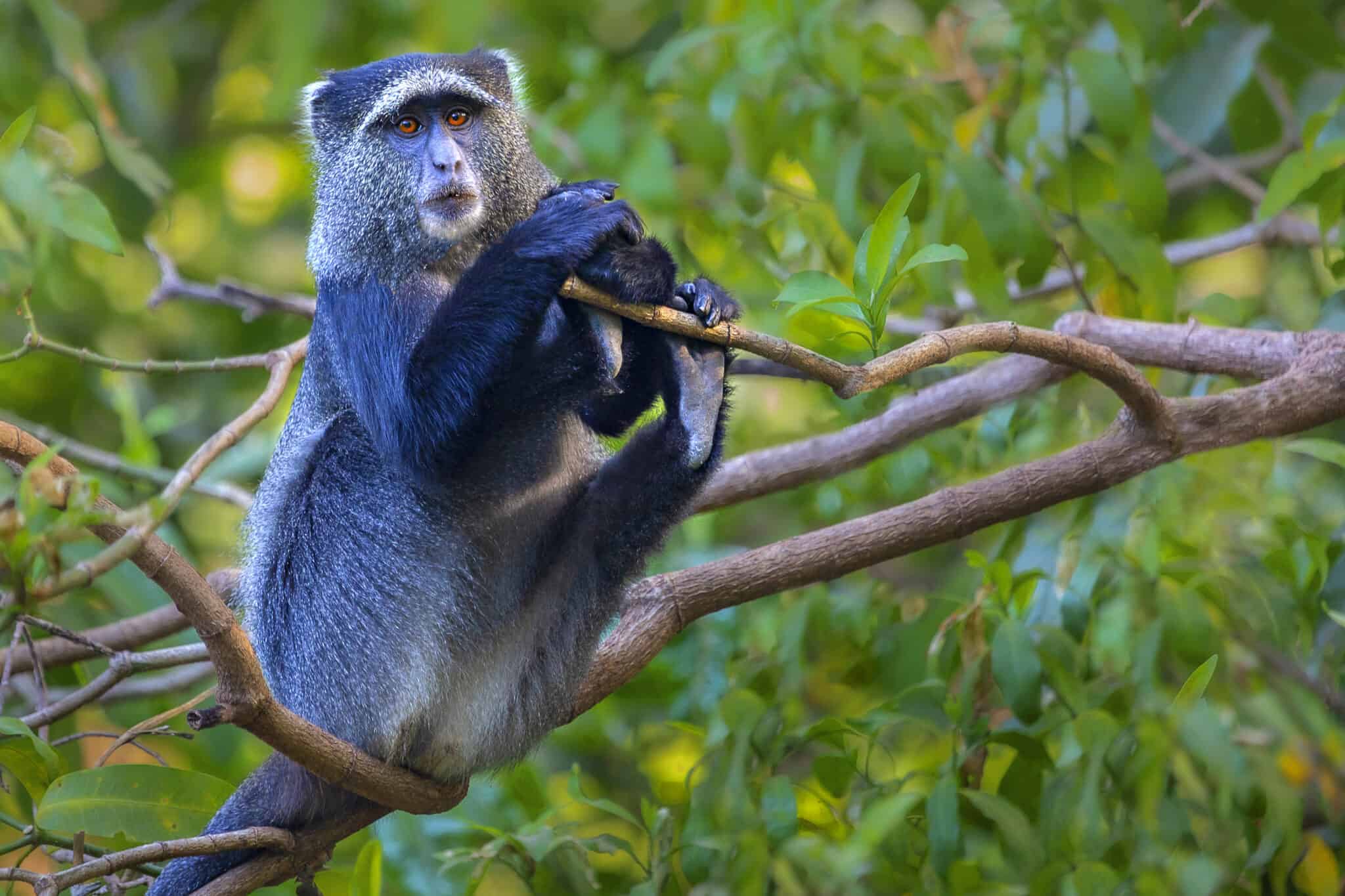
Old World monkeys inhabit diverse environments across Africa and Asia. The term Catarrhini translates to "downward-nosed", describing nostrils that point downward and sit close together. Unlike many of their American counterparts, Old World monkeys never possess prehensile tails. Instead, they often feature calloused sitting pads on their rear ends, known as ischial callosities, which make resting on branches comfortable.
All Old World monkeys belong to a single biological family: Cercopithecidae. Taxonomists divide this family into two major subfamilies:
Subfamily Cercopithecinae
This subfamily includes cheek-pouched monkeys such as macaques, baboons, guenons, and mandrills. Cheek pouches allow these animals to stuff food quickly and retreat to safety before chewing.
- Rhesus Macaque: Scientifically named Macaca mulatta, this species is widely studied in behavioral and medical research.
- Olive Baboon: Designated as Papio anubis, this terrestrial primate roams the savannas and woodlands of sub-Saharan Africa.
Subfamily Colobinae
Colobines are leaf-eating monkeys, including langurs, colobus monkeys, and the proboscis monkey. They feature complex, multi-chambered stomachs that ferment cellulose from tough leaves, much like ruminants.
- Hanuman Langur: Scientifically classified as Semnopithecus entellus.
- Proboscis Monkey: Endemic to Borneo, this species carries the scientific name Nasalis larvatus.
Monkeys Versus Apes in Taxonomy
A common point of confusion in primate taxonomy involves distinguishing monkeys from apes. While casual speech often groups them together, scientific classification separates them cleanly based on morphology and ancestry.
Apes—including gibbons, gorillas, chimpanzees, orangutans, and humans—belong to the superfamily Hominoidea. Morphologically, apes do not have tails, possess broader chests, and feature larger relative brain sizes than monkeys. In the tree of life, Old World monkeys are more closely related to each other than to apes, making traditional "monkeys" a paraphyletic group unless apes are included in the broader simian clade.
According to the Integrated Taxonomic Information System (ITIS), maintaining these distinct diagnostic boundaries prevents structural overlap between superfamilies and ensures accurate phylogenetic tracking.
Common Mistakes in Primate Classification
Amateur naturalists and writers frequently make specific errors when discussing primate zoology. Recognizing these pitfalls keeps scientific communication precise.
- Calling Lemurs Monkeys: Lemurs belong to the suborder Strepsirrhini, making them distant prosimian relatives rather than monkeys. They split from the simian lineage tens of millions of years ago.
- Ignoring Binomial Nomenclature Rules: A scientific name always consists of two parts—the capitalized genus followed by the lowercase species name (e.g., Macaca mulatta), both italicized. Writing just the species name or capitalizing the specific epithet violates taxonomic convention.
- Assuming All Monkeys Have Prehensile Tails: Only select New World families possess tails capable of full grasping. Old World monkeys cannot use their tails for gripping, and some species, such as the Barbary macaque, lack external tails entirely.
For official data registries on global biodiversity and conservation statuses, researchers often consult the International Union for Conservation of Nature (IUCN) Red List.
Frequently Asked Questions
Do monkeys have a single scientific name?
No. Because "monkey" is a common vernacular term covering hundreds of species, each individual species possesses its own unique binomial scientific name (such as Mandrillus sphinx for the mandrill).
Are humans considered monkeys?
No. Humans belong to the family Hominidae within the superfamily Hominoidea (apes). While humans and monkeys share a common ancestral primate lineage in the order Primates, humans are not monkeys or even apes in a strict colloquial sense, though cladistically humans fall within the broader simian clade.
What is the main physical difference between New World and Old World monkeys?
The primary physical markers are nose structure and tail capabilities. New World monkeys have flat noses with outward-facing nostrils and frequently possess prehensile tails. Old World monkeys have narrow noses with downward-facing nostrils and lack prehensile tails.
Why do colobine monkeys have complex stomachs?
Colobine monkeys eat a diet heavy in fibrous leaves and seeds. Their specialized, multi-chambered stomachs use specialized bacteria to break down tough plant cellulose before digestion, similar to the digestive system of cows.