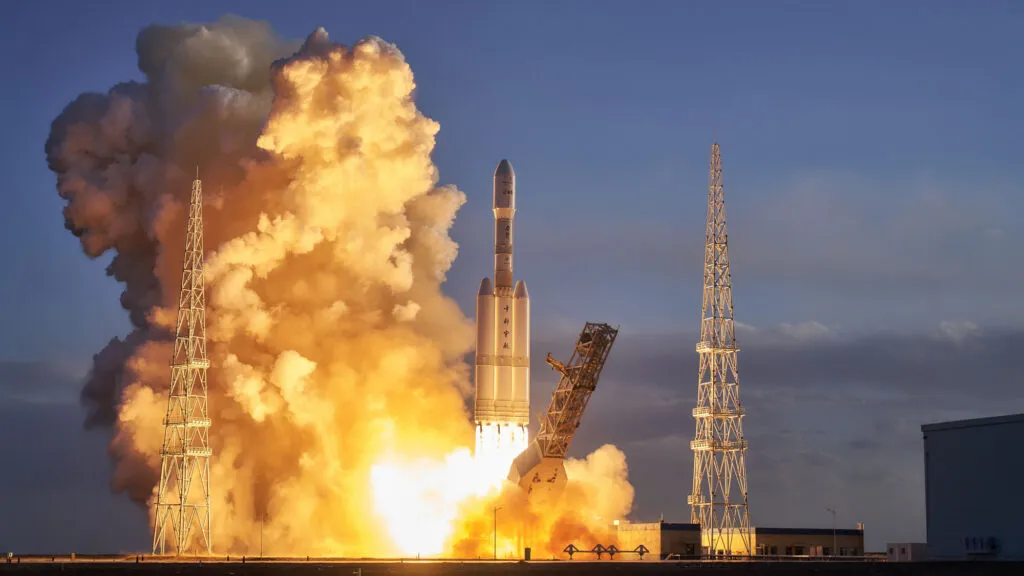
Reaching the Moon takes anywhere from three days to several months, depending entirely on your propulsion system, trajectory, and mission goals. If you board an Apollo-style direct transfer or a modern crewed capsule like NASA's Orion, you'll cross the roughly 240,000 miles (384,400 kilometers) of space in about 75 to 96 hours. However, uncrewed probes using fuel-efficient ion thrusters take much longer, while high-speed flyby probes can cross lunar orbit in mere hours.
Understanding lunar travel time requires looking past simple distance. Spacecraft don't drive in a straight line; they navigate complex orbital mechanics, gravitational pulls, and fuel constraints.
The Core Timeline: Three to Five Days
For crewed spacecraft, the standard journey to the Moon spans three to five days. This timeframe has remained remarkably consistent since the late 1960s because human physiological limits, life support supplies, and orbital mechanics dictate similar flight paths.
During the historic Apollo 11 mission in 1969, the spacecraft achieved lunar orbit insertion roughly 75 hours and 50 minutes after liftoff (about 3 days and 4 hours). Landing on the surface took a bit longer, with the lunar module touching down at 102 hours and 45 minutes—just over four days.
Modern missions follow comparable trajectories. For instance, the crewed Artemis II mission took about five days to complete its lunar flyby trajectory. Modern safety protocols, broader free-return loops, and comprehensive systems checks in high Earth orbit add a day or two compared to the rushed pace of the Cold War space race, but the transit phase itself remains measured in days rather than weeks.
Why Trajectory Changes Flight Duration
The duration of a trip to the Moon depends heavily on the specific path a mission chooses. Mission planners balance three primary trajectory types:
Direct Transfer and Insertion
This is the fastest route for crewed missions. A powerful rocket launches the spacecraft directly onto a trans-lunar trajectory, and upon arrival, the spacecraft fires its engines to brake into lunar orbit. This method puts astronauts at the Moon in roughly three days.
Free-Return Trajectories
Used extensively as a safety measure during Apollo 8 and Artemis II, a free-return trajectory loops around the Moon using lunar gravity to sling the spacecraft back toward Earth without requiring a major braking burn. Because the spacecraft relies on orbital mechanics to turn around rather than immediate propulsion, the transit often stretches closer to five days.
Low-Energy Transfers
Uncrewed cargo vessels and scientific satellites often use ballistic lunar transfers or low-energy transfers. By utilizing the gravitational pull of both the Earth and the Sun, these probes save massive amounts of fuel. The trade-off is time: instead of three days, these winding routes can take three to four months to reach lunar orbit.
Historical and Modern Mission Comparisons
Comparing past and present missions highlights how engineering goals shape travel duration.
- Apollo 11 (1969): Reached lunar orbit in 3 days, 4 hours; landed on day 4. Total round trip lasted just over 8 days.
- Artemis II (2026): Completed a crewed lunar flyby in approximately 5 days on a 9-day total mission duration, prioritizing extensive onboard testing in Earth orbit before heading outward.
- Intuitive Machines IM-1 (2024): A private commercial lander that took about 6 days to reach the lunar surface.
- SMART-1 (2003): A European Space Agency probe powered by an ion drive that took 13.5 months to spiral out of Earth's gravity and reach the Moon.
If you strip away the need to brake, orbit, or land, the absolute speed record belongs to flyby probes. NASA's New Horizons probe crossed the distance of the Moon's orbit in just 8 hours and 35 minutes on its way to Pluto, traveling at extreme velocities with no intention of stopping.
Common Misconceptions About Lunar Travel
When discussing space travel, popular media often creates unrealistic expectations.
A common mix-up involves confusing orbit entry with touchdown. While a spacecraft might enter the Moon's sphere of influence or achieve lunar orbit in 76 hours, descending to the surface requires additional orbital maneuvers, descent checks, and landing sequences that add a full day to the timeline.
Another frequent error is assuming that newer rockets automatically mean drastically faster travel times. Modern rockets like NASA's Space Launch System (SLS) carry heavier payloads and prioritize crew safety over raw speed. Reaching the Moon faster requires burning exponentially more fuel to decelerate upon arrival, which isn't practical for heavy human-rated transport systems.
Frequently Asked Questions
Can you drive a car to the Moon?
Physically, no, because cars require an atmosphere and a paved road, neither of which exists in the vacuum of space. However, if you could drive continuously at a highway speed of 60 mph (96 km/h) across the average 238,855-mile distance, the uninterrupted road trip would take roughly 166 days.
How long does a complete round trip take?
A crewed round trip typically lasts between 8 and 10 days. For example, Apollo 11 took 8 days and 3 hours from launch to splashdown, while Artemis II spanned just over 9 days. Future missions involving surface stays will naturally extend this window to weeks or months.
Why do some spacecraft take months to reach the Moon?
Spacecraft equipped with electric ion thrusters trade speed for fuel efficiency. Instead of a massive, instant rocket burn, they use continuous, low-thrust acceleration over a long period, taking a spiral path outward that requires months to intercept the Moon.
How fast do lunar rockets travel?
During trans-lunar injection, rockets accelerate spacecraft to escape velocities exceeding 24,500 mph (nearly 40,000 km/h) to break free from Earth's primary gravity well before coasting uphill against Earth's pull, slowing down significantly as they approach the Moon.
Read more about mission profiles directly on the NASA Artemis Mission Overview and explore historical mission timelines via the Canadian Space Agency Lunar Exploration Guide.