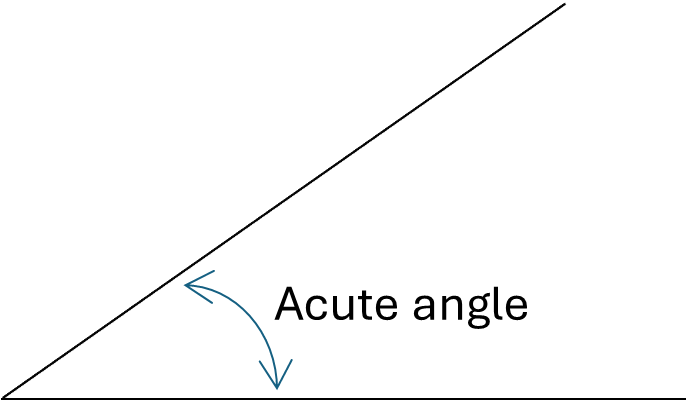
An acute isosceles triangle combines two distinct geometric conditions: all three interior angles measure strictly less than ninety degrees, and exactly two sides share equal length with corresponding base angles of equal measure. This intersection of properties creates specific mathematical relationships that govern height, area, and internal symmetry.
Understanding how these triangles function requires analyzing side length ratios, angle bounds, and coordinate geometry applications. Unlike equilateral triangles where all angles equal sixty degrees, or right isosceles triangles featuring a ninety-degree vertex, the acute isosceles triangle occupies a flexible parameter space that influences structural stability and trigonometric calculations.
Defining Characteristics and Angle Bounds
An isosceles triangle possesses two sides of equal length, traditionally labeled as $a$, and a third distinct side known as the base $b$. The angles opposite these equal sides are also equal, designated as base angles $\alpha$. The angle between the two equal sides is the vertex angle $\beta$.
For the triangle to qualify as acute, every interior angle must satisfy the condition:
$$\theta < 90^\circ$$
Because the sum of angles in any Euclidean triangle equals $180^\circ$, the angle sum relation is:
$$2\alpha + \beta = 180^\circ$$
To maintain an acute classification while satisfying the isosceles condition, the vertex angle $\beta$ must remain strictly greater than zero and less than $90^\circ$. Simultaneously, the base angles $\alpha$ must fall between $45^\circ$ and $90^\circ$. If $\beta$ reaches $90^\circ$, the triangle becomes a right isosceles triangle. If $\beta$ exceeds $90^\circ$, it becomes an obtuse isosceles triangle. If $\beta$ equals $60^\circ$, the triangle expands into a regular equilateral triangle.
The Strict Limits of the Vertex Angle
The mathematical bounds of the vertex angle $\beta$ dictate the range of possible shapes for this specific triangle type. Since the base angles $\alpha$ must be acute ($\alpha < 90^\circ$) and equal to each other, the minimum value for $\alpha$ in an acute triangle is limited by the requirement that no angle can be a right angle or obtuse.
If $\alpha$ approaches $45^\circ$, the vertex angle $\beta$ approaches $90^\circ$:
$$2(45^\circ) + 90^\circ = 180^\circ$$
Thus, the strict inequality for the vertex angle of an acute isosceles triangle is:
$$0^\circ < \beta < 90^\circ$$
This restriction ensures that dropping an altitude from the vertex angle bisects both the vertex angle and the base, splitting the figure into two identical right-angled triangles.
Fundamental Formulas and Measurements
Calculating the perimeter, height, and area of an acute isosceles triangle relies on standard trigonometric identities and the Pythagorean theorem.
Perimeter Calculation
The perimeter $P$ is the sum of all three side lengths:
$$P = 2a + b$$
Where $a$ represents the length of the two equal legs and $b$ represents the base.
Altitude and Height
Drawing a perpendicular line from the vertex angle $\beta$ to the base $b$ bisects the base into two segments of length $b/2$. This altitude $h$ forms two congruent right triangles with hypotenuse $a$ and leg $b/2$. Applying the Pythagorean theorem yields:
$$a^2 = h^2 + \left(\frac{b}{2}\right)^2$$
Rearranging the formula to solve for height $h$:
$$h = \sqrt{a^2 - \frac{b^2}{4}}$$
For this height to be a real number greater than zero, the side lengths must satisfy the triangle inequality theorem, meaning the sum of the two equal sides must exceed the base ($2a > b$).
Area Calculation
The area $A$ is derived from the standard base-times-height formula for triangles:
$$A = \frac{1}{2} \cdot b \cdot h$$
Substituting the altitude formula into the area equation gives:
$$A = \frac{1}{2} b \sqrt{a^2 - \frac{b^2}{4}}$$
Alternatively, using trigonometry, if the two equal sides $a$ and the included vertex angle $\beta$ are known, the area can be calculated as:
$$A = \frac{1}{2} a^2 \sin(\beta)$$
This trigonometric approach provides a direct method when side-angle-side data is available rather than base-and-height measurements.
Trigonometric Properties and Side Ratios
The internal symmetry of an acute isosceles triangle allows for straightforward trigonometric breakdowns. By splitting the triangle down its central altitude, the ratio of the base to the legs can be expressed through the base angle $\alpha$:
$$\cos(\alpha) = \frac{b / 2}{a} = \frac{b}{2a}$$
This relationship shows that the ratio of the base to the equal sides depends entirely on the cosine of the base angle. Because $\alpha$ must remain between $45^\circ$ and $90^\circ$, the ratio $b / 2a$ will always fall between $0$ and $\frac{\sqrt{2}}{2}$ (approximately $0.707$).
For more details on fundamental geometric proofs and angle theorems, consult the National Council of Teachers of Mathematics.
Coordinate Geometry and Vector Applications
Placing an acute isosceles triangle on a Cartesian coordinate plane simplifies vector analysis and physics calculations involving balanced forces.
If the midpoint of the base $b$ rests at the origin $(0, 0)$, the coordinates of the three vertices can be mapped as follows:
- Vertex 1 (Left base): $\left(-\frac{b}{2}, 0\right)$
- Vertex 2 (Right base): $\left(\frac{b}{2}, 0\right)$
- Vertex 3 (Apex): $(0, h)$
Using these coordinates, the distance formula confirms the equality of the two slanted sides:
$$d = \sqrt{\left(0 - \left(-\frac{b}{2}\right)\right)^2 + (h - 0)^2} = \sqrt{\frac{b^2}{4} + h^2} = a$$
This symmetry makes the figure a standard model in structural engineering, particularly when analyzing load distributions across symmetrical roof trusses or suspension bridge supports. For further reading on structural mechanics and geometric load paths, explore resources provided by the National Institute of Standards and Technology.
Common Misconceptions and Errors
Calculations involving triangles often involve conceptual errors regarding angle limits and side proportions. Recognizing these pitfalls prevents invalid geometric assumptions.
- Assuming Equilateral Symmetry: A common mistake treats all isosceles triangles as equilateral. While every equilateral triangle is acute and isosceles, an acute isosceles triangle does not require a $60^\circ$ vertex angle.
- Ignoring Angle Bounds: Treating a right isosceles triangle ($90^\circ$ vertex) or an obtuse isosceles triangle ($>90^\circ$ vertex) as acute violates the strict interior angle requirement where all angles must remain below $90^\circ$.
- Violating the Triangle Inequality: Selecting arbitrary numbers for side lengths without checking $2a > b$ results in impossible figures that cannot close in a two-dimensional plane.
Frequently Asked Questions
Can an acute isosceles triangle have a 90-degree angle?
No. An acute triangle requires all three interior angles to measure strictly less than $90^\circ$. A triangle with a $90^\circ$ angle is classified as a right triangle.
What is the minimum possible vertex angle for this triangle?
The vertex angle can approach $0^\circ$ theoretically in a degenerate limit, but in a valid non-degenerate Euclidean triangle, it can be any positive angle strictly less than $90^\circ$, provided the base angles remain equal and less than $90^\circ$.
How do you find the area if you only know the side lengths?
You can find the area by splitting the triangle into two right-angled triangles using the altitude formula, or by applying Heron's formula using the lengths of all three sides ($a$, $a$, and $b$).
Why is this specific triangle shape important in engineering?
Its bilateral symmetry distributes physical loads equally across both slanted sides, making it a foundational shape for roof trusses, bridges, and architectural framing.



