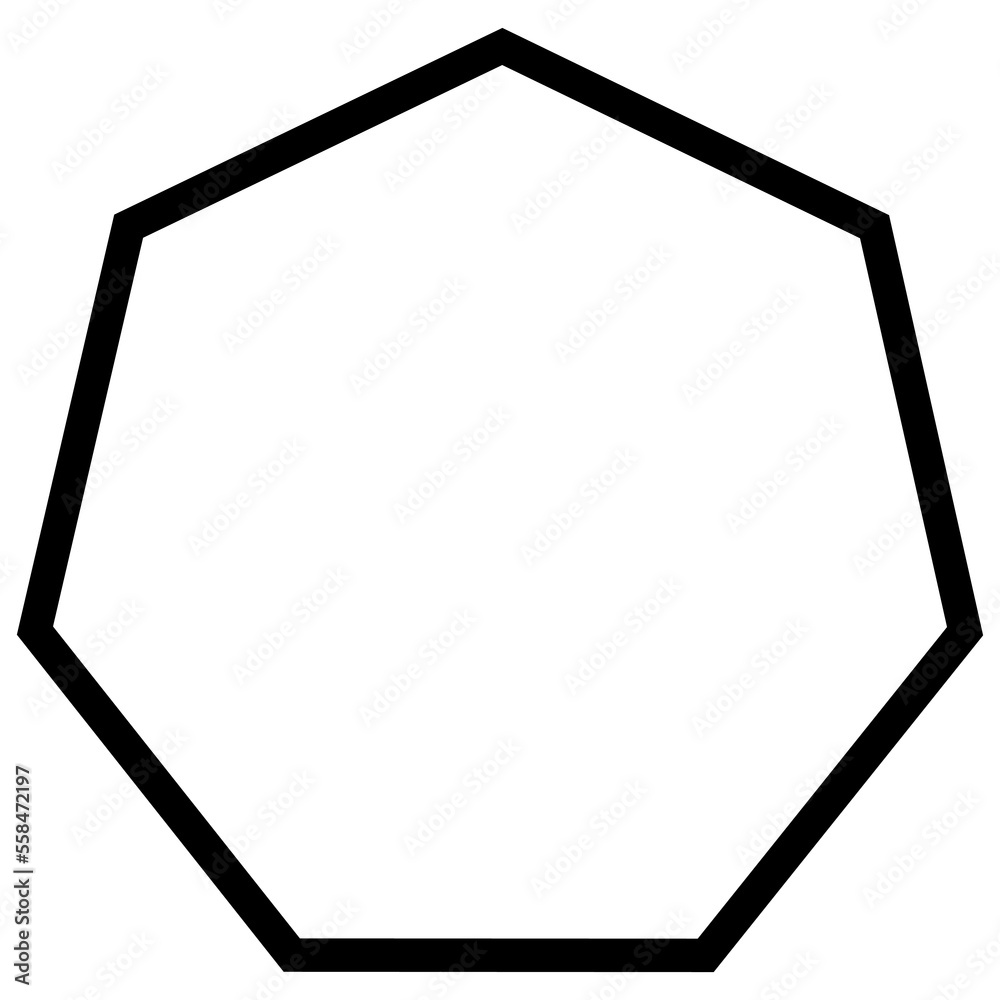
A heptagon is a seven-sided polygon. If you count its edges, corners, and interior angles, you will find exactly seven of each. It sits in geometry textbooks right between the more common hexagon and octagon, yet it often causes confusion because its angles don't break down into clean, round numbers.
Understanding a heptagon requires looking past basic definitions to examine its interior angle sums, diagonal counts, and differences between regular and irregular forms. Whether you are solving a geometry problem or trying to model a complex shape in computer-aided design software, mastering these properties clears up common calculation errors.
Core Properties of a Heptagon
Every heptagon shares a baseline set of geometric characteristics regardless of how warped or stretched its shape might appear. These properties define the fundamental framework of the 7-sided polygon:
- Sides: Exactly 7 straight boundary segments.
- Vertices: Exactly 7 corner points where the sides meet.
- Interior Angles: Exactly 7 angles formed inside the shape.
- Diagonals: Exactly 14 internal line segments connecting non-adjacent vertices.
Unlike squares or regular hexagons, regular heptagons cannot tile a flat surface without leaving gaps. This trait stems from the math behind interior angle measurements, which we will break down next. To see the complete picture, check out the recent article by The New York Times.
Calculating Angles: Formulas and Rules
The internal angles of any polygon follow a strict rule based on the number of sides ($n$). To find the sum of all interior angles in a heptagon, subtract two from the number of sides and multiply the result by 180 degrees:
$$\text{Sum} = (n - 2) \times 180^{\circ}$$
For a heptagon, plug in seven for $n$:
$$\text{Sum} = (7 - 2) \times 180^{\circ} = 5 \times 180^{\circ} = 900^{\circ}$$
The interior angles of any heptagon always add up to $900^{\circ}$.
Regular Versus Irregular Heptagons
A regular heptagon features equal side lengths and equal interior angles. Because the total sum is $900^{\circ}$ and there are seven angles, you divide to find the measurement of a single interior angle:
$$900^{\circ} / 7 \approx 128.57^{\circ}$$
Each exterior angle of a regular heptagon measures approximately $51.43^{\circ}$, calculated by dividing the total $360^{\circ}$ exterior rotation by seven.
An irregular heptagon has sides of varying lengths and angles of different sizes, though the interior angles must still add up to $900^{\circ}$. For example, if an irregular heptagon has six interior angles measuring $130^{\circ}$, $140^{\circ}$, $120^{\circ}$, $150^{\circ}$, $100^{\circ}$, and $110^{\circ}$, their sum is $750^{\circ}$. Subtracting that from $900^{\circ}$ reveals that the seventh angle must measure $150^{\circ}$.
Convex and Concave Variations
Heptagons also split into categories based on whether their vertices point inward or outward:
- Convex heptagons have every interior angle measuring less than $180^{\circ}$. The shape bulges outward uniformly, and no line segment between two interior points crosses outside the boundary.
- Concave heptagons feature at least one interior angle greater than $180^{\circ}$. This creates a "dent" or cave-in effect along one side of the perimeter.
Real-World Examples and Uses
You won't find heptagons in honeycomb structures because nature favors shapes that tessellate cleanly, but human design uses the 7-sided polygon for specific functional reasons.
The United Kingdom uses a seven-sided coin for its fifty-pence and twenty-pence pieces. Vending machines and coin-operated slots recognize these coins because a regular heptagon maintains a constant breadth when measured across opposite edges. No matter how the coin rotates as it slides through a slot, the diameter remains identical, allowing mechanical detectors to verify its size reliably.
Architects and graphic designers also employ heptagonal geometry when they want visual symmetry that feels slightly unexpected. Because the human eye easily registers squares, triangles, and hexagons due to their prevalence in nature, a seven-sided form introduces subtle visual friction that captures attention without looking chaotic. You can explore more about polygon properties through the National Council of Teachers of Mathematics or review foundational geometry references on MathWorld.
Common Mistakes to Avoid
When working with heptagons, students and designers frequently run into a few predictable traps:
- Assuming clean decimal values: Trying to force regular heptagon angles into clean fractions or whole numbers leads to cumulative rounding errors in software models. Always keep high-precision decimal values or exact trigonometric ratios until the final step of a calculation.
- Confusing diagonals: Forgetting the diagonal formula $n(n-3)/2$ often leads to guessing. For a heptagon, this yields $7(4)/2 = 14$ diagonals.
- Confusing interior and exterior sums: Remember that interior angle sums scale with the number of sides, but the sum of exterior angles for any convex polygon is always exactly $360^{\circ}$.
Frequently Asked Questions
Why can't a regular heptagon tessellate a flat surface?
Tessellation requires shapes to fit together around a point so their interior angles add up to exactly $360^{\circ}$. Since each interior angle of a regular heptagon is roughly $128.57^{\circ}$, no whole-number multiple divides evenly into $360^{\circ}$, leaving unavoidable gaps.
Can you construct a regular heptagon with a compass and straightedge?
No. Ancient Greek mathematicians proved that constructing a regular polygon requires compass and straightedge tools only when the number of sides is the product of a power of two and distinct Fermat primes. Because seven is a prime number that is not a Fermat prime, classical geometric construction is impossible without extra tools or approximation methods.
How do you find the side length of a regular heptagon if you know the radius?
You can use trigonometry. If you know the circumradius ($R$), the side length ($s$) is calculated using the formula $s = 2R \sin(\pi/7)$, which relies on the central angle division of a seven-sided shape.
Are all 7-sided polygons regular?
No. Regularity requires all sides to be equal in length and all interior angles to be equal. An irregular heptagon can have completely random side lengths and angle measurements as long as it maintains seven straight edges and closed vertices.



