Your shoulder relies on a delicate network of bones, tendons, and fluid-filled sacs to achieve an extraordinary range of motion. At the center of this biomechanical marvel sits the acromion, a bony projection forming the roof of the shoulder joint. When this structure narrows or develops irregularities, everyday tasks like lifting groceries or reaching overhead turn painful.
Understanding how the acromion shapes shoulder health helps clarify why certain anatomical variations lead to chronic discomfort while others allow for pain-free movement. This guide explores the structure, biomechanics, and clinical impact of the acromion, along with practical steps for maintaining shoulder longevity.
The Anatomical Blueprint of the Acromion
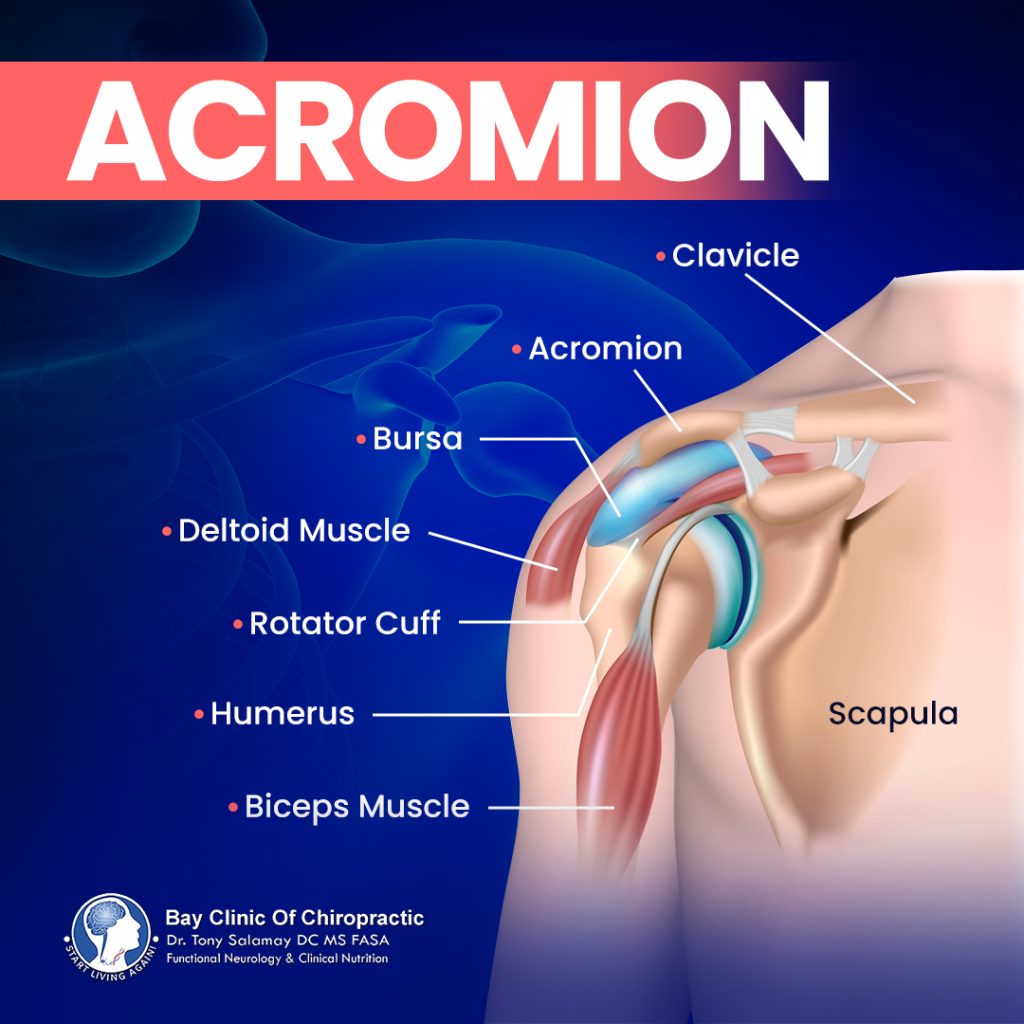
The acromion is the lateral extension of the scapula, or shoulder blade. It arches over the glenohumeral joint—the main ball-and-socket joint of the shoulder—and connects with the collarbone to form the acromioclavicular (AC) joint.
Bone shape varies significantly from person to person. Orthopedic specialists classify these variations into three distinct morphotypes, which directly influence how much clearance exists beneath the bony arch:
- Type I (Flat): The undersurface is smooth and flat, offering a wide subacromial space. This shape minimizes friction on the underlying soft tissues.
- Type II (Curved): The bone follows the rounded contour of the humeral head, providing moderate clearance during arm elevation.
- Type III (Hooked): The anterior edge curves downward like a hook. This geometry crowds the subacromial space, predisposing the area to mechanical wear and tear.
Beyond simple shape, bone spurs can form over time due to repetitive friction or degenerative wear at the AC joint. These spurs further reduce the available clearance, putting extra pressure on the rotator cuff tendons below.
Biomechanical Role in Shoulder Mobility
The shoulder possesses the greatest mobility of any joint in the human body, but this flexibility comes at the cost of inherent stability. The acromion acts as a stable mechanical anchor and a protective shield for the structures passing underneath.
During arm abduction—lifting your arm out to the side—the humerus moves upward toward the acromial arch. In a healthy joint, the supraspinatus tendon slides smoothly through this narrow passage. The subacromial bursa, a slippery fluid-filled sac, cushions the tendon and reduces friction.
When the arm reaches angles past ninety degrees, the acromion coordinates with the clavicle and scapula to allow full rotation. If the structural clearance is compromised by a hooked acromion or swelling, the smooth gliding motion turns into a mechanical pinch. This repetitive friction damages the tendons and bursa over time, limiting functional mobility.
Common Pathologies Linked to Acromial Shape
Structural crowding beneath the acromion triggers several well-documented clinical conditions. Recognizing these issues early prevents long-term joint degeneration.
Subacromial Impingement Syndrome
This condition occurs when soft tissues become compressed under the acromial arch during arm movements. Pain typically flares up when reaching overhead or lifting objects away from the body. Patients often describe a painful arc of motion, where discomfort peaks between sixty and one hundred twenty degrees of elevation.
Rotator Cuff Tendinopathy and Tears
Chronic rubbing against the undersurface of the acromion weakens the rotator cuff tendons, particularly the supraspinatus. This friction leads to tendinopathy, characterized by dull aches and weakness. Left unmanaged, frayed tissue can progress to partial or full-thickness rotator cuff tears.
Acromioclavicular Joint Arthritis
Because the acromion forms the outer half of the AC joint, degenerative wear affects this junction directly. AC joint osteoarthritis causes localized pain right at the top of the shoulder, often worsening when crossing the arm over the chest or sleeping on the affected side.
Clinical Diagnosis and Conservative Management
Diagnosing acromion-related pain requires a combination of physical assessments and advanced imaging. Clinicians perform specific orthopedic maneuvers, such as the Neer and Hawkins-Kennedy tests, to reproduce impingement symptoms and isolate the source of discomfort.
Imaging studies provide definitive structural details. Standard X-rays reveal the acromial shape (flat, curved, or hooked) and highlight any bone spurs or AC joint degeneration. When soft tissue damage or bursitis is suspected, magnetic resonance imaging offers a detailed view of the rotator cuff tendons.
Most patients improve without surgery through targeted conservative care:
- Physical Therapy: Strengthening the scapular stabilizers and rotator cuff muscles improves joint mechanics, pulling the humeral head down and increasing effective clearance beneath the arch.
- Activity Modification: Avoiding repetitive overhead lifting during flare-ups gives inflamed tissues time to heal.
- Targeted Injections: For severe inflammation, an ultrasound-guided corticosteroid injection into the subacromial bursa reduces pain and swelling, creating a window for effective rehabilitation.
When Surgery Becomes Necessary
If conservative treatments fail to relieve symptoms after six months, orthopedic surgeons may recommend an arthroscopic procedure called subacromial decompression.
During this minimally invasive operation, the surgeon inserts a tiny camera and specialized instruments through small incisions. They shave away a small portion of the undersurface of the acromion and remove inflamed bursal tissue, creating more physical room for the rotator cuff tendons to glide without friction.
Recovery requires structured rehabilitation to restore full range of motion and rebuild rotator cuff strength, ensuring long-term joint stability. For more detailed insights on shoulder preservation, visit the American Academy of Orthopaedic Surgeons.
Frequently Asked Questions
Can you change the shape of your acromion without surgery?
No. The bony shape of your acromion is a permanent structural feature determined by genetics and natural skeletal development. However, you can prevent secondary bone spurs and manage symptoms effectively through targeted physical therapy and posture correction.
What is the difference between a rotator cuff tear and shoulder impingement?
Shoulder impingement is the mechanical pinching of tendons beneath the acromion, while a rotator cuff tear is an actual structural breach or rip in the tendon fibers. Impingement often serves as the precursor to tendon tears if left untreated for years.
How long does recovery take after subacromial decompression?
Most patients regain basic arm mobility within a few weeks, but complete tissue healing and return to heavy lifting or overhead sports typically take three to six months of consistent physical therapy.
Does sleeping position affect shoulder pain caused by the acromion?
Yes. Sleeping directly on the affected shoulder increases pressure on the subacromial space, worsening nighttime pain. Sleeping on your back or on the unaffected side with a supportive pillow under your arm helps alleviate nocturnal discomfort.