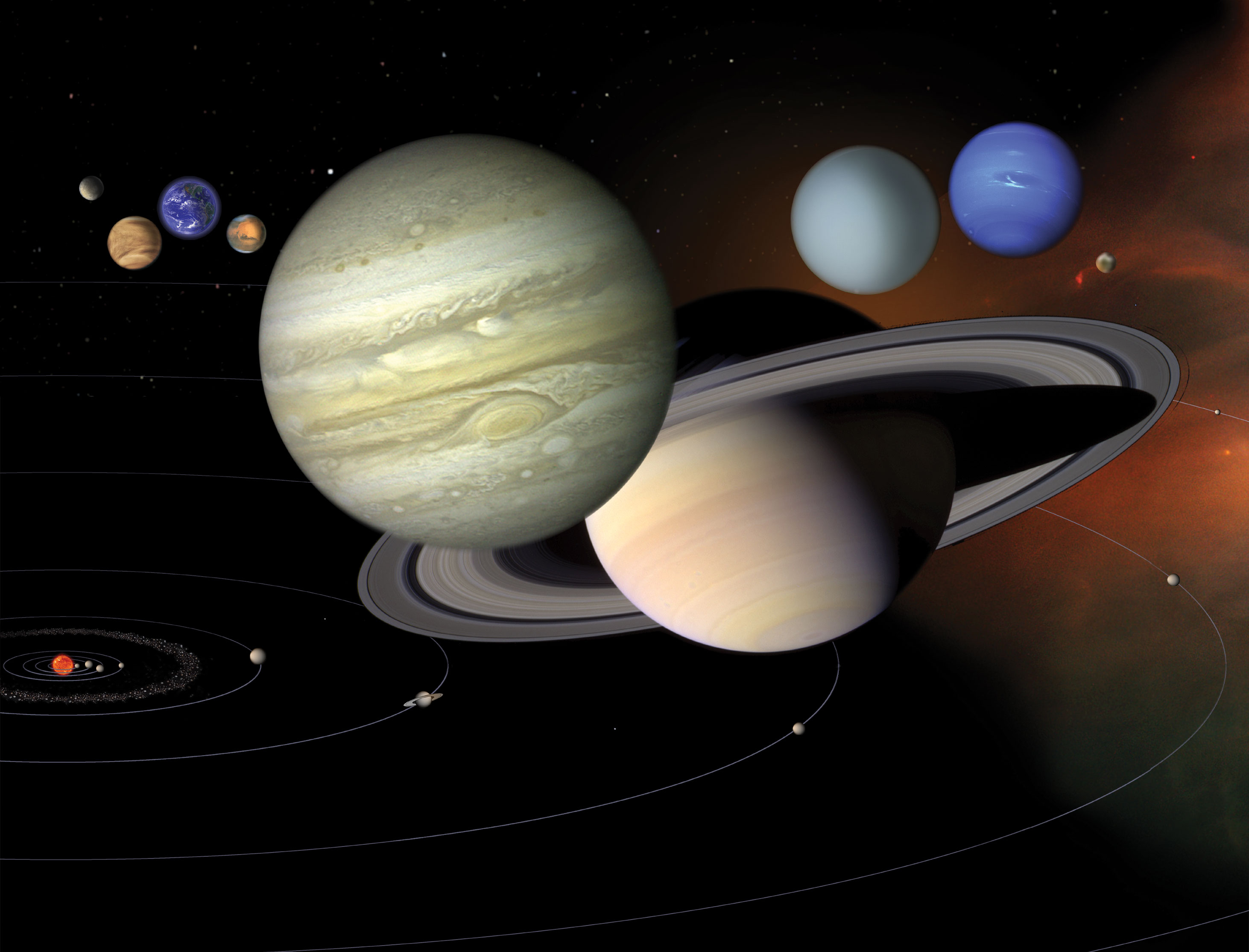
When you picture planetary rings, Saturn usually comes to mind first. Its bright, icy bands dominate textbook illustrations and capture public imagination. Yet Saturn isn't alone in hosting these cosmic halos. All four of the outer giant planets in our solar system possess ring systems. Jupiter, Saturn, Uranus, and Neptune each wear distinct adornments made of ice, dust, and rock fragments. None of the inner rocky worlds—Mercury, Venus, Earth, and Mars—have ring systems today.
Understanding why these rings exist, how they differ, and what they're made of reveals a lot about planetary formation and orbital mechanics. Let's break down the mechanics behind these structures, examine each ringed world, and answer common questions about cosmic rings.
What Causes Planetary Rings?
Planetary rings form when material orbits a celestial body within a specific gravitational boundary known as the Roche limit. Inside this threshold, a planet's tidal forces are stronger than the gravitational self-attraction of a loose body, such as a passing comet, asteroid, or captured moon. If an object wanders too close, the planet tears it apart.
Alternatively, rings can consist of primordial debris left over from the planet's formation that failed to accrete into a moon, or material kicked up by meteorite impacts on existing inner moons. Over time, particle collisions grind this material down into the fine dust, ice chunks, and boulders we see today.
Saturn: The Crown Jewel of Ring Systems
Saturn hosts the most extensive and brilliant ring system in our solar system. First glimpsed by Galileo Galilei in 1610—though he couldn't quite make out what they were—Saturn's rings span hundreds of thousands of kilometers while remaining remarkably thin, often only about 10 meters thick in places.
Composition and Structure
The rings are composed primarily of water ice, ranging from microscopic dust grains to house-sized boulders. Astronomers divide the main visible structures into lettered regions, notably the A, B, and C rings, separated by gaps like the prominent Cassini Division. Fainter structures like the D, E, F, and G rings extend further outward.
Age and Origin Debate
For decades, scientists debated whether Saturn's rings formed alongside the planet 4.5 billion years ago or appeared much later. Data from NASA's Cassini spacecraft suggested the rings might be remarkably young—potentially only 10 to 100 million years old—born from the destruction of an icy moon or a massive comet. More recent studies suggest ring particles might resist cosmic dust pollution better than previously thought, leaving room for older origin theories. You can read more about ongoing research via NASA Science.
Jupiter: The Faint Dusty Halo
Jupiter, the largest planet in our solar system, also has rings, though you won't see them through standard backyard binoculars. Discovered in 1979 by the Voyager 1 spacecraft, Jupiter's ring system is faint, dark, and composed largely of microscopic dust.
System Layout
Jupiter's system features three main components:
- A thick, donut-shaped inner halo ring
- A relatively bright, thin main ring
- Two distant, faint gossamer rings named Amalthea and Thebe, fed by dust from small moons sharing those names.
Unlike Saturn's pristine ice, Jupiter's rings are dark because they consist of rocky dust kicked up when high-speed meteoroids slam into the planet's small inner satellites. Because Jupiter's intense radiation and atmospheric drag constantly destroy these particles, the ring material must be continually replenished.
Uranus: The Tilted, Dark Rings
Uranus features 13 distinct, narrow rings that circle the ice giant in its extreme, sideways-tilted orientation. Scientists discovered the first of these rings in 1977 during a stellar occultation, when Uranus passed in front of a distant star and the rings briefly blocked the starlight.
Unique Characteristics
Unlike Saturn's bright ice rings, the rings of Uranus are composed of extremely dark material, likely organic compounds darkened by cosmic rays. Most are razor-thin and opaque, kept tightly confined by tiny shepherd moons. The outermost rings even display distinct colors, ranging from bright blue to reddish hues. The Planetary Society offers extensive archives detailing how Voyager 2 mapped these elusive structures during its 1986 flyby.
Neptune: The Clumpy Ring Arcs
Neptune hosts at least five distinct rings, which were definitively imaged by Voyager 2 in 1989. These rings are exceptionally faint and made of dark dust particles similar to those found around Uranus and Jupiter.
The Mystery of the Arcs
The most famous ring of Neptune, the outermost Adams ring, contains several bright, dense arcs of material named Liberté, Egalité, Fraternité, and Courage. Ordinarily, gravitational forces and particle collisions should cause ring material to spread out evenly in a smooth circle over time. The fact that these arcs remain clumped together puzzled astronomers for years until they realized the gravitational influence of the nearby moon Galatea helps stabilize them.
Could Other Bodies Have Rings?
Planetary rings aren't strictly limited to the four gas and ice giants. Astronomers have discovered ring systems around smaller bodies in the outer solar system, including the centaur asteroid Chariklo and the dwarf planet Haumea. These discoveries prove that ring formation is a common mechanical process throughout the cosmos whenever a small body retains material inside its Roche limit.
Frequently Asked Questions
Do any rocky planets have rings?
No inner rocky planets—Mercury, Venus, Earth, or Mars—currently have ring systems. However, scientists calculate that Mars's doomed moon Phobos is spiraling inward and may eventually break apart to form a ring around Mars tens of millions of years from now.
Can you see Saturn's rings without a telescope?
You cannot resolve Saturn's rings with the naked eye, but you can see that Saturn looks elongated or oval-shaped using basic binoculars. A small amateur telescope at 30x magnification easily reveals the main ring structure.
Why are Saturn's rings made of ice while Jupiter's are made of dust?
The composition depends on where the planet formed and its local environment. Saturn formed further out where water ice was abundant and stable, whereas Jupiter sits closer to the Sun and experiences intense radiation that destroys ice, leaving behind rocky meteorite dust.
Will Saturn's rings disappear forever?
Evidence suggests Saturn's rings are slowly draining into the planet via "ring rain"—a phenomenon where water ice is pulled toward Saturn by gravity and magnetic fields. Over the next 100 to 300 million years, these rings may fade away entirely.



