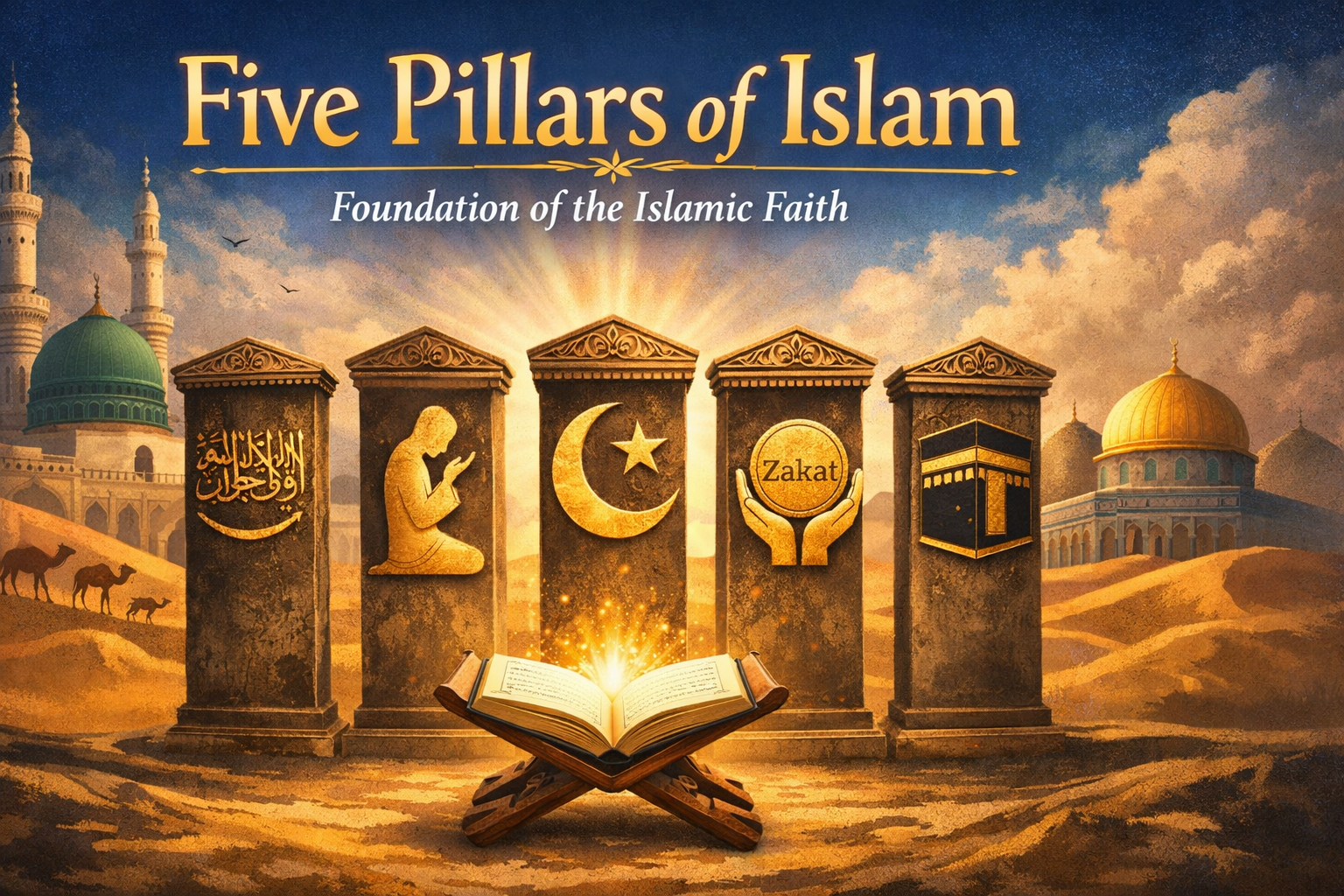
Islam emerged in the early 7th century on the Arabian Peninsula, specifically within the arid and commercially vibrant region of Hejaz. Its foundational moments occurred across two primary urban centers: Mecca and Medina, located in what is now modern-day Saudi Arabia. Rather than developing in an isolated vacuum, the faith took root at the crossroads of major trade routes, shaped by a unique blend of tribal nomadic cultures, Jewish and Christian monotheistic influences, and indigenous polytheistic traditions.
Understanding where was Islam founded requires tracing the footsteps of the Prophet Muhammad from the rocky cliffs of Jabal an-Nour to the political consolidation of the early Muslim community. The geographic and cultural landscape of the Hejaz dictated not only how the religion was born, but how it rapidly expanded outward across three continents.
The Geographic and Cultural Landscape of 7th-Century Arabia
Before the advent of Islam, the Arabian Peninsula was a mosaic of nomadic pastoralists known as Bedouins and settled urban merchants. Geographically, the peninsula presented severe challenges. Harsh deserts separated scattered oases and coastal trading hubs. Yet, the Hejaz region in western Arabia thrived because it hosted critical caravan routes connecting the Mediterranean world with the Indian Ocean and southern incense-producing lands.
Mecca sat directly along these lucrative trade arteries. It was not just a commercial depot; it was a spiritual sanctuary anchored by the Kaaba, a cube-shaped shrine that housed numerous tribal idols and attracted annual pilgrimages from across the peninsula.
- Tribal Loyalty: Society relied on clan ties rather than central governance, meaning personal protection depended entirely on family and tribal alliances.
- Religious Pluralism: Polytheism dominated, though communities of Christians, Jews, and Hanifs (indigenous monotheists) also lived throughout the region.
- Economic Inequality: Wealth accumulated by successful merchant clans created social friction, leaving vulnerable populations exposed.
Mecca: The Birthplace of Revelation
Mecca served as the physical birthplace of the Prophet Muhammad around 570 CE and the site where the faith first emerged. Muhammad belonged to the respected clan of Banu Hashim, a faction of the ruling Quraysh tribe. As a merchant, he traveled widely and gained a reputation for fairness, earning the title Al-Amin (the trustworthy).
The turning point occurred in 610 CE. While seeking solitude for contemplation, Muhammad retreated to a cave named Hira on Mount Jabal an-Nour, just outside Mecca. According to historical tradition, it was here that he received his first divine revelations through the angel Gabriel.
"Read in the name of your Lord who created..." — these opening verses of the Quran launched a movement that challenged the polytheistic status quo of Mecca.
Initial followers were few, drawn primarily from Muhammad's immediate family and close circle, including his wife Khadijah. As Muhammad began preaching publicly against idol worship and calling for strict monotheism and social justice, he faced fierce opposition from the Meccan oligarchy. The ruling Quraysh viewed his message as a direct threat to the economic stability tied to the pagan pilgrimage trade at the Kaaba.
Medina: The Migration and Political Foundation
After years of persecution, social boycotts, and escalating violence against early Muslims in Mecca, a vital geographic shift took place in 622 CE. Invited by feuding tribes in the agricultural oasis town of Yathrib—located roughly 400 kilometers north of Mecca—Muhammad and his followers migrated north.
This migration, known as the Hijrah, marks Year 1 of the Islamic lunar calendar. Yathrib was soon renamed Madinat an-Nabi (the City of the Prophet), or simply Medina.
Medina changed the trajectory of the faith from a persecuted religious minority into an organized sociopolitical state.
- The Constitution of Medina: Muhammad drafted a treaty that united the conflicting local clans and Jewish tribes under a single administrative framework, guaranteeing religious freedom and mutual defense.
- Institutional Growth: The first mosque was constructed, serving as a spiritual center, a court of law, and a parliament.
- Strategic Consolidation: From this northern base, the community developed defensive military capabilities and diplomatic networks that gradually shifted the balance of power in Arabia.
For deeper context on the preservation of these historical narratives, the Metropolitan Museum of Art provides extensive breakdowns of early Islamic art and historical geography.
The Return to Mecca and Pan-Arabian Unity
Relations between Medina and the pagan leadership in Mecca deteriorated into open conflict, marked by several key military engagements. By 630 CE, the balance of power had firmly inverted. Muhammad marched on Mecca with an army of thousands of converts.
Instead of enacting revenge, Mecca surrendered with minimal resistance. Muhammad entered the city, cleared the idols from the interior of the Kaaba, and rededicated the ancient shrine to the worship of the one true God.
This bloodless conquest of Mecca effectively unified the Arabian Peninsula under Islam. Various regional tribes sent delegations to Medina to pledge allegiance, tying political loyalty to the new religious order. When the Prophet Muhammad passed away in 632 CE in Medina, the geographic core of Islam was secure, setting the stage for rapid expansion across the Middle East, North Africa, and beyond.
To explore scholarly timelines regarding the expansion of the early caliphates following these events, consult resources like The British Museum.
Frequently Asked Questions
Was Islam founded in a single city?
No. While Mecca is universally recognized as the physical birthplace of the Prophet Muhammad and the site of the first revelations, Medina served as the birthplace of the first Islamic state and administrative center. Both cities share equal foundational importance.
Why did early Muslims migrate from Mecca to Medina?
They faced severe economic boycotts, social ostracization, and physical violence from the ruling polytheistic Quraysh tribe in Mecca. The migration to Medina provided a safe haven where Muhammad was invited to arbitrate local tribal disputes.
What role did trade routes play in spreading early Islam?
The Hejaz region sat at the crossroads of major international trade arteries. Merchants traveling through Mecca and Medina exchanged not only physical goods like spices and textiles, but also new ideas, cultural philosophies, and religious concepts, which accelerated the reach of the new faith.
How does the geography of Arabia influence modern Islamic practice?
Every day, millions of Muslims worldwide direct their ritual prayers toward the Kaaba in Mecca, regardless of where they live on earth. Additionally, the annual pilgrimage (Hajj) requires physically traveling to Mecca and its surrounding sacred sites in western Saudi Arabia.



