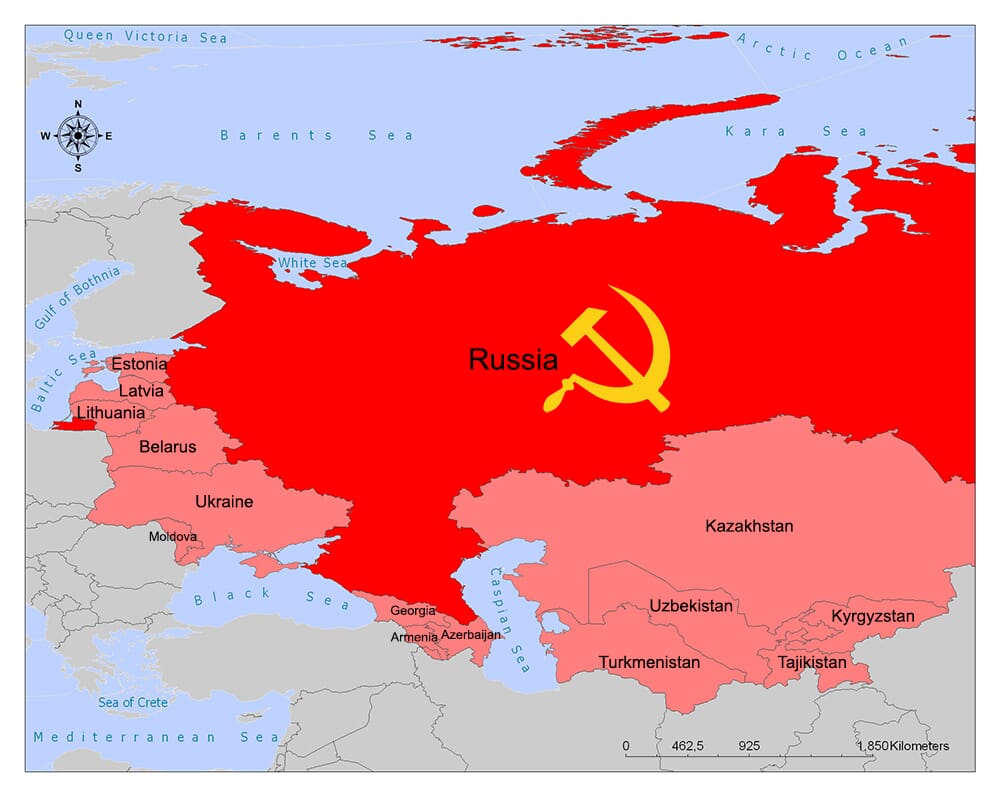
The abbreviation USSR stands for the Union of Soviet Socialist Republics, a vast federal socialist state that spanned Eurasia from 1922 until its collapse in 1991. Commonly referred to as the Soviet Union, it functioned as a single-party state governed by the Communist Party and grew into one of the world's two defining superpowers during the twentieth century.
Understanding the USSR requires unpacking more than just its name. Each word in the acronym reflected a specific political, geographic, and ideological framework designed to reshape global politics. Behind the acronym lay a complex federation of fifteen distinct republics, a centralized command economy, and a legacy that still influences modern international relations.
Breaking Down the Acronym: What Each Word Meant
To understand how the state operated, it helps to examine the four core components of its official title. Each term carried specific administrative and ideological weight under Marxist-Leninist doctrine.
- Union: The state was structured as a federal union composed of multiple subnational republics. While designed to unite various territories under a shared banner, power remained heavily centralized in Moscow.
- Soviet: Derived from the Russian word soviet, meaning "council." Soviets were worker and peasant councils that first emerged during the 1905 and 1917 revolutions. They formed the grassroots legislative backbone of the government structure, though actual policy was dictated from the top down.
- Socialist: The state operated on socialist economic principles, eliminating private ownership of major industries, land, and resources in favor of state and collective control.
- Republics: Officially, the constituent territories were structured as republics possessing nominal rights to self-determination and even secession. In reality, local autonomy was heavily restricted by the ruling Communist Party.
The Rise and Formation of the Soviet State
The roots of the USSR trace back to the Russian Revolution of 1917, which dismantled the centuries-old Russian Empire. After the Bolsheviks, led by Vladimir Lenin, overthrew the provisional government, the country plunged into a brutal civil war between the communist "Reds" and the anti-communist "Whites".
By 1922, the Bolsheviks secured victory and formally established the Union of Soviet Socialist Republics through a treaty uniting the Russian, Ukrainian, Belarusian, and Transcaucasian republics. Following Lenin's death in 1924, Joseph Stalin assumed control, steering the nation toward rapid industrialization and agricultural collectivization through aggressive centralized Five-Year Plans. These policies transformed an agrarian society into an industrial powerhouse at an immense human cost.
The Fifteen Constituent Republics
While Russia (officially the Russian Soviet Federative Socialist Republic) was the largest and most dominant member, the USSR was formally composed of fifteen distinct union republics:
- Armenia
- Azerbaijan
- Belarus (formerly Belorussia)
- Estonia
- Georgia
- Kazakhstan
- Kyrgyzstan
- Latvia
- Lithuania
- Moldova
- Russia
- Tajikistan
- Turkmenistan
- Ukraine
- Uzbekistan
Each republic maintained its own capital, flag, and nominal government structures, but economic quotas, military deployment, and foreign policy were tightly controlled by the central leadership in Moscow.
Superpower Status and the Cold War
The geopolitical trajectory of the USSR shifted dramatically during World War II. After absorbing a devastating invasion by Nazi Germany in 1941, the Soviet military bore the brunt of the land war in Europe, ultimately capturing Berlin in 1945. This victory expanded Soviet political influence across Eastern Europe, creating a buffer zone of satellite states.
This division set the stage for the Cold War, a decades-long geopolitical and ideological standoff against the United States and its capitalist allies. The conflict manifested through an arms race, proxy wars, and technological competition—most notably the space race, which saw the USSR launch Sputnik in 1957 and send Yuri Gagarin as the first human into space in 1961.
Why Did the USSR Collapse?
By the late 1980s, the Soviet system faced crippling economic stagnation, widespread consumer shortages, and severe structural inefficiencies. General Secretary Mikhail Gorbachev introduced sweeping reforms known as glasnost (political openness) and perestroika (economic restructuring) to revitalize the state.
Instead of saving the union, these reforms exposed deep systemic flaws and unleashed long-suppressed nationalist movements across the republics. Independent declarations swept through the Baltic states, Ukraine, and elsewhere. On December 26, 1991, the Supreme Soviet voted itself out of existence, formally dissolving the USSR and splitting the territory into fifteen independent sovereign nations.
Frequently Asked Questions
Was the USSR the same thing as Russia?
No. Russia was the largest and most politically dominant republic within the Soviet Union, accounting for over half of its population and the majority of its landmass, but it was just one of fifteen equal-on-paper republics that made up the union.
What was the Cyrillic acronym for the USSR?
In Russian, the state was written using the Cyrillic alphabet as СССР, which stands for Soyuz Sovetskikh Sotsialisticheskikh Respublik. Transliterated into the Latin alphabet, it reads as SSSR.
Did individual republics have the right to leave the USSR?
Formally, Article 72 of the 1977 Soviet Constitution guaranteed each union republic the right to freely secede from the union. In practice, however, the centralized apparatus of the Communist Party treated any secessionist movements as treasonous until the final years of the regime.
How many countries were created when the Soviet Union dissolved?
The dissolution of the Soviet Union resulted in the emergence of fifteen fully independent post-Soviet states, including the Russian Federation, Ukraine, Belarus, Kazakhstan, and the Baltic states of Estonia, Latvia, and Lithuania.



