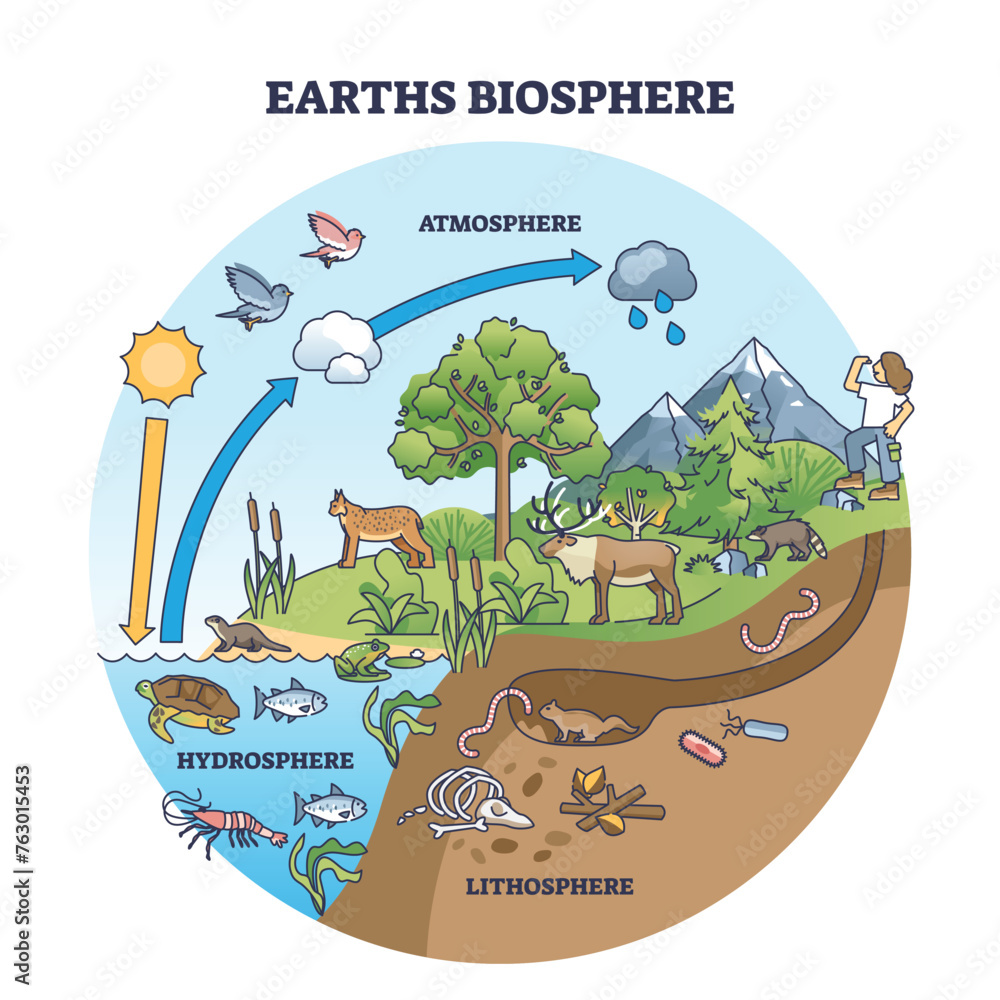
The biosphere is the global ecological layer where every living organism exists, interacting directly with Earth's air, water, and solid ground. It functions as the planet's ultimate life-support system, driving climate stability, filtering water, and recycling essential nutrients across land and ocean. Without this thin biological envelope—stretching from deep ocean trenches to the lower atmosphere—Earth would be a barren, lifeless rock.
Understanding how the biosphere operates, how energy flows through it, and why human disruptions threaten its stability is crucial for addressing modern environmental challenges. Let's break down how this massive planetary network actually works.
Defining the Biosphere
Russian mineralogist and geochemist Vladimir Vernadsky popularized the modern scientific definition of the biosphere in his 1926 book The Biosphere. He described it not merely as a collection of living things, but as an active geological force that transforms the face of the planet.
The biosphere sits at the intersection of three major physical zones of Earth:
- The Atmosphere: The gaseous envelope surrounding the planet, providing carbon dioxide for plants and oxygen for animals.
- The Hydrosphere: All liquid water, ice, and vapor across oceans, rivers, and underground aquifers.
- The Lithosphere: The solid outer crust, including soils and rocks where microbes, plants, and burrowing animals dwell.
Life doesn't just exist inside these spheres; it connects them. Microbes weather rocks into soil, marine algae pump oxygen into the atmosphere, and forests draw down carbon to regulate global temperatures.
How Energy and Nutrients Flow Through the Biosphere
The biosphere operates through two non-negotiable physical rules: energy flows in a one-way path from the sun, while matter cycles endlessly within the system.
The Solar Engine and Primary Production
Solar radiation hits Earth, and photosynthetic organisms—plants, phytoplankton, and cyanobacteria—capture that light energy, converting it into chemical energy. This process forms the foundation of every food web on the planet.
Herbivores eat the plants, carnivores eat the herbivores, and decomposers break down what's left. At each step, energy is lost as heat, meaning the biosphere requires a constant, uninterrupted influx of sunlight to keep running.
Biogeochemical Cycles
While energy dissipates, physical matter stays put. Elements like carbon, nitrogen, phosphorus, and water cycle continuously between living organisms and their physical environments.
- The Carbon Cycle: Plants pull carbon dioxide from the air; animals eat the plants; respiration, decay, and volcanic activity release it back. Oceans act as massive carbon storage vaults, absorbing surplus atmospheric gases.
- The Nitrogen Cycle: Plants need nitrogen to build proteins, but they can't use the nitrogen gas floating in the air. Specialized soil bacteria fix atmospheric nitrogen into usable chemical compounds, sustaining agricultural and natural plant growth alike.
Real-World Examples of Biosphere Dynamics
To see the biosphere in action, look at how complex systems balance themselves across different biomes.
The Amazon Rainforest acts as a massive biological engine. Transpiration from billions of trees pumps moisture back into the atmosphere, creating regional flying rivers of rain that sustain agriculture thousands of miles away.
In marine environments, coral reefs showcase extreme interdependence. Polyps build calcium carbonate skeletons that form homes for thousands of species, while microscopic algae inside their tissues provide food via photosynthesis. When ocean temperatures rise too high, corals expel these algae, leading to mass bleaching events that threaten the entire local food web.
Beneath our feet, soil microbiomes dictate terrestrial survival. A single teaspoon of healthy dirt holds billions of bacteria and fungi that break down dead organic matter, suppress plant diseases, and keep nutrient loops turning.
Human Impacts on Earth's Life-Support System
Human industrial expansion has altered the biosphere faster than at any point in geological history. We are driving what scientists call the Anthropocene epoch.
- Habitat Fragmentation: Urban sprawl, intensive agriculture, and clear-cutting convert wild ecosystems into isolated patches, cutting off migration corridors and causing sharp drops in global biodiversity.
- Carbon Disruption: Burning fossil fuels pulls ancient carbon out of the lithosphere and dumps it into the atmosphere, raising global temperatures, acidifying oceans, and disrupting predictable weather patterns.
- Chemical Overload: Industrial fertilizers flood aquatic systems with excess nitrogen and phosphorus, creating massive dead zones in coastal oceans where oxygen levels plummet.
Fixing these imbalances requires shifting from extractive consumption to regenerative management. Practices like no-till farming, marine protected areas, and large-scale ecological restoration help repair fractured feedback loops.
Frequently Asked Questions
Where does the biosphere begin and end?
The biosphere doesn't have a hard ceiling or floor. It extends roughly from the deepest ocean trenches—where microbes thrive around hydrothermal vents—up to about six miles into the atmosphere, where airborne bacteria and spores can occasionally be found. However, the vast majority of all biomass concentrates near the surface of the land and oceans.
Is the biosphere considered a single living organism?
Strictly speaking, no. While the Gaia hypothesis suggests Earth's biosphere behaves like a self-regulating organism by maintaining habitable temperatures and chemical balances, it lacks genetic reproduction and central nervous coordination. It is better understood as a complex, decentralized network of millions of self-sustaining ecosystems.
How does climate change threaten the biosphere?
Climate change shifts temperature and precipitation zones faster than many species can adapt or migrate. When regional climates shift too quickly, forests die back, coral reefs bleach, and food webs collapse, reducing the overall resilience and biological capacity of the planet's life-support network.
What is the difference between a biome and the biosphere?
A biome is a specific regional community defined by climate and vegetation—such as a tundra, desert, or tropical rainforest. The biosphere encompasses all of Earth's biomes combined into one single, interconnected global system.



