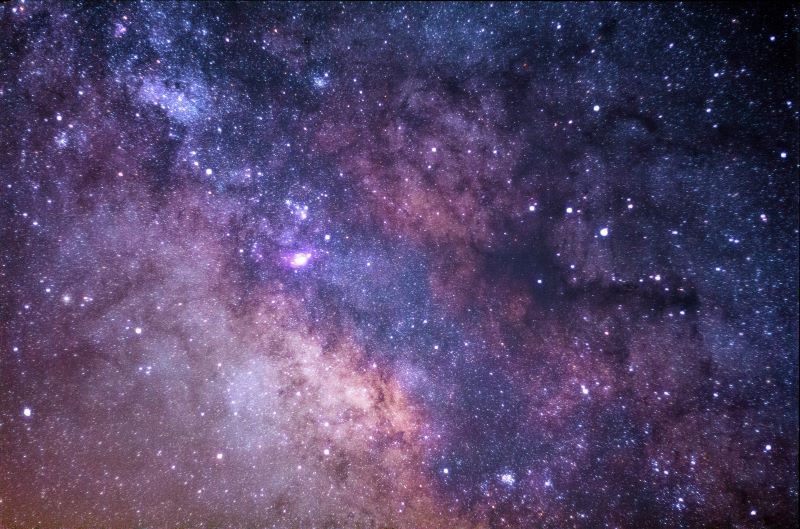
What is space? It's the huge, mostly empty ocean that sits between Earth, the Moon, the planets, and every star you see at night. Unlike the air we breathe down here, space has almost no matter in it, meaning it's an enormous vacuum where sound can't travel and gravity keeps entire worlds spinning in place.
Children often picture space as a black ceiling dotted with glowing stickers, but it's actually a vast, active frontier without an end. It contains everything in existence—from rocky asteroids and icy comets to blazing suns, spiraling galaxies, and black holes. To understand it clearly, let's explore how space works, what lives inside it, and how it differs from our home planet.
Why Is Space Mostly Empty?
Down on Earth, you're surrounded by air molecules. If you shout, those molecules bump into each other and carry sound waves to your friend's ears. In space, those molecules are spread so far apart that they barely touch.
Physicists call this an almost-perfect vacuum. Because there are hardly any gas particles to scatter sunlight, space looks pitch black even when the sun is shining brightly nearby. If you floated in space without a helmet, you wouldn't hear a single sound because there's no air to carry the vibrations.
Temperatures in the Vacuum
Without an atmosphere to trap heat or block raw radiation, temperatures in space are extreme. When sunlight hits an object in space, it can bake up to 250 degrees Fahrenheit (121 degrees Celsius). But if that same object steps into a shadow, it plunges to minus 250 degrees Fahrenheit (-156 degrees Celsius).
What Makes Up the Universe?
Space isn't just empty air; it's home to countless cosmic objects organized in grand structures.
- The Solar System: Our local neighborhood includes the Sun at the center, eight major planets (like Earth, Mars, and Saturn), dozens of moons, and millions of asteroids and comets.
- Stars and Galaxies: Our Sun is just one ordinary star. Millions of other stars cluster together into giant swirling pinwheels called galaxies. We live in the Milky Way galaxy, which holds over 100 billion stars.
- Nebulas: These are giant, colorful clouds of dust and gas floating in space where new stars are born.
How Do Astronauts Live in Space?
Living in space is very different from living on Earth. Astronauts aboard the International Space Station experience microgravity, which makes them float around as if they're constantly falling in slow motion.
Because there's no gravity holding things down, everyday routines change completely:
- Eating: Food comes in sealed packets or freeze-dried pouches. Liquids have to be sipped through straws so tiny drops don't float away and ruin sensitive electronics.
- Sleeping: Astronauts strap themselves into sleeping bags attached to walls so they don't drift around and bump into equipment while dreaming.
- Exercising: To keep their bones and muscles strong in zero gravity, astronauts must work out on special resistance machines for two hours every single day.
Common Misconceptions About Space
When learning about the cosmos, kids and adults often pick up a few myths along the way.
One common mistake is thinking that the Sun is on fire. Fire needs oxygen to burn, but the Sun doesn't use combustion. Instead, it's a giant nuclear reactor that squashes atoms together to create massive amounts of light and heat.
Another mix-up is believing that black holes act like cosmic vacuum cleaners, sucking up everything in the universe. In reality, a black hole only pulls in things that get dangerously close to its edge. If our Sun were suddenly replaced by a black hole of the exact same mass, Earth wouldn't get sucked in—we'd just keep orbiting it in the dark.
Frequently Asked Questions
Where does space actually begin?
Scientists draw an invisible boundary called the Kármán line, located about 62 miles (100 kilometers) above Earth's surface. Once an aircraft flies past this line, the air is too thin to provide lift, and you officially enter outer space.
Why doesn't the Moon crash into Earth?
The Moon wants to fly off in a straight line because of its speed, but Earth's gravity pulls it inward. This constant tug-of-war creates a balanced loop called an orbit, keeping the Moon circling around us instead of crashing down.
How big is the universe?
Nobody knows for sure. We can only see the part of the universe where light has had time to reach us since the Big Bang, known as the observable universe. It stretches across a mind-boggling 93 billion light-years in diameter.
Can you hear sound in space?
No. Because sound waves require a medium like air, water, or solid ground to travel through, sound cannot move across the empty vacuum of space. If two spaceships exploded right next to each other, you wouldn't hear a sound from the outside.



