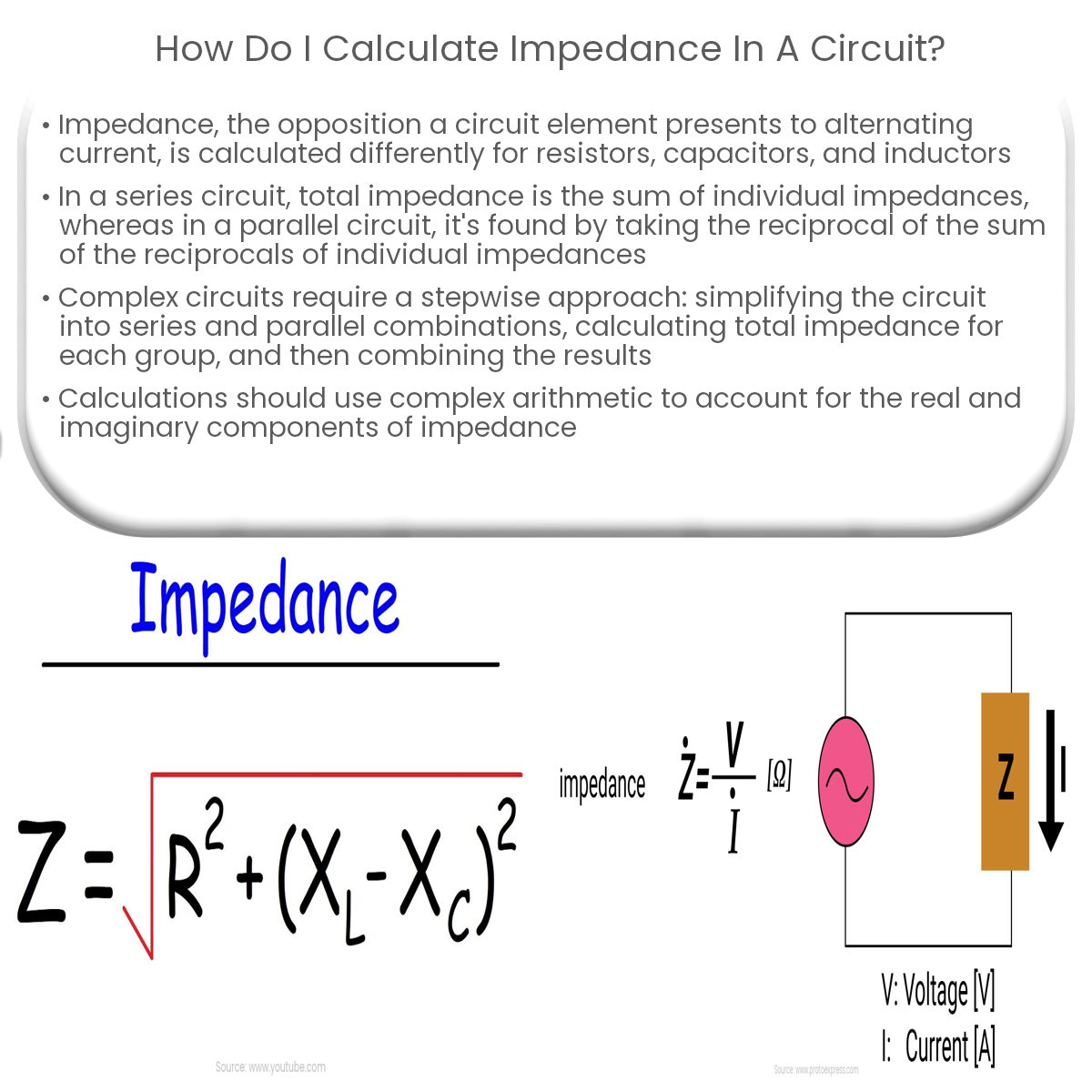
Impedance is the total opposition that a circuit offers to the flow of alternating current. While standard electrical resistance only deals with how a material slows down direct current, impedance brings two additional factors into play: inductance and capacitance. If you've ever wondered why your audio amplifier behaves differently with different speakers, or why high-frequency radio signals require precise cable matching, impedance provides the underlying answer.
At its core, impedance is measured in ohms, just like regular resistance. However, it changes depending on the frequency of the electrical signal passing through the circuit. Understanding this concept allows you to design cleaner audio setups, troubleshoot faulty wiring, and comprehend how alternating current systems transfer power efficiently without overheating components.
The Foundations of Alternating Current
To understand impedance, you must first look at how alternating current differs from direct current. Direct current flows in a single, steady direction from a power source like a battery. Resistance in a direct current circuit remains constant, governed entirely by Ohm's Law, where voltage equals current multiplied by resistance.
Alternating current behaves quite differently. The voltage and current continuously reverse direction, typically cycling back and forth fifty or sixty times every second. As the current constantly shifts magnitude and direction, it interacts with the physical components of the circuit in new ways.
Resistance Versus Reactance
In an alternating current circuit, the total opposition consists of two distinct phenomena: resistance and reactance.
- Resistance ($R$): The friction-like opposition offered by materials like copper or carbon. It converts electrical energy into heat and does not change when the frequency changes.
- Reactance ($X$): The opposition created by inductors and capacitors due to their ability to store and release electrical energy temporarily. Reactance fluctuates depending on how fast the electrical signal alternates.
When you combine resistance and reactance, you get impedance, represented by the symbol $Z$. Because resistance and reactance act at right angles to one another mathematically, you can't simply add them together. You must combine them using vector addition, which forms the foundation of AC circuit analysis.
How Inductance and Capacitance Shape Impedance
Every real-world circuit contains more than just resistors. Inductors and capacitors are fundamental building blocks that introduce frequency-dependent behavior into your designs.
Inductive Reactance
An inductor consists of a coil of wire. When alternating current flows through it, the changing magnetic field creates a back-electromotive force that opposes changes in current. This property is known as inductance.
As the frequency of the signal increases, the inductor fights the current more aggressively. Therefore, inductive reactance increases as frequency goes up. At very high frequencies, an inductor can act almost like an open circuit, blocking signals entirely.
Capacitive Reactance
A capacitor consists of two conductive plates separated by an insulating material. It stores electrical energy in an electrostatic field. When alternating current tries to pass through, the capacitor charges and discharges continuously.
Unlike inductors, capacitors become more conductive as frequency increases. At low frequencies or with direct current, a capacitor blocks current completely once it's charged. At high frequencies, capacitive reactance drops significantly, allowing signals to pass through easily.
The Mathematical Nature of Impedance
In technical terms, impedance is expressed as a complex number:
$$Z = R + jX$$
In this equation, $R$ represents the real part (resistance), $X$ represents the imaginary part (reactance), and $j$ is the imaginary unit used in electrical engineering.
To find the magnitude of the impedance—the total opposition felt by the circuit—you calculate the square root of the sum of the squared resistance and squared reactance:
$$Z = \sqrt{R^2 + X^2}$$
This relationship shows that reactance plays a massive role in shaping how a circuit responds to different frequencies. If a circuit has high reactance, its total impedance will be high, even if the physical resistance of the wires is very low. You can learn more about how standard electrical units are defined by visiting the National Institute of Standards and Technology.
Why Impedance Matching Matters in the Real World
Impedance matching is the practice of designing the output impedance of a signal source to be equal to the input impedance of the load attached to it. Getting this right is crucial across multiple engineering fields.
Audio Engineering
In audio systems, matching matters for maximum power transfer and signal integrity. If you connect an electric guitar with high output impedance straight into a mixing console with low input impedance, you lose high frequencies and signal strength. Audio engineers use direct injection boxes to bridge these gaps cleanly.
Radio Frequency and Telecommunications
At radio frequencies, mismatched impedance causes signal reflections inside coaxial cables. These reflections bounce back toward the transmitter, creating standing waves that can overheat equipment and degrade broadcast quality. Radio transmitters and antenna systems are carefully calibrated to a standard fifty ohms to prevent these issues. You can read technical guidelines on transmission systems through the Federal Communications Commission.
Common Mistakes When Working with Impedance
People often run into trouble when they confuse standard resistance with impedance, or when they ignore frequency effects entirely.
- Treating Ohm's Law as universal for AC: You can't just plug an AC voltage and a multimeter resistance reading into basic Ohm's Law to find the true current. You must account for phase angles and frequency-dependent reactance.
- Ignoring speaker ratings: Connecting low-impedance speakers to an amplifier rated only for higher loads can draw excessive current and trigger thermal protection shutdowns or burn out output transistors.
- Assuming wires have zero reactance: At high frequencies, even straight copper traces on a printed circuit board act like transmission lines with notable inductive and capacitive properties.
Frequently Asked Questions
What is the difference between resistance and impedance?
Resistance only opposes direct current and is independent of frequency. Impedance is a broader term used in alternating current circuits that includes resistance alongside frequency-dependent reactance from inductors and capacitors.
Why is impedance measured in ohms?
Because impedance serves the same fundamental purpose as resistance—it limits the flow of current for a given voltage—it uses the ohm as its unit of measurement.
Can impedance be negative?
The magnitude of impedance is always a positive scalar value. However, the reactive component can be positive for inductive reactance or negative for capacitive reactance.
How does frequency affect impedance?
As frequency increases, inductive reactance goes up while capacitive reactance goes down. This means a circuit's total impedance changes dynamically depending on the frequencies passing through it.


