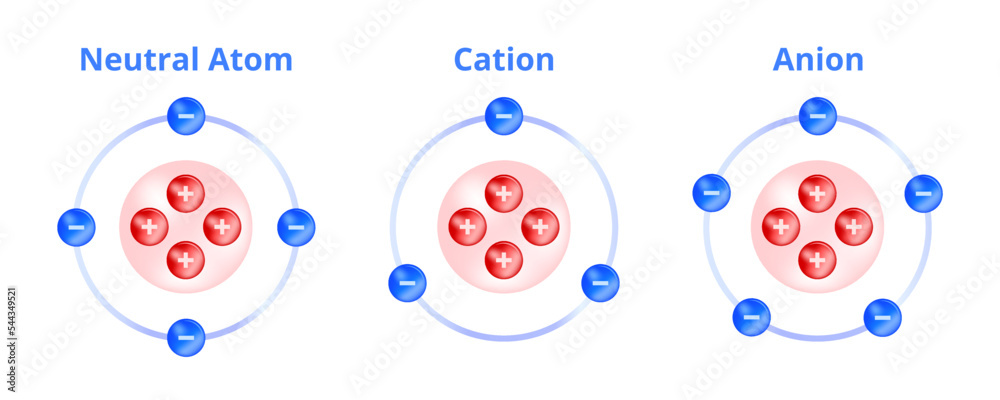
An ion is any atom or group of atoms that bears a net electric charge. While neutral atoms contain an equal number of protons and electrons, ions have an imbalance. When an atom loses electrons, it becomes a positively charged particle known as a cation. When an atom gains electrons, it forms a negatively charged particle called an anion. This fundamental charge imbalance dictates how matter interacts across chemistry, biology, and everyday technology.
Understanding ions begins with atomic structure. In a stable, neutral atom, the positively charged protons in the nucleus are balanced by the negatively charged electrons orbiting that nucleus. Because opposite charges attract, electrons remain bound to the atom. However, external energy can disrupt this balance. If sufficient energy is applied to strip an electron away, or if an extra electron is captured, the atom transforms into an ion, driving chemical reactions, electrical conductivity, and biological signaling.
The Mechanics of Ionization
Ionization is the process by which an electrically neutral atom acquires a positive or negative charge. This transformation requires energy, known as ionization energy, or releases energy, known as electron affinity.
Atoms seek stability, which often means achieving a full outer electron shell, frequently consisting of eight valence electrons, as described by the octet rule. Elements on the left side of the periodic table, such as sodium, possess few valence electrons and readily give them up to achieve stability, forming cations. Conversely, elements on the right side, such as chlorine, lack only one or two electrons to fill their outer shells and tend to capture electrons, forming anions. For another look on this development, check out the latest update from Smithsonian Magazine.
Cations vs. Anions
The core distinction between the two types of ions lies in electron transfer:
- Cations: Formed when metallic elements lose electrons. Because protons outnumber electrons, the net charge is positive. For example, a sodium atom ($Na$) loses one electron to become a sodium ion ($Na^+$).
- Anions: Formed when non-metallic elements gain electrons. Because electrons outnumber protons, the net charge is negative. For example, a chlorine atom ($Cl$) gains one electron to become a chloride ion ($Cl^-$).
When oppositely charged ions meet, they form ionic bonds through electrostatic attraction. The classic example is sodium chloride, or table salt, where sodium cations and chloride anions lock into a rigid, crystalline lattice structure.
Natural and Induced Ionization Sources
Ions form continuously through natural environmental mechanisms and industrial applications. Cosmic rays, ultraviolet radiation from the National Aeronautics and Space Administration, and thermal energy in flames all supply the necessary kinetic or electromagnetic energy to strip electrons from atoms.
In laboratory and industrial settings, physicists and engineers use particle accelerators, electrical discharges, and high-intensity lasers to ionize gases. This controlled ionization forms the basis of mass spectrometry, plasma displays, and ion propulsion systems used in modern spacecraft.
Ions in Biological Systems
Life depends entirely on the movement and regulation of ions across cell membranes. Biological fluids contain dissolved salts that dissociate into ions, creating electrolytes such as sodium, potassium, calcium, and magnesium.
Nerve impulses travel through the body via the action potential, a rapid sequence of events where sodium and potassium ions rush in and out of neurons through specialized protein channels. Without this precise electrical signaling, muscles couldn't contract, the heart wouldn't beat, and the brain couldn't process thoughts.
Common Mistakes and Misconceptions
People often confuse atoms, molecules, and ions, or misunderstand how charge works. Here are a few frequent errors to avoid:
- Assuming ions are always single atoms: While simple ions consist of a single atom, polyatomic ions like sulfate ($SO_4^{2-}$) or ammonium ($NH_4^+$) consist of multiple covalently bonded atoms acting as a single charged unit.
- Confusing charge with mass: Losing or gaining electrons changes an atom's electric charge drastically, but it has a negligible impact on its mass because electrons are roughly 1,836 times lighter than protons.
- Believing pure water conducts electricity: Pure water is a poor conductor. It only conducts electricity when dissolved ions, such as salts or acids, are present to carry the electrical current.
Frequently Asked Questions
How do ions differ from isotopes?
Isotopes are variants of a chemical element that share the same number of protons but have a different number of neutrons, affecting atomic mass. Ions, on the other hand, differ in their number of electrons, affecting electric charge. An atom can be both an isotope and an ion simultaneously.
Why don't electrons crash into the nucleus?
According to quantum mechanics, electrons exist in specific probabilistic orbitals rather than fixed planetary tracks. They possess quantized energy levels that keep them at stable average distances from the nucleus, preventing them from collapsing inward under electrostatic attraction.
What is plasma and how does it relate to ions?
Plasma is often called the fourth state of matter. It occurs when a gas is heated to extreme temperatures or subjected to strong electromagnetic fields, causing electrons to separate entirely from their parent nuclei. This creates a fluid mixture of unbound electrons and positive ions that can conduct electricity and respond strongly to magnetic fields.
Are all dissolved minerals in water ionic?
Most salts, acids, and bases dissociate into ions when dissolved in water because polar water molecules pull the crystal lattice apart. However, covalent compounds like sugar dissolve into neutral molecules rather than separating into ions, which is why sugar water does not conduct electricity well.



