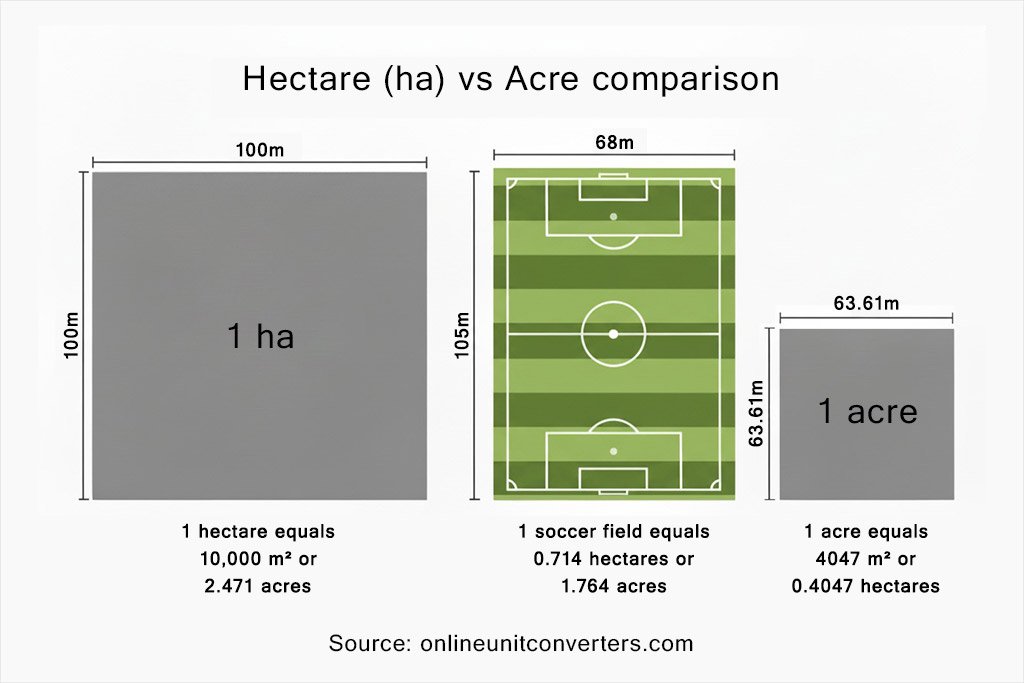
A single hectare equals exactly 10,000 square meters, or about 2.47 acres. If you're looking at modern farmland, this standard measurement does much more than mark boundary lines. It acts as the core unit for tracking soil health, calculating input costs, and pricing agricultural real estate.
Farmers, lenders, and land investors don't just ask how many hectares a property covers anymore. They want to know what each individual hectare produces, how much water it holds, and how digital sensors can maximize its output.
Understanding the Hectare Definition and Scale
The word hectare comes from the metric system, combining hecto (meaning one hundred) with are (a unit of 100 square meters). One hundred of those ares make a hectare.
To visualize it, imagine a square plot measuring 100 meters on each side. That's a hectare. It's slightly larger than two American football fields laid side by side. Further reporting on the subject has been provided by BBC.
While the imperial system relies on acres, the metric hectare dominates international agricultural data, global land registries, and scientific research. Understanding this scale matters because global commodity yields, carbon credit calculations, and trade agreements are increasingly calculated on a per-hectare basis.
How Land Valuation Has Shifted Beyond Raw Acreage
Old-school land appraisals looked mostly at total square footage or acreage alongside proximity to a highway. Modern agricultural economics looks entirely different.
Two adjacent 100-hectare farms can carry wildly different market values based on hidden productivity drivers. A property with high organic matter, tile drainage, and reliable irrigation commands a premium price per hectare. Meanwhile, an eroded or waterlogged plot nearby trades at a deep discount, even if it spans the exact same physical area.
Financial institutions now evaluate farmland using biological productivity indices. When a lender assesses collateral for an operating loan, they analyze historical yield maps and soil nutrient tests broken down by the hectare. This turns land into a granular financial asset where every sub-section has a distinct cash-flow profile.
Precision Farming and the One-Hectare Zone
Precision agriculture breaks large fields into micro-zones, but the hectare remains the baseline for operational planning. GPS-guided tractors, drone sprayers, and variable-rate fertilizer applicators operate by treating every square meter of a hectare differently.
Instead of dumping uniform fertilizer across an entire 50-hectare field, agronomists use yield monitoring data to apply nitrogen precisely where plants need it. This targeted approach cuts chemical waste by up to 25% while lifting yields.
The hectare transforms from a static drawing on a cadastral map into a managed production block. Farmers track fuel use, seed drop rates, and moisture retention per hectare, turning every section into a tightly monitored profit center.
Sustainability Metrics Calculated Per Hectare
Environmental regulations and corporate sustainability targets are shifting how land value is measured. Governments and food brands track environmental performance metrics directly per hectare.
- Carbon Sequestration: Soil organic carbon storage is measured in tons per hectare, allowing farmers to generate tradable carbon credits.
- Water Use Efficiency: Crop yield per cubic meter of irrigation water applied across a hectare determines long-term drought resilience.
- Biodiversity Index: Habitat preservation zones measured as a percentage of total land hectares help farms qualify for premium-priced supply chains.
The Food and Agriculture Organization emphasizes that sustainable intensification—getting more food out of existing farmland without clearing new forests—relies entirely on optimizing these per-hectare ecological indicators.
Common Mistakes in Agricultural Land Evaluation
Buyers and new investors often make costly errors when assessing farmland value because they rely on outdated metrics.
The biggest mistake is assuming uniform productivity across a property. A listing that boasts 200 fertile hectares might hide fifty hectares of rocky or poorly drained soil that drains profit margins. Always request historical yield monitor maps rather than relying on gross acreage totals.
Another error is ignoring water rights and irrigation infrastructure. A hectare of prime soil in a drought-prone region with strict pumping limits is worth significantly less than a similar hectare backed by a secure, permitted well or canal share.
Frequently Asked Questions
How many acres are in one hectare?
One hectare equals approximately 2.47 acres (or 0.4047 hectares in one acre). To convert acres to hectares, multiply your acre total by 0.4047.
Why do global agricultural reports use hectares instead of acres?
The metric system offers a standardized, universal language for international trade, scientific research, and global commodity reporting by the USDA Economic Research Service.
Does soil quality change the market price per hectare?
Yes. Soil fertility, pH balance, and subsoil drainage often dictate land prices more than geographic location. High-grade arable land commands much higher per-hectare prices than marginal soils.
How does precision technology impact a single hectare?
Sensors and variable-rate machinery let farmers manage sub-sections of a hectare independently, applying exact amounts of water and fertilizer to boost efficiency and lower input costs.



