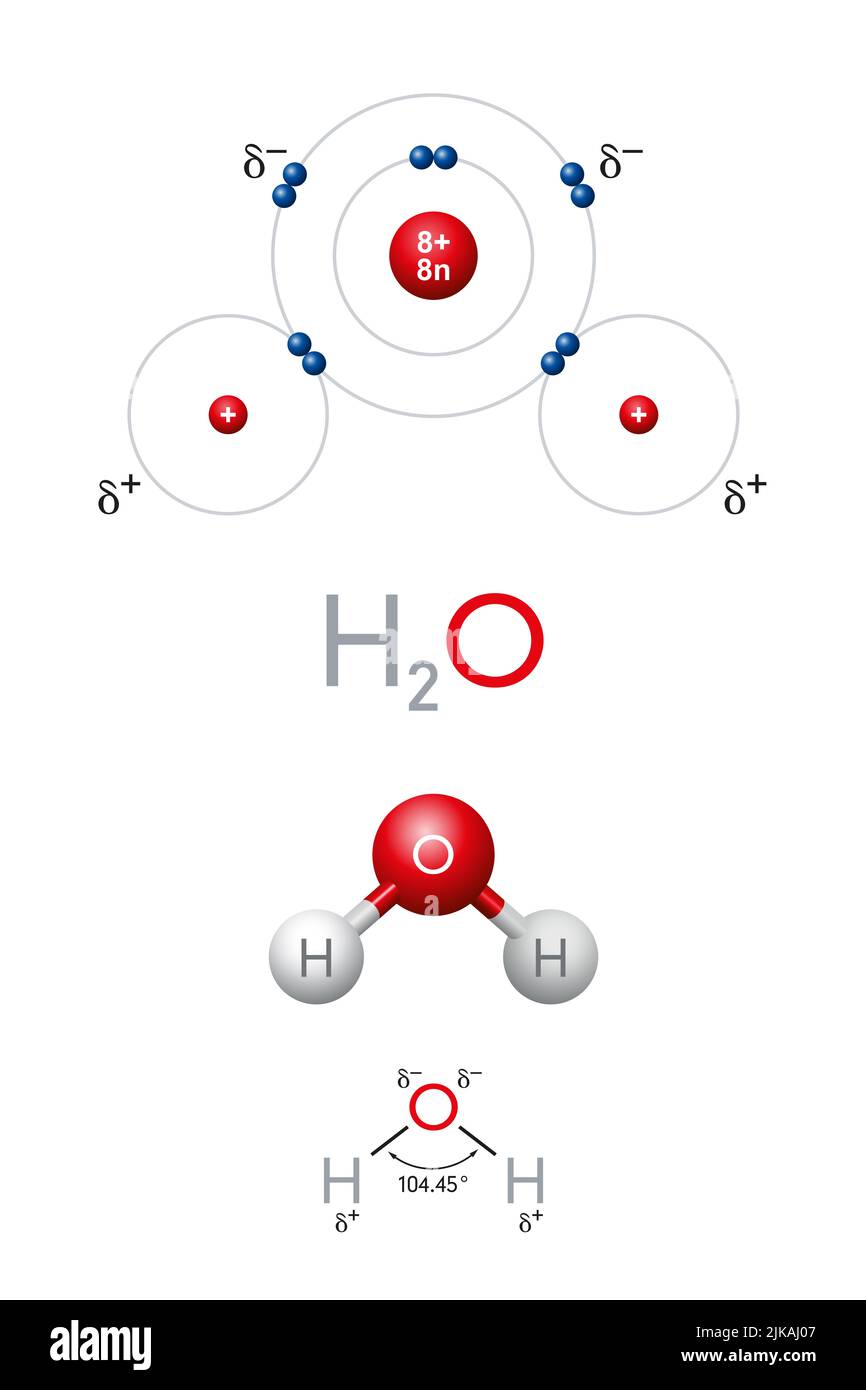
Water is the chemical compound H₂O, but its formal IUPAC chemical nomenclature is oxidane. Every single molecule consists of two hydrogen atoms bonded to a single oxygen atom via covalent bonds.
Understanding this simple ratio unlocks the physics and chemistry behind Earth's most abundant liquid. Let's look at why water behaves the way it does, how its molecular architecture shapes our world, and what standard chemical analyses reveal about its properties.
The Systematic Chemical Name: Oxidane
While everyone calls it water, the International Union of Pure and Applied Chemistry recognizes oxidane as the systematic name for H₂O. In broader chemical contexts, you'll also see terms like hydrogen oxide.
Common names persist because water was studied and named long before modern systematic nomenclature rules were established. However, when chemists describe water as a ligand in coordination complexes or specialized chemical nomenclature, oxidane is the precise term used.
The Atomic Breakdown of H₂O
The formula H₂O is a precise blueprint:
- Hydrogen (H): Two atoms of the lightest and most abundant element in the universe.
- Oxygen (O): One atom of a highly reactive, electronegative chalcogen.
- The Ratio: Exactly two hydrogen atoms for every one oxygen atom, bonded in a fixed stoichiometric ratio.
This composition means water is a pure chemical compound rather than a mixture. No matter where you source it—from a glacial stream, a laboratory tap, or deep underground aquifers—pure water always maintains this exact 2:1 atomic ratio.
Molecular Geometry and Polarity
Water's physical properties stem directly from its shape and electrical charge distribution. It isn't a linear molecule; instead, it adopts a bent or V-shaped geometry with an bond angle of roughly 104.5 degrees.
Why Water is Bent
The central oxygen atom has six valence electrons. Two of these are shared with the single electrons from two hydrogen atoms, forming two single covalent bonds. The remaining four electrons form two unbonded lone pairs. According to valence shell electron pair repulsion theory, these lone pairs push the hydrogen atoms downward, creating that characteristic bent structure.
The Dipole Moment
Oxygen has a much higher electronegativity than hydrogen. It hogs the shared electrons, pulling them closer to its nucleus. This creates a partial negative charge near the oxygen atom and partial positive charges near the two hydrogen atoms. Because the molecule is bent, these charges don't cancel out. Water becomes a polar molecule with a strong dipole moment.
Hydrogen Bonding and Anomalous Behavior
That polarity creates intermolecular forces known as hydrogen bonds. The partially positive hydrogen of one molecule attracts the partially negative oxygen of another.
These bonds are individually weak, but collectively they give water high boiling points, high melting points, and exceptional surface tension compared to similar molecules like hydrogen sulfide (H₂S).
- Universal Solvent: Because of its polarity, water pulls apart ionic compounds like sodium chloride and dissolves polar organic molecules.
- Density Anomaly: Most substances shrink and become denser as they freeze. Water reaches maximum density at 4 degrees Celsius. As it solidifies into ice, hydrogen bonds force the molecules into an open hexagonal crystal lattice, making ice less dense than liquid water. That's why ice floats.
Practical Analysis and Testing of Water
In environmental science and water treatment plants, technicians test water purity through precise analytical metrics rather than just relying on its chemical formula.
- pH Testing: Pure water has a neutral pH of 7 at 25 degrees Celsius, where hydrogen ions ($H^+$) and hydroxide ions ($OH^-$) balance out at $10^{-7}$ moles per liter.
- Conductivity Measurements: Pure H₂O is a poor conductor of electricity. High electrical conductivity indicates dissolved mineral ions or impurities.
- Total Dissolved Solids (TDS): Meters measure the combined content of all inorganic and organic substances dissolved in a liquid, tracked in parts per million.
You can review water quality standards and guidelines through the U.S. Environmental Protection Agency. For broader chemical definitions and nomenclature updates, consult the International Union of Pure and Applied Chemistry.
Frequently Asked Questions
Is H₂O the only chemical formula for water?
Yes, H₂O is the standard molecular formula. In specialized isotopic contexts, you might see variations like heavy water, which is represented as $D_2O$ because it contains deuterium instead of standard hydrogen.
Why doesn't water mix with oil?
Oil molecules are nonpolar and lack charged regions. Water's polar molecules prefer to form hydrogen bonds with each other rather than interact with nonpolar hydrocarbons, causing oil and water to separate.
Can pure H₂O conduct electricity?
Extremely pure water is actually a poor conductor because it has very few free ions. It's the dissolved salts, minerals, and impurities in tap or natural water that allow electricity to flow easily.
What is heavy water?
Heavy water replaces standard hydrogen atoms with deuterium, a heavier isotope of hydrogen containing one neutron. Its chemical formula is $D_2O$ or $^2H_2O$, and it's used primarily in nuclear reactors as a neutron moderator.


