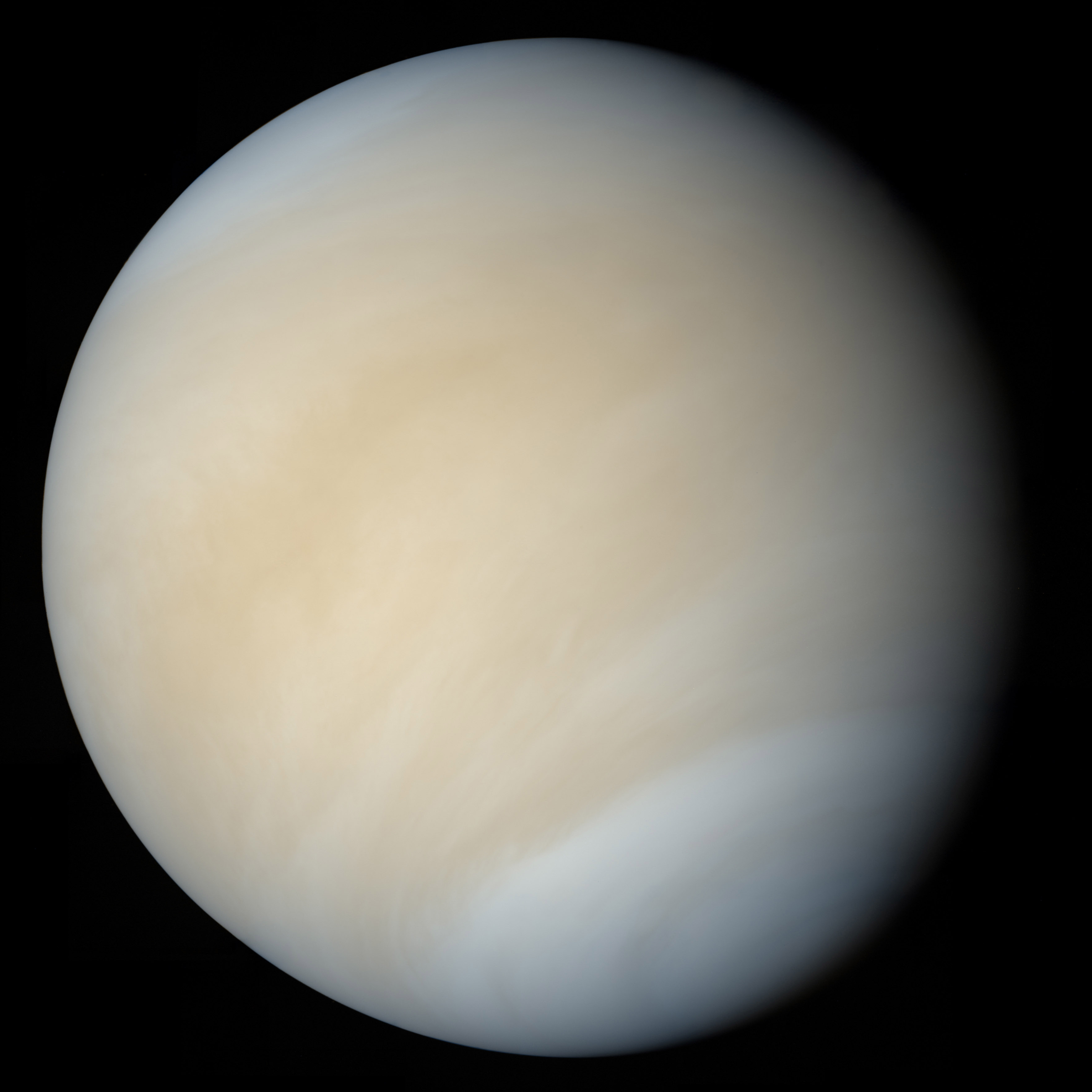
Venus orbits the Sun at an average distance of about 67.2 million miles, or 108.2 million kilometers. That places it second in line from our star, sitting comfortably between the scorching orbit of Mercury and the temperate, life-sustaining path of Earth. Because its orbit is remarkably circular, this distance doesn't fluctuate wildly the way it does for planets with highly elliptical paths. Yet, that relatively stable separation from the Sun drives the runaway greenhouse effect that makes Venus the hottest world in the solar system.
Understanding how Venus interacts with solar radiation requires looking past a simple average number. Its orbital mechanics, day length, and atmospheric composition work together to trap solar heat permanently. We're going to break down the exact orbital numbers, compare its journey to Earth's, and examine why being closer to the Sun turned this planetary twin into a pressurized furnace.
The Orbital Mechanics of Venus
Every planet carves out a distinct path around the Sun, shaped by gravity, velocity, and orbital eccentricity. Venus travels along one of the most circular paths of any planet in our cosmic neighborhood.
Perihelion, Aphelion, and Orbital Shape
Planets don't move in perfect circles; they follow ellipses. However, the eccentricity of the Venusian orbit is just 0.0067. For comparison, Earth's eccentricity is about 0.0167, and Pluto's is a dramatic 0.248.
- Perihelion (Closest Approach): Venus gets as close as 66.8 million miles (107.5 million kilometers) to the Sun.
- Aphelion (Farthest Distance): Its most distant point reaches 67.7 million miles (108.9 million kilometers).
- Average Radius: The semi-major axis settles right at 67.2 million miles (108.2 million kilometers), or roughly 0.72 astronomical units (AU).
Because the difference between its closest and farthest points is less than one million miles, solar radiation hitting the planet remains nearly constant throughout its year. Seasons on Venus aren't driven by distance changes. Instead, they are practically non-existent due to an axial tilt of just 3 degrees.
Orbital Speed and Year Length
Venus zips through space faster than Earth does, completing a full circuit around the Sun in just 225 Earth days. It moves at an average orbital speed of roughly 21.7 miles per second (35 kilometers per second).
While its year is short, its rotation is remarkably slow and backward. Venus rotates on its axis once every 243 Earth days. This means a single Venusian solar day—from one sunrise to the next—takes 117 Earth days. If you stood on the surface beneath the thick clouds, the Sun would take months to crawl across the sky from west to east.
Comparing Venus and Earth
For decades, astronomers called Venus Earth's twin. They share nearly identical sizes, masses, and rocky compositions. Venus has a radius of about 3,760 miles, compared to Earth's 3,959 miles, and boasts roughly 81 percent of Earth's mass.
Yet, their evolutionary paths diverged drastically. While Earth sits at an average distance of 93 million miles (1,50 million kilometers) from the Sun—receiving a moderate amount of solar flux—Venus orbits 26 million miles closer. That shorter distance meant Venus received about twice the solar energy Earth gets in its early history.
When the Sun grew brighter over billions of years, that extra heat triggered a tipping point. Early oceans on Venus evaporated, filling the atmosphere with water vapor. Water is a potent greenhouse gas, trapping more heat and driving temperatures higher until the rocks themselves began releasing carbon dioxide.
Atmospheric Amplification of Solar Heat
Distance alone doesn't explain why Venus is hot enough to melt lead. Mercury is closer to the Sun, yet Venus holds the title of the hottest planet.
The atmosphere of Venus consists of 96.5 percent carbon dioxide, with thick clouds of sulfuric acid hovering miles above the surface. This creates a crushing atmospheric pressure at the surface—about 92 times that of Earth, equivalent to the pressure found nearly a mile deep in Earth's oceans.
Solar radiation penetrates the upper cloud layers and warms the surface. When the surface tries to radiate that energy back out as infrared heat, the dense carbon dioxide blanket blocks it completely. This thermal trap drives surface temperatures to a blistering 900 degrees Fahrenheit (475 degrees Celsius) day and night, from equator to poles.
Observing Venus From Earth
Because Venus sits inside Earth's orbit, it never strays far from the Sun in our sky. You'll always spot it either shortly before sunrise as the morning star or shortly after sunset as the evening star.
Ancient astronomers tracked these phases carefully. Galileo Galilei observed the complete cycle of Venusian phases through his early telescope in 1610, proving definitively that Venus orbits the Sun rather than Earth. When Venus is closest to Earth during its inferior conjunction, it sits about 24 million miles away from us, appearing as a thin, bright crescent.
Space agencies have taken advantage of this proximity. Numerous missions, including NASA's Magellan orbiter and the European Space Agency's Venus Express, mapped its hidden surface through radar and studied its runaway climate.
Frequently Asked Questions
Why is Venus hotter than Mercury if Mercury is closer to the Sun?
Mercury lacks a substantial atmosphere to trap heat. While the sunlit side of Mercury reaches extreme temperatures, its night side plunges into extreme cold. Venus has a thick, carbon dioxide-rich atmosphere that wraps the entire planet in a permanent greenhouse blanket, maintaining uniform, extreme heat everywhere on the surface.
How long is a day on Venus compared to its year?
A single rotation on its axis takes 243 Earth days, making its sidereal day longer than its 225-day year. However, because it rotates retrograde (backwards), the sun rises and sets every 117 Earth days.
Can humans ever land on the surface of Venus?
Current technology cannot support human missions to the surface. The crushing pressure, 900-degree Fahrenheit heat, and corrosive sulfuric acid rain would destroy traditional landers within hours. Soviet Venera probes in the 1970s and 1980s managed to survive for only a few hours before succumbing to the environment.
Does Venus have any moons?
Venus has zero natural moons. Astronomers suspect that any primordial moons it might have formed with were likely destabilized or pulled away due to gravitational interactions and the planet's slow, retrograde rotation.



