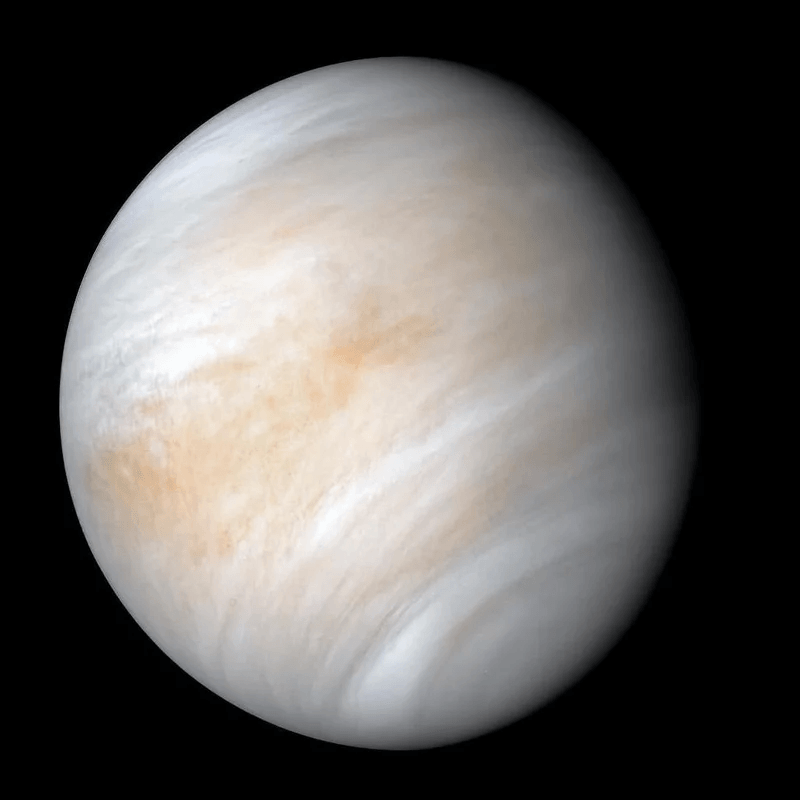
Sitting at an average distance of 0.72 astronomical units (AU) from the Sun, Venus orbits just 108 million kilometers away from our star. While that proximity sounds modest, it plunges our planetary neighbor into an inescapable atmospheric furnace. Earth thrives at 1.0 AU, but shrinking that gap by less than a third creates a world where surface temperatures soar past 460 degrees Celsius and atmospheric pressures crush like an ocean trench.
This article explores why sitting at 0.72 AU turned Venus into the solar system's most hostile hothouse. We'll look at the exact orbital mechanics, the physics of its runaway greenhouse effect, and how solar radiation shaped a world vastly different from our own.
Understanding the 0.72 AU Orbit
An astronomical unit equals the mean distance from Earth to the Sun, roughly 149.6 million kilometers. At 0.723 AU, Venus traces an orbit tighter and faster than Earth's, completing a full revolution every 225 Earth days.
Unlike Earth's slightly elliptical path, Venus maintains the most circular orbit of any planet in the solar system. Its orbital eccentricity is less than 0.01. That near-perfect circle means the planet experiences zero seasonal variation from orbital distance. It doesn't swing closer or farther away to catch a seasonal break.
Furthermore, Venus has an axial tilt of just 2.64 degrees. Earth tilts at 23.5 degrees, giving us distinct seasons as different hemispheres lean toward or away from the sun. Venus stands nearly upright, locking its equator and mid-latitudes into an eternal, unrelenting glare.
The Physics of Extreme Solar Flux
Proximity to the Sun governs the amount of solar radiation a planet absorbs, following the inverse-square law. Because Venus sits at 0.72 AU, it receives a solar flux roughly 1.9 times greater than what reaches Earth.
- Solar Constant: Venus absorbs about 2,613 watts per square meter of solar energy, compared to Earth's 1,361 watts.
- Albedo Paradox: Thick clouds of sulfuric acid cover Venus, reflecting about 75% of incoming sunlight back into space.
- Trapped Heat: Despite reflecting three-quarters of the light, the remaining 25% enters the system and gets trapped permanently by the dense atmosphere.
You might wonder how a planet reflecting so much sunlight gets so hot. The answer lies in what happens after that light hits the surface.
The Runaway Greenhouse Effect
Billions of years ago, Venus may have possessed liquid oceans and a climate resembling early Earth. As the Sun gradually brightened over cosmological timescales, that extra energy at 0.72 AU tipped the climate balance.
When surface temperatures rose slightly, oceans began to evaporate. Water vapor acts as a potent greenhouse gas. As more water entered the atmosphere, it trapped more heat, causing more evaporation in a vicious feedback loop.
Eventually, solar ultraviolet radiation split the atmospheric water molecules in the upper atmosphere. Hydrogen—being light—escaped into space, while oxygen bonded with surface carbon to form massive amounts of carbon dioxide. Today, the atmosphere consists of 96.5% carbon dioxide under a pressure 90 times greater than Earth's sea-level pressure.
Surface Realities and Atmospheric Hell
If you stood on the Venusian surface, the atmospheric pressure would feel equivalent to being nearly one kilometer underwater on Earth. The air isn't a gas anymore; due to extreme heat and pressure, the lower atmosphere behaves as a supercritical fluid.
Temperatures remain uniform day and night, hovering around 464 degrees Celsius (865 degrees Fahrenheit). That's hot enough to melt lead, zinc, and tin. The wind at the surface moves slowly—just a few kilometers per hour—but because the air is so dense, it exerts immense mechanical force against any structure or lander.
For deeper context on planetary evolution and atmospheric physics, NASA provides extensive data through the Solar System Exploration portal.
Common Misconceptions About Venus
Space enthusiasts often encounter several myths regarding Venus and its orbital placement:
- Myth: Venus is the hottest planet because it's closest to the Sun.
- Reality: Mercury is closer (averaging 0.39 AU), but it lacks a thick atmosphere. Venus is hotter because its runaway greenhouse effect traps heat far more effectively than Mercury's thin exosphere traps its daytime warmth.
- Myth: Venus rotates normally like Earth.
- Reality: Venus rotates backward (retrograde rotation) and extremely slowly, taking 243 Earth days to complete one single rotation—longer than its entire year.
- Myth: We can easily land rovers to study the surface.
- Reality: Soviet Venera landers achieved historic success in the 1970s and 1980s, but the extreme environment destroyed the probes in less than two hours.
Frequently Asked Questions
Why is Mercury not hotter than Venus if it is closer to the Sun?
Mercury sits much closer to the Sun at roughly 0.39 AU, but it lacks a substantial atmosphere. Without greenhouse gases to trap heat, Mercury's night side plunges to minus 180 degrees Celsius, while Venus maintains a searing 464 degrees globally due to its thick carbon dioxide blanket.
Could humans ever colonize Venus at 0.72 AU?
While surface colonization is impossible with current technology, scientists propose exploring Venus via aerobots floating in the upper atmosphere. At an altitude of about 50 kilometers, atmospheric pressure drops to roughly 1 bar, and temperatures hover around comfortable room temperature, making cloud-city habitats theoretically viable.
How does the 0.72 AU distance affect spacecraft missions?
Traveling to Venus requires less delta-v and shorter transit times from Earth than missions to outer planets or even Mars during unfavorable windows. Agencies like the European Space Agency utilize Venus for gravity assists, as seen with the BepiColombo mission looping past the planet on its way to Mercury.
Did Venus always have such a thick atmosphere?
No. Planetary scientists believe Venus originally outgassed a volatile-rich atmosphere similar to Earth's, but the lack of plate tectonics to recycle carbon dioxide into the crust, combined with intense solar radiation at 0.72 AU, locked the gas in the atmosphere permanently.



