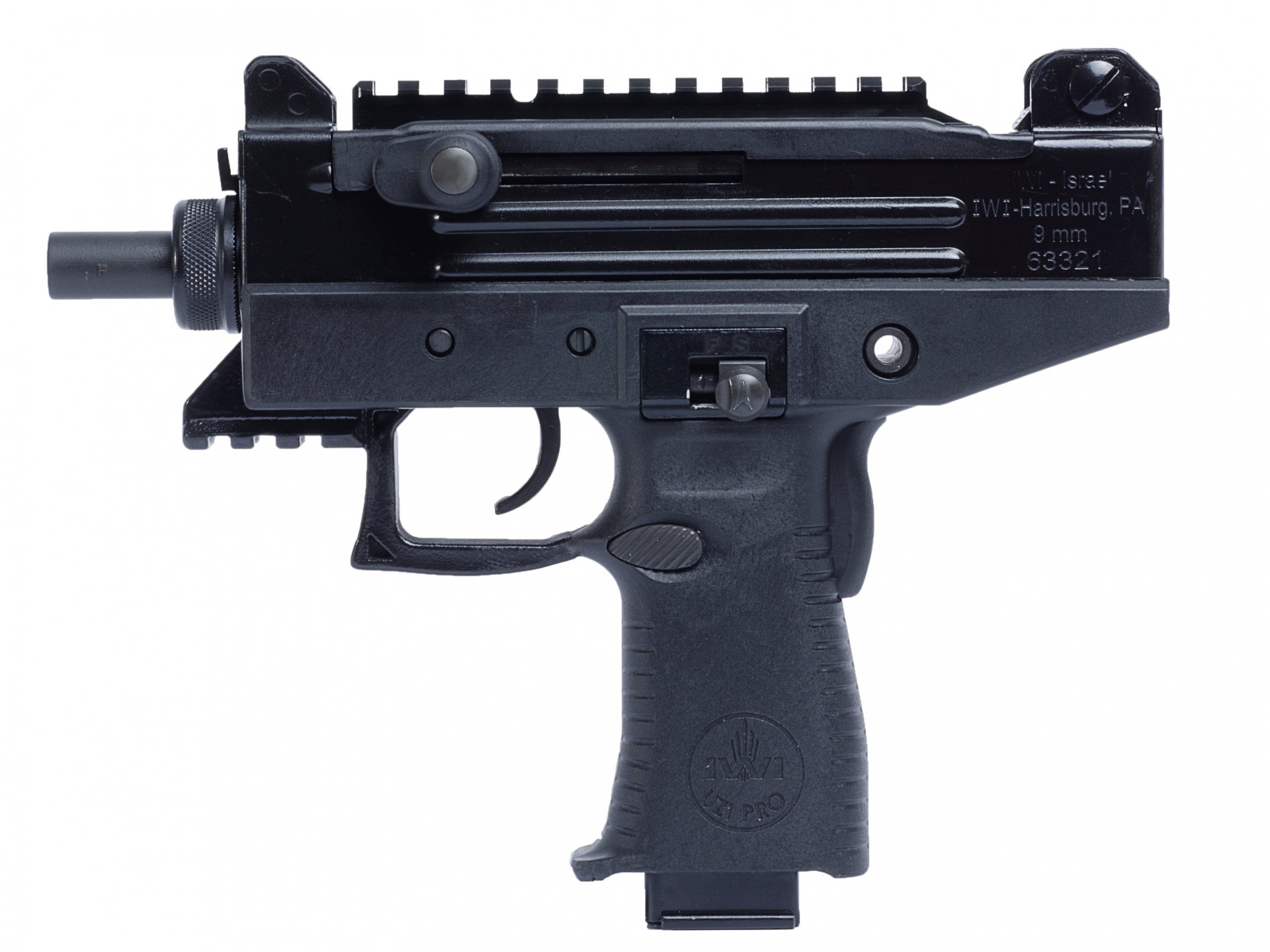
The Uzi submachine gun changed close-quarters combat forever when it entered service with Israeli special forces in 1954. Designed by Major Uziel Gal in the wake of the 1948 Arab-Israeli War, this weapon solved an urgent national defense problem by combining simple stamped-metal manufacturing with radical mechanical innovations. It grew into a global icon, exported to over 90 countries and adopted by military units, law enforcement agencies, and security details worldwide.
At its core, the weapon relies on an open-bolt blowback mechanism paired with a telescoping bolt that wraps around the barrel. This smart engineering keeps the overall length short while retaining a heavy bolt mass and a standard barrel length. You get a compact, reliable firearm that feeds from a magazine housed directly inside the pistol grip, making reloading intuitive even in pitch darkness.
Origins and Development
Following the declaration of independence, the newly formed state of Israel faced severe arms embargoes and a chaotic mix of mismatched surplus firearms. To standardize military equipment, the Israel Defense Forces initiated a program to design a domestic submachine gun that was inexpensive to build, tough enough for desert operations, and simple for conscripts to maintain.
Major Uziel Gal drew partial inspiration from Czech firearm designs like the CZ 25, which featured a similar magazine-in-grip configuration and open-bolt blowback layout. However, Gal refined these concepts substantially. He built the first prototype in 1950, and after rigorous testing, the weapon entered service in 1954, first seeing combat during the 1956 Suez Crisis with a fixed wooden stock.
Production was handed over to Israel Military Industries (IMI), which scaled manufacturing rapidly. The weapon's straightforward construction relied heavily on heavy stamping and welded sheet metal, which lowered production costs and allowed the young nation to arm its forces quickly.
Technical Innovations and Operation
The engineering behind the Uzi centers on efficiency and reliability in adverse environments like sand and mud. Several key features defined its mechanical success:
- Telescoping Bolt: By wrapping the bolt forward over the rear portion of the barrel, engineers shortened the overall length of the weapon by several inches without sacrificing barrel length or bolt weight.
- Magazine-in-Grip Placement: Locating the magazine well inside the pistol grip utilized the "hand-finds-hand" principle. Shooters could reload instinctively by feel, which proved critical during night operations and high-stress encounters.
- Open-Bolt Air Cooling: The bolt stays locked to the rear before firing, holding the chamber open between bursts. This design allows air to circulate through the barrel, reducing the risk of cook-offs during sustained automatic fire.
- Safety Mechanisms: Early military variants featured a grip safety, a manual safety selector (Safe, Semi, Full-Auto), and a ratchet mechanism on the top-cover charging handle to prevent accidental discharges if the bolt slipped during cocking.
The standard variant chambered the 9x19mm Parabellum cartridge and fed from box magazines holding 25, 32, or 40 rounds. Its cyclic rate of fire hovered around 600 rounds per minute, making it controllable when fired in short bursts from the shoulder or hip.
Evolution of the Uzi Family
As military tactics shifted toward counter-terrorism and close-protection details in the 1970s and 1980s, the original design proved too large for concealed carry or tight vehicle spaces. Manufacturers responded by shrinking the platform into specialized variants.
The Mini Uzi
Introduced in 1980, the Mini Uzi reduced the overall length and weight to better suit specialized units and vehicle crews. It featured a shorter barrel and a higher cyclic rate of roughly 950 rounds per minute due to the reduced mass of the lighter bolt. Despite its smaller size, it retained the familiar ergonomics of its predecessor.
The Micro Uzi and Uzi Pro
Released in 1986, the Micro Uzi scaled the platform down even further into a machine-pistol format. Operating on a closed-bolt mechanism in many configurations, it delivered a blistering rate of 1,200 rounds per minute. Decades later, Israel Weapon Industries (IWI) introduced the modern Uzi Pro, which incorporates polymer construction, Picatinny rails for optics and lights, and a repositioned charging handle on the left side to improve modern tactical utility.
Cultural Impact and Global Legacy
Beyond its military service, the Uzi achieved unmatched pop culture saturation. From news photographs of the United States Secret Service guarding high-profile officials to appearances in action cinema, the silhouette became instantly recognizable. Its name, short and punchy, rolled off the tongue easily, cementing its status in modern media.
While modern assault rifles and PDWs (Personal Defense Weapons) have largely replaced traditional submachine guns in frontline military units, the Uzi remains a landmark achievement in firearms engineering. It proved that clever layout choices could make a weapon shorter, more balanced, and easier to produce without compromising battlefield durability.
Frequently Asked Questions
Why is the magazine housed inside the pistol grip?
Placing the magazine inside the pistol grip centers the weapon's weight directly over the shooter's hand. This layout improves balance, reduces muzzle climb during automatic fire, and allows for intuitive reloads by feel.
What ammunition does the standard Uzi use?
The standard military variant is chambered for the 9x19mm Parabellum cartridge. Conversion kits and civilian semi-automatic variants have also been produced in .22 Long Rifle, .41 Action Express, and .45 ACP.
Is the Uzi still in active military service?
While frontline military adoption has largely shifted to modular carbines and personal defense weapons, specialized police units, security details, and reserve elements around the world still field the platform and its modern variants.
How does an open-bolt system work?
In an open-bolt firearm, pulling the trigger releases the bolt, which travels forward, strips a round from the magazine, chambers it, and fires it immediately. This leaves the breech open between shots, helping cool the barrel during sustained fire.


