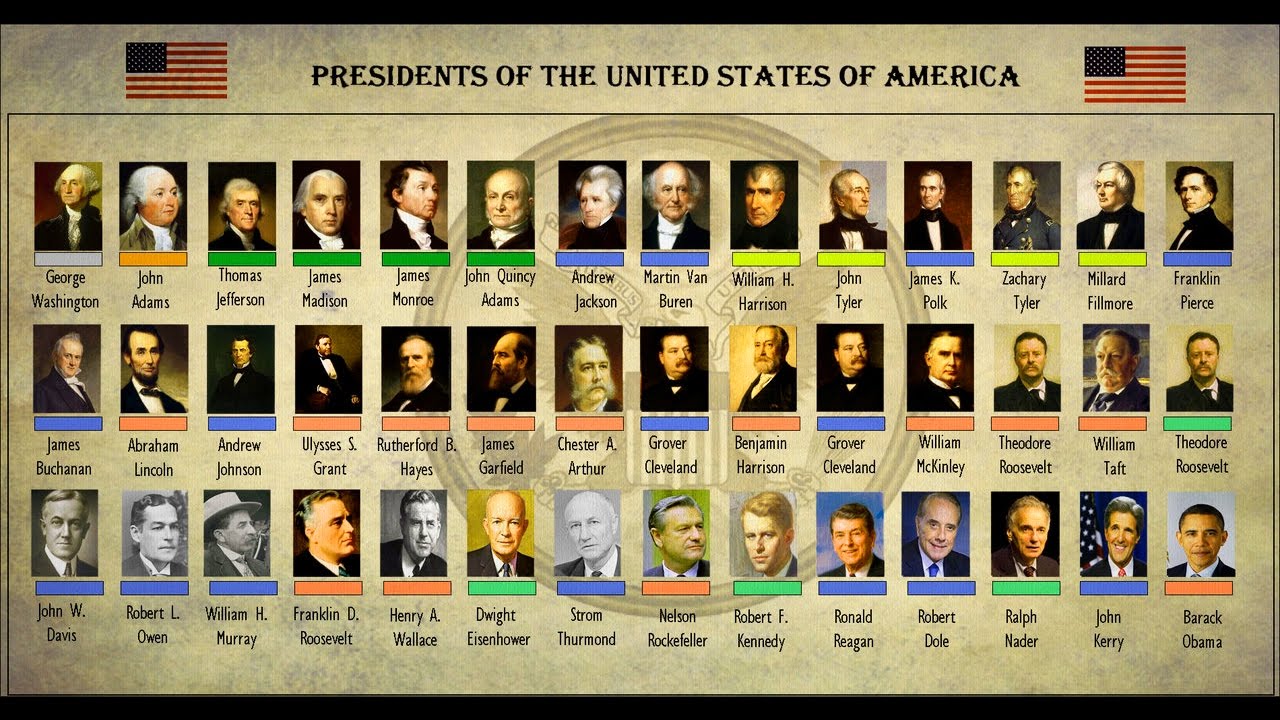
Learning the American presidents in order offers a clear lens into how the country's executive office evolved over centuries. From George Washington's fragile launch of a brand-new constitutional office to modern administrations managing global digital economies, every leader added new precedents, powers, and controversies to the presidency.
The U.S. presidency is an unbroken chain of authority shaped by constitutional design, national crises, and individual ambition. Examining these leaders chronologically reveals how executive power expanded far beyond what the founders initially outlined in Article II of the Constitution.
The Founding Era and Early Expansion (1789–1829)
The first four decades established whether the federal experiment would survive. The initial leaders wrestled with foreign wars, financial collapse, and defining the boundaries of presidential power.
- George Washington (1789–1797): Set foundational precedents, including the two-term limit and the formation of a cabinet. He favored neutrality in European conflicts, warning against permanent foreign alliances.
- John Adams (1797–1801): Navigated an undeclared naval war with France (the Quasi-War) and signed the controversial Alien and Sedition Acts, which heavily damaged his public standing.
- Thomas Jefferson (1801–1809): Orchestrated the 1803 Louisiana Purchase, doubling the nation's landmass while privately questioning whether the Constitution granted him the authority to do so.
- James Madison (1809–1817): Led the country through the War of 1812 against Great Britain, which saw Washington D.C. burned and solidified American economic independence.
- James Monroe (1817–1825): Presided over the "Era of Good Feelings" and established the Monroe Doctrine, warning European powers against interfering in the Western Hemisphere.
- John Quincy Adams (1825–1829): Focused on infrastructure, science, and education, though his legislative agenda stalled due to fierce political opposition from Andrew Jackson's camp.
Jacksonian Democracy and Sectional Crisis (1829–1865)
This era marked the rise of mass political parties, populist rhetoric, and the escalating tensions over slavery that culminated in civil war.
- Andrew Jackson (1829–1837): Expanded executive power through frequent vetoes and the dismantling of the Second Bank of the United States. His administration also enforced the deadly Indian Removal Act.
- Martin Van Buren (1837–1841): Inherited the Panic of 1837, a severe financial depression caused largely by Jackson's banking policies, which crippled his single term.
- William Henry Harrison (1841): Died of pneumonia just 31 days into his term, serving the shortest tenure in U.S. history and triggering the first constitutional succession crisis.
- John Tyler (1841–1845): Became known as "His Accidency" after breaking with his own Whig party over national bank vetoes. He successfully annexed Texas in his final days.
- James K. Polk (1845–1849): Achieved every major territorial and political goal in four years, including the Oregon Territory settlement and winning the Mexican-American War, which added vast western lands.
- Zachary Taylor (1849–1850): A military hero who died in office after serving little over a year, leaving the explosive debate over slavery expansion in the territories unresolved.
- Millard Fillmore (1850–1853): Signed the Compromise of 1850, including the Fugitive Slave Act, which temporarily delayed civil conflict while deepening regional hatreds.
- Franklin Pierce (1853–1857): Supported the Kansas-Nebraska Act, a catastrophic policy that allowed popular sovereignty on slavery and sparked violent guerilla warfare in the territories ("Bleeding Kansas").
- James Buchanan (1857–1861): Failed to address or halt the secession of Southern states following the election of Abraham Lincoln, widely regarded by historians as one of the weakest presidencies.
- Abraham Lincoln (1861–1865): Led the Union through the Civil War, issued the Emancipation Proclamation, and redefined the moral purpose of American democracy before his assassination.
Reconstruction, Industrialization, and Gilded Age (1865–1901)
Following Lincoln's death, the nation grappled with rebuilding the South, integrating millions of freed slaves, and managing explosive industrial growth alongside massive corporate monopolies.
- Andrew Johnson (1865–1869): Clashed fiercely with a Republican Congress over Reconstruction policies and became the first president to be impeached, though he was acquitted by a single vote in the Senate.
- Ulysses S. Grant (1869–1877): Enforced civil rights protections for Black Americans in the South using federal troops, though his administration suffered from widespread cabinet corruption.
- Rutherford B. Hayes (1877–1881): Secured the presidency through the disputed Compromise of 1877, which officially ended federal military reconstruction in the South.
- James A. Garfield (1881): Assassinated just months into his term by a disgruntled office seeker, an event that catalyzed major civil service reform.
- Chester A. Arthur (1881–1885): Surprised critics by championing the Pendleton Civil Service Reform Act, ensuring government jobs were awarded based on merit rather than political patronage.
- Grover Cleveland (1885–1889 & 1893–1897): The only president to serve two non-consecutive terms. He focused on tariff reduction and vetoed numerous private pension bills for Civil War veterans.
- Benjamin Harrison (1889–1893): Signed the Sherman Antitrust Act to curb monopolistic business practices, though enforcement during his term remained weak.
- William McKinley (1897–1901): Led the country to victory in the Spanish-American War, transforming the United States into an overseas colonial power with possessions like Puerto Rico and the Philippines.
The Modern Presidency and Global Conflict (1901–1945)
The 20th century transformed the American president into a global leader and the primary engine of domestic policy, regulatory oversight, and military strategy.
- Theodore Roosevelt (1901–1909): Championed the "Square Deal," regulated major trusts, aggressively promoted conservation of public lands, and advanced the construction of the Panama Canal.
- William Howard Taft (1909–1913): Pursued more antitrust suits than Roosevelt but fractured the Republican party, leading to a bitter three-way election in 1912.
- Woodrow Wilson (1913–1921): Created the Federal Reserve, enacted progressive labor laws, led the nation through World War I, and championed the failed League of Nations.
- Warren G. Harding (1921–1923): Promoted a "return to normalcy" after WWI, but his administration was plagued by severe corruption scandals, most notably Teapot Dome.
- Calvin Coolidge (1923–1929): Emphasized small government, tax cuts, and laissez-faire economic policies during the roaring economic boom of the 1920s.
- Herbert Hoover (1929–1933): Blamed for failing to halt the devastating onset of the Great Depression after the 1929 stock market crash, relying initially on voluntary cooperation rather than direct federal relief.
- Franklin D. Roosevelt (1933–1945): The only president elected to four terms. He rescued the economy through the New Deal and mobilized the nation's industrial might to fight World War II.
The Cold War and Civil Rights (1945–1993)
Post-war presidents navigated nuclear standoffs, proxy wars abroad, and turbulent domestic movements for racial equality and social change.
- Harry S. Truman (1945–1953): Authorized the atomic bombings of Japan, integrated the military, and established the Truman Doctrine to contain Soviet communism during the early Cold War.
- Dwight D. Eisenhower (1953–1961): Ended the Korean War, created the Interstate Highway System, and warned against the growing influence of the "military-industrial complex."
- John F. Kennedy (1961–1963): Managed the high-stakes Cuban Missile Crisis and established the Peace Corps, though his civil rights legislation stalled before his 1963 assassination.
- Lyndon B. Johnson (1963–1969): Passed landmark civil rights and voting rights acts, launched the "Great Society" social programs, but deeply divided the country over the Vietnam War.
- Richard Nixon (1969–1974): Opened diplomatic relations with China and eased tensions with the Soviet Union, but resigned in 1974 due to the Watergate burglary cover-up.
- Gerald Ford (1974–1977): Pardoned Richard Nixon to heal national wounds, which cost him widespread political capital during a difficult economic stagflation period.
- Jimmy Carter (1977–1981): Focused foreign policy on human rights and brokered the Camp David Accords, but struggled domestically with an energy crisis and the Iran hostage situation.
- Ronald Reagan (1981–1989): Lowered taxes, deregulated industries, increased military spending, and applied ideological pressure that contributed to the eventual collapse of the Soviet Union.
- George H.W. Bush (1989–1993): Managed the peaceful dissolution of the Soviet Union and successfully assembled a global coalition to win the 1991 Gulf War.
The Contemporary Era (1993–Present)
Recent decades have brought rapid technological change, economic globalization, ongoing Middle Eastern conflicts, and intense domestic polarization.
- Bill Clinton (1993–2001): Oversaw an extended period of economic growth and budget surpluses, though his second term was marred by personal scandals leading to impeachment.
- George W. Bush (2001–2009): Responded to the September 11 attacks by launching the War on Terror, invading Afghanistan and Iraq, and creating the Department of Homeland Security.
- Barack Obama (2009–2017): Passed the Affordable Care Act, navigated the aftermath of the 2008 financial crisis, and authorized the raid that killed Osama bin Laden.
- Donald Trump (2017–2021): Focused on deregulation, conservative judicial appointments, and trade protectionism, leading to two historic impeachments before leaving office.
- Joe Biden (2021–2025): Passed major infrastructure and climate legislation, rallied international support for Ukraine, and navigated post-pandemic economic recovery.
- Donald Trump (2025–Present): Returned to the White House following the 2024 election, focusing heavily on border enforcement, trade tariffs, and deregulation.
Common Mistakes When Studying the Presidents
- Confusing Succession with Election: Remember that vice presidents who inherit the office (such as Tyler or Ford) did not win a presidential election on their own ticket at the time they took office.
- Ignoring Institutional Evolution: Assuming George Washington held the same sweeping executive powers as modern presidents is a major historical error; powers expanded gradually over centuries through precedent and crisis.
- Misdating Terms: Keep in mind that inaugurations shifted from March to January with the 20th Amendment in 1933, altering how term lengths are counted for early figures.
Frequently Asked Questions
Which president served the shortest term in office?
William Henry Harrison holds this record. He served for only 31 days in 1841 before dying from pneumonia, which he contracted after delivering a lengthy inaugural address in cold weather without an overcoat.
How many presidents have been impeached?
Three presidents have been impeached by the House of Representatives: Andrew Johnson in 1868, Bill Clinton in 1998, and Donald Trump in 2019 and 2021. None of them were convicted by the Senate.
Who was the only president to serve more than two terms?
Franklin D. Roosevelt won four consecutive presidential elections between 1932 and 1944. Following his death in office, Congress passed the 22nd Amendment in 1951, legally limiting future presidents to two terms.
Who was the youngest person to assume the presidency?
Theodore Roosevelt is the youngest person to serve as president, taking office at age 42 following the assassination of William McKinley. John F. Kennedy was the youngest person ever elected to the office, at age 43.



