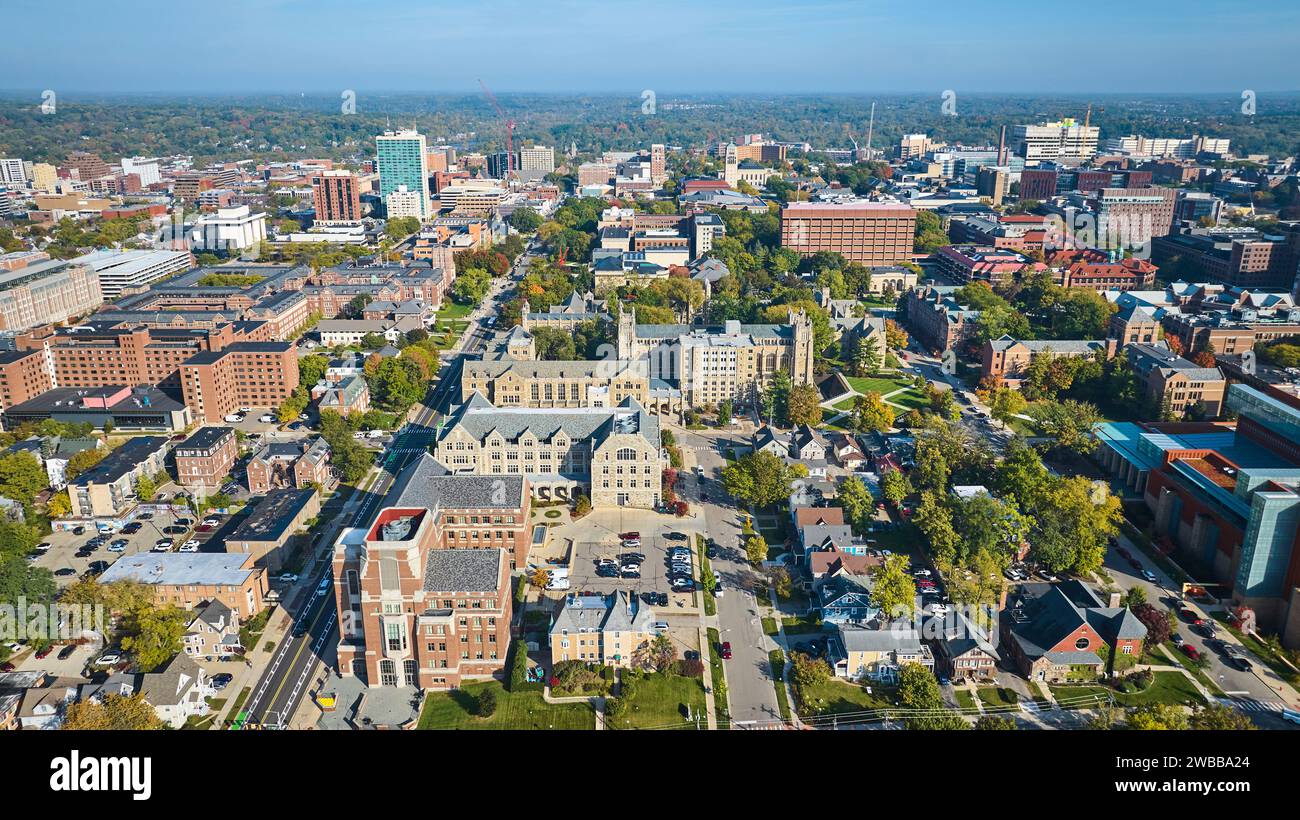
Choosing your academic path at a major research university isn't just about picking a subject you enjoy; it's about aligning your interests with the right college, prerequisites, and career outcomes. If you're navigating Umich Ann Arbor majors, the sheer volume of choices can feel overwhelming. With over 100 undergraduate degree programs spread across multiple distinct schools and colleges, knowing where to start makes all the difference.
The University of Michigan doesn't use a quarter system, despite common misconceptions; it operates on a standard semester system with Fall and Winter terms, alongside spring and summer spring-half terms. Understanding how admissions, cross-campus transfers, and prerequisites work will keep you from wasting time and tuition dollars. Let's break down how to evaluate your options, navigate the institutional structure, and pick the right path without getting lost in the system.
Understanding the College Structure at U-M
Unlike smaller liberal arts colleges where every student applies to a single general admissions pool, U-M is split into distinct schools and colleges. Each operates with its own admissions criteria, faculty, and graduation requirements. When you apply, you're typically admitted directly to a specific unit, such as the College of Literature, Science, and the Arts (LSA) or the College of Engineering.
Switching between these colleges later is possible, but it requires meeting specific prerequisite courses and GPA thresholds. Knowing which unit houses your target subject is the first rule of academic planning.
College of Literature, Science, and the Arts (LSA)
LSA is the largest undergraduate college on campus, housing everything from natural sciences to the humanities and social sciences.
- Flexibility: You don't have to declare a specific major until the end of your sophomore year.
- Breadth Requirements: Students must complete coursework in race and ethnicity, quantitative reasoning, and natural science distribution.
- Popular Paths: Economics, Psychology, Political Science, and Computer Science (which is offered through both LSA and Engineering).
College of Engineering
Consistently ranked among the top public engineering programs nationally, this college is structured heavily around hands-on design and technical depth.
- Direct Admissions: Most students enter as direct first-year admits, though cross-campus transfer options exist.
- First-Year Engineering (ENGR 100): Every freshman takes an introduction to engineering course that involves hands-on team projects solving real-world design problems.
- Popular Paths: Mechanical Engineering, Computer Science, Biomedical Engineering, and Aerospace Engineering.
Stephen M. Ross School of Business
The Ross School is famous for its action-based learning model, but getting in requires a deliberate strategy.
- Admissions Structure: While some students enter as direct high school admits, a large cohort applies during their freshman year for winter admission to start as sophomores.
- Multidisciplinary Design: Coursework heavily integrates team projects with corporate partners, requiring strong group collaboration skills from day one.
How to Choose Your Major: A Step-by-Step Framework
Don't wait until your junior year registration window to figure out what you want to study. Use a structured, methodical approach to narrow down your options during your first two semesters.
- Audit your graduation requirements early: Pull up the University of Michigan Office of the Registrar site and look at the LSA or college bulletin. Check foreign language, math, and distribution requirements so you knock them out while exploring.
- Take gateway courses in your top three choices: If you're torn between economics, statistics, and public policy, enroll in Econ 101, Stats 250, and PubPol 201 during your first year. Your grades in these entry-level courses will tell you honestly whether you enjoy the day-to-day work of that discipline.
- Talk to departmental peer advisors: Every department employs upperclassmen peer advisors who give honest, unfiltered advice about workload, grading curves, and professor reputations that official brochures leave out.
- Map the four-year timeline: Sketch out a semester-by-semester spreadsheet. If a major requires five sequential chemistry classes with lab prerequisites, you need to start immediately or you won't graduate on time.
Common Pitfalls to Avoid
Students make predictable mistakes when choosing their academic paths at large universities. Watch out for these traps:
- Chasing prestige over fit: Picking a notoriously brutal engineering or finance major just for the starting salary when you despise calculus will tank your GPA. Graduate schools and employers care deeply about your GPA and practical portfolio.
- Ignoring prerequisite bottlenecks: Many upper-level courses require specific prerequisites that fill up within minutes during registration. Always register for gateway classes as early as your timestamp allows.
- Waiting too long to declare: While LSA allows you to wait until sophomore year, delaying too long in structured programs like nursing, architecture, or engineering means you'll have to take summer classes to catch up.
Frequently Asked Questions
Can I double major across different schools at U-M?
Yes, but it's complex. Known as a dual degree, it requires approval from both academic units and usually means completing 150 total credits rather than the standard 120. Check with academic advisors in both colleges before committing.
What happens if I enter as an undeclared student?
You'll enter LSA or the Division of Kinesiology as undeclared, which is completely normal. Advisors help you test different subjects through general education requirements without putting you behind schedule.
How difficult is a cross-campus transfer to the Ross School of Business?
It's competitive. Admissions committees look closely at your college GPA, your performance in prerequisite courses like economics and calculus, and your essay responses detailing your commitment to action-based business problem-solving.
Are research opportunities available for undergraduates?
Yes. The University of Michigan Undergraduate Research Opportunity Program (UROP) connects first- and second-year students with paid faculty research projects across all disciplines, from medical labs to historical archives.



