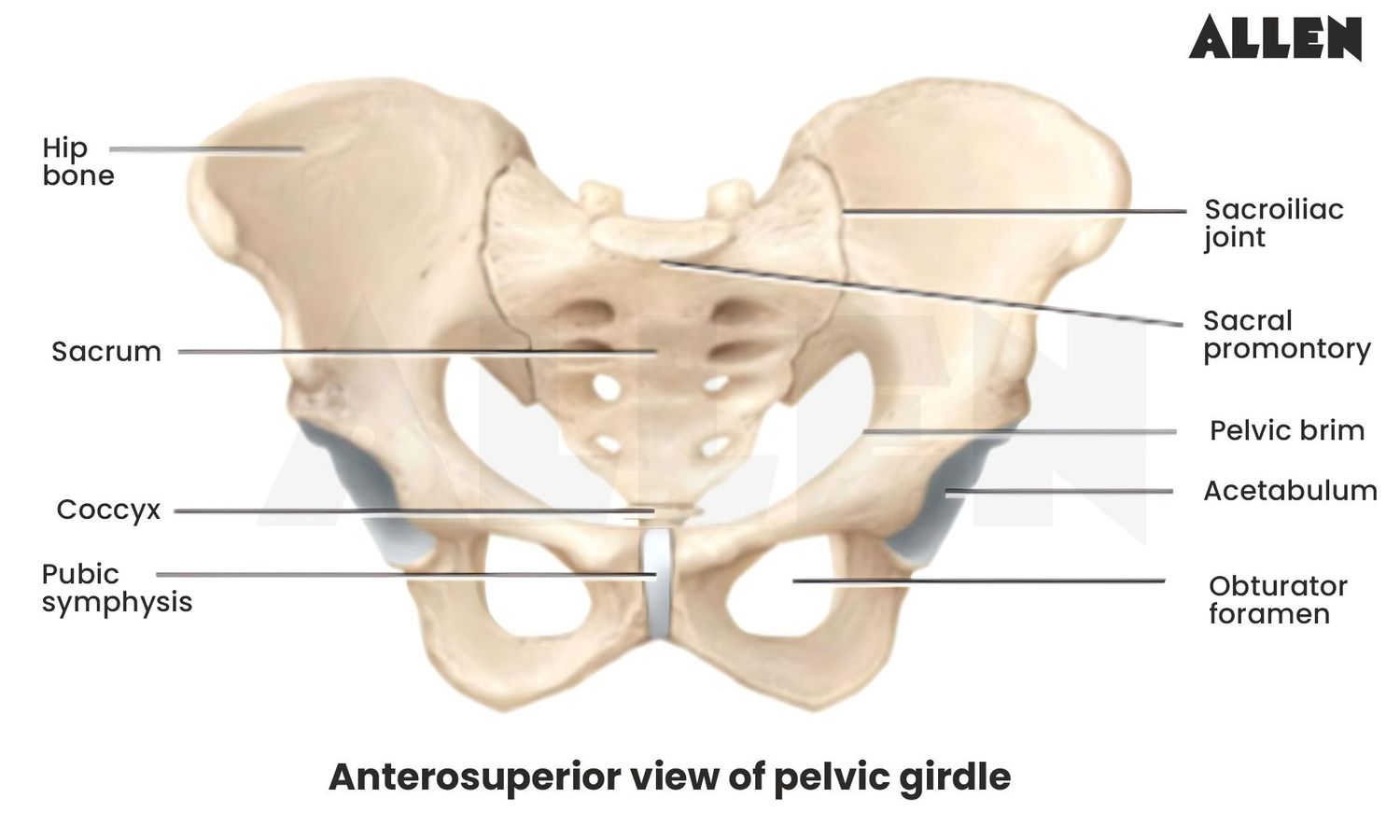
Anatomists divide the human bony pelvis into two distinct regions separated by an imaginary boundary known as the pelvic brim or linea terminalis. Understanding the difference between the true and false pelvis is essential for grasping human locomotion, abdominal support, and obstetrics. While the upper false pelvis functions primarily as an abdominal wall supporter and visceral container, the lower true pelvis acts as the rigid bony canal through which a baby passes during childbirth.
The pelvic brim acts as the structural dividing line. Everything situated superior to this boundary is the greater or false pelvis, while everything inferior belongs to the lesser or true pelvis. Recognizing how these two regions differ in skeletal composition, spatial orientation, and clinical relevance helps clarify why pelvic geometry varies significantly across individuals and sexes.
Defining the Pelvic Brim
The pelvic brim forms the anatomical threshold between the upper and lower pelvic compartments. This continuous, oval-shaped ring starts posteriorly at the sacral promontory, extends laterally across the arcuate line of the ilium and the pectineal line of the pubis, and terminates anteriorly at the pubic crest and the superior margin of the pubic symphysis.
Anything resting above this ring occupies the false pelvis, whereas structures enclosed below it reside within the true pelvis. Because the pelvic brim tilts forward at roughly a 50 to 60-degree angle relative to the horizontal plane in an upright standing position, the contents of the upper pelvis are directed forward and upward against the lower abdominal wall.
Anatomy of the False Pelvis
The false pelvis, also called the greater pelvis, is structurally an extension of the abdominal cavity rather than part of the true birth canal.
Boundaries and Structure
- Posterior boundary: Formed by the lumbar vertebrae.
- Lateral boundaries: Enclosed by the expansive iliac fossae of the hip bones.
- Anterior boundary: Bounded by the lower anterior abdominal wall, as there is no rigid bony wall at the front.
Contents and Function
The false pelvis houses lower abdominal viscera, notably parts of the small intestine, the sigmoid colon, and—during pregnancy—the expanding uterus. It provides muscular attachments for abdominal wall stabilizers and the iliacus muscle. While it doesn't restrict fetal descent directly, its width and form influence the overall shape of the hips and support abdominal pressure dynamics during core activation and lifting.
Anatomy of the True Pelvis
The true pelvis, or lesser pelvis, represents the deep, bony container located entirely beneath the pelvic brim. It holds profound clinical importance in obstetrics, gynecology, and urology because its rigid dimensions dictate the path of pelvic organs and childbirth.
Structural Subdivisions
The true pelvis is engineered as a curved bony tunnel featuring three distinct functional zones:
- The Pelvic Inlet: The upper opening defined by the pelvic brim, marking the entrance to the true pelvis.
- The Pelvic Cavity: A curved space spanning from the inlet down to the pelvic outlet, housing the bladder, rectum, and reproductive organs.
- The Pelvic Outlet: The diamond-shaped inferior opening bounded by the pubic arch, ischial tuberosities, and the coccyx.
Clinical Significance
During labor, the fetus must navigate the fixed diameters of the true pelvis. If the true pelvis is too narrow—a condition evaluated via pelvimetry—vaginal delivery can become obstructed. Furthermore, the floor of the true pelvis is supported by the levator ani muscles, which maintain urinary and fecal continence. Weakness in these muscles often leads to pelvic organ prolapse.
Key Differences Between True and False Pelvis
| Feature | False Pelvis (Greater Pelvis) | True Pelvis (Lesser Pelvis) |
|---|---|---|
| Location | Superior to the pelvic brim | Inferior to the pelvic brim |
| Skeletal Framework | Iliac fossae and upper sacrum | Pubis, ischium, lower ilium, and lower sacrum |
| Primary Function | Supports lower abdominal organs and provides muscle attachment | Forms the birth canal and contains pelvic viscera |
| Obstetric Role | None | Critical for fetal passage during labor |
For a deeper dive into skeletal anatomy resources, you can reference the National Institutes of Health or review structural summaries on Wikipedia.
Sexual Dimorphism in Pelvic Architecture
The human pelvis exhibits some of the most pronounced sexual dimorphism in the skeleton, driven largely by evolutionary adaptations for childbirth in females.
The female true pelvis is wider, shallower, and more circular, featuring a larger pelvic inlet and a broader subpubic angle (greater than 90 degrees). Conversely, the male true pelvis is narrower, deeper, and heart-shaped, with a funnel-like contraction toward the outlet and a sharp subpubic angle. The false pelvis in males tends to be deeper and more vertical, whereas female iliac wings flare outward more prominently, widening the hips.
Frequently Asked Questions
Why is the false pelvis clinically called "false"?
Early anatomists named it "false" because it doesn't enclose the true pelvic organs. It acts essentially as a lower extension of the abdominal cavity rather than a distinct basin.
Can pelvic measurements change over time?
Bony dimensions become fixed after skeletal maturity following puberty. However, the joints and ligaments surrounding the pelvis—such as the pubic symphysis—soften during pregnancy due to relaxin hormones, allowing temporary expansion.
What medical imaging is used to assess pelvic dimensions?
Computed tomography (CT) scans and magnetic resonance imaging (MRI) are utilized to measure true pelvis diameters accurately when evaluating cephalopelvic disproportion during high-risk pregnancies.



